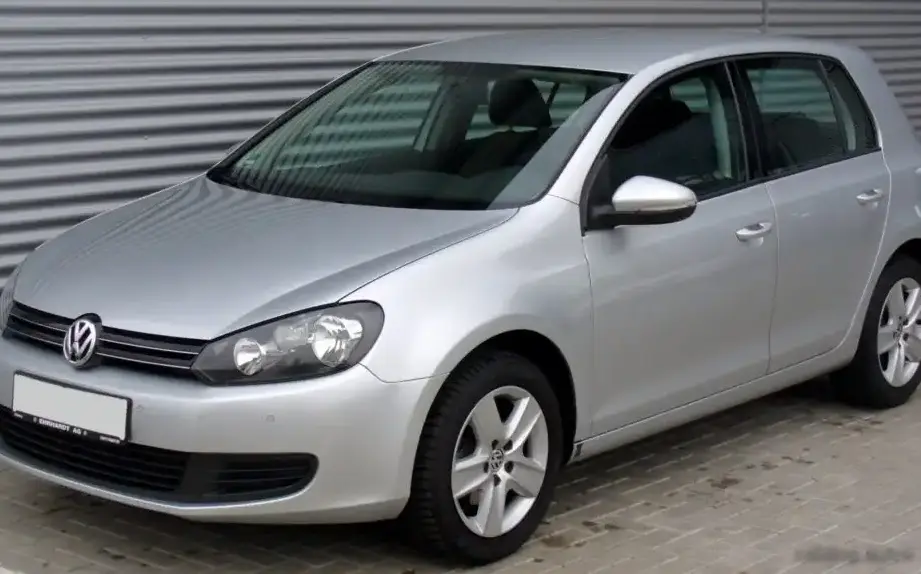
The Volkswagen Golf VI 1.6 TDI (105 hp) BMT DSG, produced from 2009 to 2012, represented an important entry point into the sixth generation of Volkswagen’s iconic hatchback. Positioned as a fuel-efficient and practical option, this variant played a significant role in the Golf VI’s success, particularly in European markets where diesel engines were highly favored. It utilized Volkswagen’s advanced common rail diesel technology paired with a dual-clutch gearbox (DSG) to deliver a balance of economy and usability. This model was a key component of the Golf VI range, bridging the gap between more basic trims and the higher-performance petrol and diesel options.
Technical Specifications
| Brand | Volkswagen |
| Model | Golf |
| Generation | Golf VI (5-door) |
| Type (Engine) | 1.6 TDI (105 Hp) BMT DSG |
| Start of production | 2009 |
| End of production | 2012 |
| Powertrain Architecture | Internal Combustion engine |
| Body type | Hatchback |
| Seats | 5 |
| Doors | 5 |
| Fuel consumption (urban) | 4.7 l/100 km (50 US mpg, 60.1 UK mpg, 21.3 km/l) |
| Fuel consumption (extra urban) | 3.9 l/100 km (60.3 US mpg, 72.4 UK mpg, 25.6 km/l) |
| Fuel consumption (combined) | 4.2 l/100 km (56 US mpg, 67.3 UK mpg, 23.8 km/l) |
| CO2 emissions | 109 g/km |
| Fuel Type | Diesel |
| Acceleration 0 – 100 km/h | 11.2 sec |
| Acceleration 0 – 62 mph | 11.2 sec |
| Acceleration 0 – 60 mph | 10.6 sec |
| Maximum speed | 190 km/h (118.06 mph) |
| Emission standard | Euro 5 |
| Weight-to-power ratio | 12 kg/Hp, 83 Hp/tonne |
| Weight-to-torque ratio | 5.1 kg/Nm, 197.6 Nm/tonne |
| Power | 105 Hp @ 4400 rpm |
| Power per litre | 65.7 Hp/l |
| Torque | 250 Nm @ 1500-2500 rpm (184.39 lb.-ft. @ 1500-2500 rpm) |
| Engine layout | Front, Transverse |
| Engine Model/Code | CAYC |
| Engine displacement | 1598 cm3 (97.52 cu. in.) |
| Number of cylinders | 4 |
| Engine configuration | Inline |
| Number of valves per cylinder | 4 |
| Fuel injection system | Diesel Commonrail |
| Engine aspiration | Turbocharger, Intercooler |
| Valvetrain | DOHC |
| Engine oil capacity | 4.3 l (4.54 US qt | 3.78 UK qt) |
| Kerb Weight | 1265 kg (2788.85 lbs.) |
| Max. weight | 1860 kg (4100.6 lbs.) |
| Max load | 595 kg (1311.75 lbs.) |
| Trunk (boot) space – minimum | 350 l (12.36 cu. ft.) |
| Trunk (boot) space – maximum | 1305 l (46.09 cu. ft.) |
| Fuel tank capacity | 55 l (14.53 US gal | 12.1 UK gal) |
| Max. roof load | 75 kg (165.35 lbs.) |
| Permitted trailer load with brakes (12%) | 1400 kg (3086.47 lbs.) |
| Permitted trailer load without brakes | 660 kg (1455.05 lbs.) |
| Permitted towbar download | 75 kg (165.35 lbs.) |
| Length | 4199 mm (165.31 in.) |
| Width | 1786 mm (70.31 in.) |
| Width including mirrors | 2048 mm (80.63 in.) |
| Height | 1480 mm (58.27 in.) |
| Wheelbase | 2578 mm (101.5 in.) |
| Front track | 1541 mm (60.67 in.) |
| Rear track | 1514 mm (59.61 in.) |
| Ride height (ground clearance) | 150 mm (5.91 in.) |
| Minimum turning circle | 10.9 m (35.76 ft.) |
| Drivetrain Architecture | Front wheel drive |
| Number of gears and type of gearbox | 7 gears, automatic transmission DSG |
| Front suspension | Independent type McPherson, Transverse stabilizer |
| Rear suspension | Independent multi-link suspension, Transverse stabilizer |
| Front brakes | Ventilated discs |
| Rear brakes | Disc |
| Assisting systems | ABS (Anti-lock braking system) |
| Steering type | Steering rack and pinion |
| Power steering | Electric Steering |
| Tires size | 195/65 R 15 |
| Wheel rims size | 6 J x 15 |
Powertrain & Engine Architecture
The heart of the Golf VI 1.6 TDI BMT DSG is the CAYC engine code, a 1.6-liter inline-four cylinder diesel engine. This engine utilizes a common rail direct injection system, delivering fuel at extremely high pressure for optimized combustion. A turbocharger with an intercooler is employed to boost power output and improve efficiency. The engine features a Double Overhead Camshaft (DOHC) valvetrain with four valves per cylinder, enhancing breathing and contributing to its relatively high power output for its displacement. The ‘BMT’ designation stands for ‘BlueMotion Technology’, indicating the inclusion of fuel-saving features like start-stop functionality and optimized aerodynamics. The engine is transversely mounted at the front of the vehicle. The seven-speed DSG (Direct-Shift Gearbox) is a crucial component, offering quick and smooth gear changes, contributing to both performance and fuel economy. This dual-clutch transmission operates similarly to two manual gearboxes in one, pre-selecting the next gear for seamless shifts.
Driving Characteristics
The 105 hp output and 250 Nm of torque, available from 1500-2500 rpm, provided adequate, though not exhilarating, performance. Acceleration from 0-60 mph took around 10.6 seconds, and a top speed of 118 mph was achievable. Compared to the more powerful 1.4 TSI petrol or 2.0 TDI diesel variants, the 1.6 TDI felt noticeably slower, particularly during overtaking maneuvers. However, the DSG transmission helped to mitigate this by providing responsive shifts and keeping the engine within its optimal torque band. The gear ratios were tuned for fuel efficiency, meaning the engine could feel strained when pushed hard. The focus was on providing a comfortable and economical driving experience rather than outright performance. The relatively low weight of the Golf VI helped to offset the modest power output, making it feel reasonably nimble in urban environments.
Equipment & Trim Levels
The 1.6 TDI BMT DSG typically came with a reasonable level of standard equipment. This included air conditioning, electric front windows, central locking, a basic audio system with CD player, and ABS brakes. Safety features such as driver and passenger airbags were standard. Interior upholstery was typically cloth, and the dashboard featured a functional, if somewhat understated, design. Optional extras included alloy wheels, a multi-function steering wheel, upgraded audio systems, parking sensors, and climate control. Trim levels varied slightly depending on the market, but generally, this variant occupied the lower-mid range of the Golf VI lineup, offering a good balance of features and affordability.
Chassis & Braking
The Golf VI 1.6 TDI utilized an independent McPherson strut suspension setup at the front and an independent multi-link suspension at the rear. This provided a comfortable ride quality and decent handling characteristics. Stabilizer bars were fitted to both axles to reduce body roll during cornering. The braking system consisted of ventilated discs at the front and solid discs at the rear, providing adequate stopping power for the vehicle’s weight and performance. ABS (Anti-lock Braking System) was standard, enhancing safety during emergency braking situations.
Market Reception & Comparison
The Golf VI 1.6 TDI BMT DSG was generally well-received by critics as a practical and economical choice. Its fuel efficiency was a major selling point, particularly in Europe where diesel fuel was often cheaper than petrol. However, some reviewers noted its lack of outright performance compared to other Golf VI variants. Compared to the 1.4 TSI, the 1.6 TDI offered better fuel economy but less power. The 2.0 TDI provided significantly more performance but at a higher price point and with slightly increased running costs. Reliability was generally good, although the DSG transmission required regular servicing to ensure optimal performance.
Legacy
The 1.6 TDI BMT DSG powertrain proved to be relatively reliable, although, like all modern diesel engines, it was susceptible to issues with the diesel particulate filter (DPF) if not driven on longer journeys regularly. In the used car market, these models represent a cost-effective entry point into Golf VI ownership. They are popular with drivers seeking a fuel-efficient and practical hatchback for daily commuting. While not the most exciting Golf VI variant, its blend of economy, usability, and Volkswagen build quality has ensured its continued appeal.