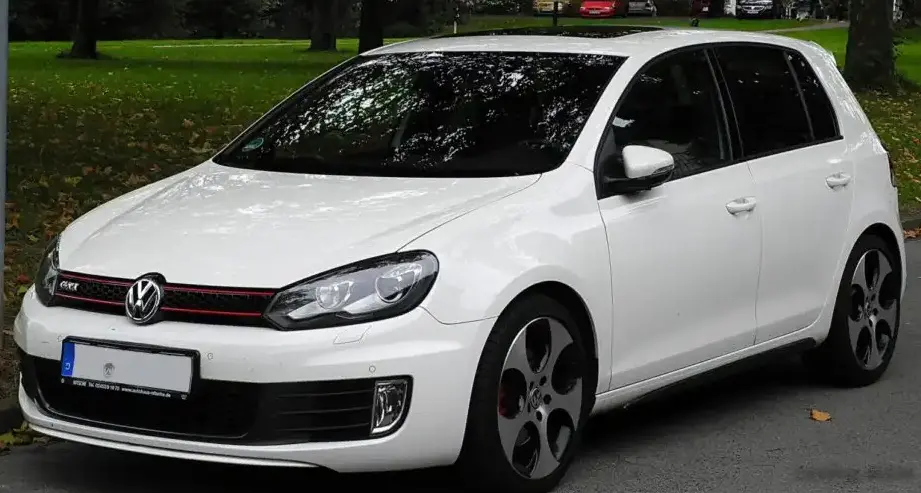
The Volkswagen Golf VI GTI 2.0 TSI (210 hp) represents a significant iteration of the iconic hot hatchback, produced between 2009 and 2012. Positioned as the performance flagship of the sixth-generation Golf lineup, it built upon the established GTI formula of blending practicality with engaging driving dynamics. This variant was a key model for Volkswagen, particularly in Europe, where the Golf reigned as a best-seller, and gained increasing traction in markets like North America. It sat at the top of the Golf VI range, offering a substantial performance upgrade over the standard Golf models and serving as a more accessible alternative to the more focused and expensive Golf R.
Technical Specifications
| Brand | Volkswagen |
| Model | Golf |
| Generation | Golf VI (5-door) |
| Type (Engine) | GTI 2.0 TSI (210 Hp) |
| Start of production | 2009 |
| End of production | 2012 |
| Powertrain Architecture | Internal Combustion engine |
| Body type | Hatchback |
| Seats | 5 |
| Doors | 5 |
| Fuel consumption (economy) – urban (NEDC) | 10 l/100 km (23.5 US mpg, 28.2 UK mpg, 10 km/l) |
| Fuel consumption (economy) – extra urban (NEDC) | 5.8 l/100 km (40.6 US mpg, 48.7 UK mpg, 17.2 km/l) |
| Fuel consumption (economy) – combined (NEDC) | 7.3 l/100 km (32.2 US mpg, 38.7 UK mpg, 13.7 km/l) |
| CO2 emissions (NEDC) | 170 g/km |
| Fuel Type | Petrol (Gasoline) |
| Acceleration 0 – 100 km/h | 6.9 sec |
| Acceleration 0 – 62 mph | 6.9 sec |
| Acceleration 0 – 60 mph | 6.6 sec |
| Maximum speed | 240 km/h (149.13 mph) |
| Emission standard | Euro 5 |
| Weight-to-power ratio | 6.3 kg/Hp, 159.3 Hp/tonne |
| Weight-to-torque ratio | 4.7 kg/Nm, 212.4 Nm/tonne |
| Power | 210 Hp @ 5300-6200 rpm |
| Power per litre | 105.8 Hp/l |
| Torque | 280 Nm @ 1700-5200 rpm (206.52 lb.-ft. @ 1700-5200 rpm) |
| Engine layout | Front, Transverse |
| Engine Model/Code | CCZB |
| Engine displacement | 1984 cm3 (121.07 cu. in.) |
| Number of cylinders | 4 |
| Engine configuration | Inline |
| Cylinder Bore | 82.5 mm (3.25 in.) |
| Piston Stroke | 92.8 mm (3.65 in.) |
| Compression ratio | 9.6:1 |
| Number of valves per cylinder | 4 |
| Fuel injection system | Direct injection |
| Engine aspiration | Turbocharger, Intercooler |
| Valvetrain | DOHC |
| Engine oil capacity | 4.7 l (4.97 US qt | 4.14 UK qt) |
| Kerb Weight | 1318 kg (2905.69 lbs.) |
| Max. weight | 1870 kg (4122.64 lbs.) |
| Max load | 552 kg (1216.95 lbs.) |
| Trunk (boot) space – minimum | 350 l (12.36 cu. ft.) |
| Trunk (boot) space – maximum | 1305 l (46.09 cu. ft.) |
| Fuel tank capacity | 55 l (14.53 US gal | 12.1 UK gal) |
| Max. roof load | 75 kg (165.35 lbs.) |
| Permitted trailer load with brakes (12%) | 1400 kg (3086.47 lbs.) |
| Permitted trailer load without brakes | 690 kg (1521.19 lbs.) |
| Permitted towbar download | 75 kg (165.35 lbs.) |
| Length | 4213 mm (165.87 in.) |
| Width | 1786 mm (70.31 in.) |
| Width including mirrors | 2048 mm (80.63 in.) |
| Height | 1469 mm (57.83 in.) |
| Wheelbase | 2578 mm (101.5 in.) |
| Front track | 1533 mm (60.35 in.) |
| Rear (Back) track | 1514 mm (59.61 in.) |
| Ride height (ground clearance) | 140 mm (5.51 in.) |
| Minimum turning circle (turning diameter) | 10.9 m (35.76 ft.) |
| Front suspension | Independent type McPherson, Transverse stabilizer |
| Rear suspension | Independent multi-link suspension, Transverse stabilizer |
| Front brakes | Ventilated discs |
| Rear brakes | Disc |
| Assisting systems | ABS (Anti-lock braking system) |
| Steering type | Steering rack and pinion |
| Power steering | Electric Steering |
| Tires size | 225/45 R 17 |
| Wheel rims size | 7.5 J x 17 |
INTRODUCTION
The Golf VI GTI 2.0 TSI (210 hp) was produced from 2009 to 2012 and represents a refinement of the GTI formula. Built on the Volkswagen Group’s A5 platform (internally designated 1HX0 for the 5-door hatchback), it offered a compelling blend of performance, practicality, and technology. This generation GTI aimed to broaden the appeal of the hot hatch, offering a more mature and sophisticated experience compared to its predecessors. The 210 hp variant was a mainstay of the lineup, providing a sweet spot between affordability and performance, and was widely available across European markets.
Powertrain & Engine Architecture
At the heart of the Golf VI GTI is the 2.0-liter turbocharged four-cylinder engine, identified by the engine code CCZB. This engine is a direct-injection (FSI) unit, utilizing a sophisticated Bosch MED17.5.20 engine control unit. The direct injection system allows for precise fuel delivery, contributing to both performance and efficiency. The engine features a dual overhead camshaft (DOHC) valvetrain with four valves per cylinder, optimizing gas flow. A single turbocharger, coupled with an intercooler, provides forced induction, boosting power output. The 210 hp version of the 2.0 TSI differs from earlier iterations through refinements to the turbocharger and engine management software. The engine is transversely mounted in the front of the vehicle. The GTI typically came equipped with a six-speed manual transmission, but a six-speed DSG (Direct-Shift Gearbox) dual-clutch automatic transmission was also offered, and is the focus of this article. The DSG provides incredibly fast and smooth gear changes, enhancing both acceleration and driving enjoyment. The DSG unit is known for its efficiency and responsiveness, though it can be more complex and potentially costly to maintain than a traditional automatic.
Driving Characteristics
The Golf VI GTI 2.0 TSI with the DSG transmission delivers a noticeably different driving experience compared to the manual version. The DSG’s quick shifts contribute to a 0-60 mph time of around 6.6 seconds, and a top speed of 149 mph. The automatic transmission allows for seamless acceleration, particularly during overtaking maneuvers. While the manual version offers more driver engagement, the DSG provides a level of convenience and ease of use that appeals to a wider audience. The gear ratios are optimized for both acceleration and fuel efficiency, with a relatively short final drive contributing to brisk off-the-line performance. Compared to the more powerful Golf R, the GTI 2.0 TSI offers a slightly less aggressive driving experience, prioritizing everyday usability over outright performance. The suspension, while firm, is well-damped, providing a comfortable ride even on less-than-perfect road surfaces.
Equipment & Trim Levels
The GTI trim level was well-equipped from the factory. Standard features included sport seats upholstered in the classic GTI plaid fabric, a leather-wrapped steering wheel, air conditioning, and an upgraded audio system. Optional extras included sunroof, navigation system, bi-xenon headlights, and parking sensors. The interior featured distinctive red accents, including stitching on the steering wheel, gearshift knob, and door panels, reinforcing the GTI’s sporty character. The dashboard layout was typical of the Golf VI, with a clear and functional design. The DSG-equipped models also featured paddle shifters mounted on the steering wheel, allowing for manual gear selection when desired.
Chassis & Braking
The Golf VI GTI utilizes an independent McPherson strut suspension at the front and a multi-link suspension at the rear. This setup provides excellent handling and ride comfort. The GTI also benefits from a transverse stabilizer bar at both the front and rear, reducing body roll during cornering. Braking duties are handled by ventilated discs at the front and solid discs at the rear. The GTI is equipped with ABS (Anti-lock Braking System) as standard, enhancing braking performance and safety. The braking system is generally considered adequate for the car’s performance, providing confident stopping power in most driving conditions.
Market Reception & Comparison
The Golf VI GTI 2.0 TSI was generally well-received by automotive critics. It was praised for its blend of performance, practicality, and refinement. The DSG transmission was often highlighted as a key selling point, offering a smooth and efficient driving experience. Compared to other trims in the Golf VI lineup, the GTI represented a significant performance upgrade, justifying its higher price tag. Fuel economy was respectable for a hot hatch, averaging around 32.2 US mpg in combined driving. Reliability was generally good, although the DSG transmission could be prone to issues if not properly maintained. Compared to rivals like the Ford Focus ST, the GTI was often seen as being more refined and sophisticated, while the Focus ST offered a more raw and engaging driving experience.
Legacy
The Golf VI GTI 2.0 TSI remains a popular choice in the used car market today. The 2.0 TSI engine, while generally reliable, requires regular maintenance, including oil changes and timing belt replacements. The DSG transmission also requires periodic servicing, including fluid changes. Well-maintained examples of the GTI 2.0 TSI can provide years of reliable and enjoyable motoring. The Golf VI GTI has cemented its place as a modern classic, representing a high point in the evolution of the hot hatchback. Its blend of performance, practicality, and technology continues to appeal to enthusiasts and everyday drivers alike.