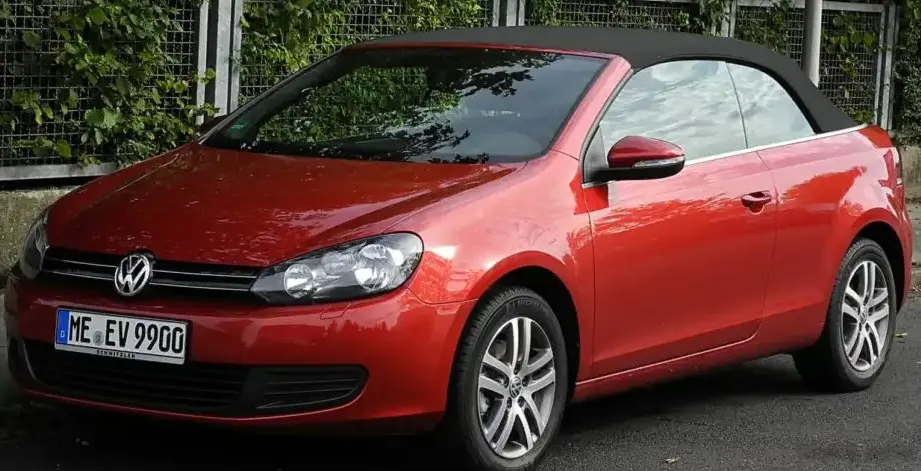
The Volkswagen Golf VI Cabriolet 1.4 TSI (160 hp) DSG represents a compelling blend of open-air motoring and modern efficiency within the sixth generation of Volkswagen’s iconic Golf range. Produced from 2011 to 2015, this variant occupied a mid-range position in the Cabriolet lineup, offering a balance between performance and fuel economy. It was primarily marketed in Europe and other regions where convertible hatchbacks remained popular, offering a more affordable and practical alternative to larger, more luxurious convertibles. This model utilized the well-regarded 1HX0/A3 platform, known for its robust construction and adaptable design.
Technical Specifications
| Brand | Volkswagen |
| Model | Golf |
| Generation | Golf VI Cabriolet |
| Type (Engine) | 1.4 TSI (160 Hp) DSG |
| Start of production | 2011 |
| End of production | 2015 |
| Powertrain Architecture | Internal Combustion engine |
| Body type | Cabriolet |
| Seats | 4 |
| Doors | 2 |
| Fuel consumption (urban) | 7.8 l/100 km (30.2 US mpg, 36.2 UK mpg, 12.8 km/l) |
| Fuel consumption (extra urban) | 5.4 l/100 km (43.6 US mpg, 52.3 UK mpg, 18.5 km/l) |
| Fuel consumption (combined) | 6.3 l/100 km (37.3 US mpg, 44.8 UK mpg, 15.9 km/l) |
| CO2 emissions | 148 g/km |
| Fuel Type | Petrol (Gasoline) |
| Acceleration 0 – 100 km/h | 8.4 sec |
| Acceleration 0 – 62 mph | 8.4 sec |
| Acceleration 0 – 60 mph | 8 sec |
| Maximum speed | 216 km/h (134.22 mph) |
| Emission standard | Euro 5 |
| Weight-to-power ratio | 9.4 kg/Hp, 106.5 Hp/tonne |
| Weight-to-torque ratio | 6.3 kg/Nm, 159.7 Nm/tonne |
| Power | 160 Hp @ 5800 rpm |
| Power per litre | 115.1 Hp/l |
| Torque | 240 Nm @ 1500-4500 rpm (177.01 lb.-ft. @ 1500-4500 rpm) |
| Engine layout | Front, Transverse |
| Engine Model/Code | CAVD, CTHD, CTKA, CNWA |
| Engine displacement | 1390 cm3 (84.82 cu. in.) |
| Number of cylinders | 4 |
| Engine configuration | Inline |
| Number of valves per cylinder | 4 |
| Fuel injection system | Direct injection |
| Engine aspiration | Turbocharger, Intercooler |
| Engine oil capacity | 3.6 l (3.8 US qt | 3.17 UK qt) |
| Kerb Weight | 1503 kg (3313.55 lbs.) |
| Max. weight | 1940 kg (4276.97 lbs.) |
| Max load | 437 kg (963.42 lbs.) |
| Trunk (boot) space – minimum | 250 l (8.83 cu. ft.) |
| Fuel tank capacity | 55 l (14.53 US gal | 12.1 UK gal) |
| Length | 4246 mm (167.17 in.) |
| Width | 1782 mm (70.16 in.) |
| Height | 1423 mm (56.02 in.) |
| Wheelbase | 2578 mm (101.5 in.) |
| Front track | 1535 mm (60.43 in.) |
| Rear (Back) track | 1508 mm (59.37 in.) |
| Minimum turning circle | 10.9 m (35.76 ft.) |
| Drivetrain Architecture | The Internal combustion engine (ICE) drives the front wheels of the vehicle. |
| Drive wheel | Front wheel drive |
| Number of gears and type of gearbox | 7 gears, automatic transmission DSG |
| Front brakes | Ventilated discs |
| Assisting systems | ABS (Anti-lock braking system) |
| Steering type | Steering rack and pinion |
| Tires size | 205/55 R16 |
| Wheel rims size | 6.5J x 16 |
Powertrain & Engine Architecture
At the heart of the Golf VI Cabriolet 1.4 TSI DSG lies the EA111 engine family, specifically the 1.4-liter turbocharged four-cylinder. Engine codes such as CAVD, CTHD, CTKA, and CNWA were commonly used, representing minor variations in calibration and emissions control. This engine featured direct fuel injection (FSI) and a turbocharger with an intercooler, enabling it to produce 160 horsepower at 5800 rpm and 240 Nm (177 lb-ft) of torque between 1500 and 4500 rpm. The direct injection system allowed for precise fuel delivery, improving both efficiency and performance. The turbocharger minimized turbo lag, providing a relatively responsive driving experience. The engine’s compact size and transverse mounting contributed to efficient packaging within the Golf’s front-wheel-drive layout.
The ‘DSG’ designation refers to Volkswagen’s dual-clutch transmission (Direct-Shift Gearbox). This 7-speed automatic transmission offered quicker and smoother gear changes compared to traditional torque-converter automatics. The DSG operates by utilizing two separate clutches – one for odd-numbered gears and one for even-numbered gears. This allows the transmission to pre-select the next gear, resulting in near-seamless shifts. The DSG also included a manual shift mode, giving drivers more control over gear selection.
Driving Characteristics
The 1.4 TSI DSG-equipped Golf VI Cabriolet offered a comfortable and refined driving experience. While not overtly sporty, the 160 hp engine provided adequate power for everyday driving and occasional spirited runs. Acceleration from 0 to 100 km/h (0-62 mph) took approximately 8.4 seconds, and the car reached a top speed of 216 km/h (134 mph). The DSG transmission contributed to smooth acceleration and minimized hesitation during overtaking maneuvers. Compared to the more powerful 1.8 TSI or diesel variants, this 1.4 TSI model prioritized fuel efficiency over outright performance. The gear ratios were tuned for a balance between acceleration and fuel economy, with taller gearing in higher gears to reduce engine speed at cruising speeds.
Equipment & Trim Levels
The Golf VI Cabriolet 1.4 TSI DSG typically came equipped with a respectable level of standard features. These included air conditioning, power windows, central locking, and an audio system with CD player. Safety features such as ABS, electronic stability control, and multiple airbags were also standard. Higher trim levels offered additional features such as alloy wheels, a multi-function steering wheel, automatic climate control, and a more advanced audio system. Optional extras included leather upholstery, a sunroof, and parking sensors. Interior upholstery was typically cloth, with leather options available at an extra cost. The dashboard layout was typical of the Golf VI, with a functional and ergonomic design.
Chassis & Braking
The Golf VI Cabriolet utilized a MacPherson strut front suspension and a multi-link rear suspension. This setup provided a good balance between ride comfort and handling. The Cabriolet’s chassis was reinforced compared to the standard Golf hatchback to compensate for the lack of a fixed roof. Front brakes were ventilated discs, providing ample stopping power. Rear brakes were typically solid discs, although some earlier models may have featured drum brakes. The steering was a rack-and-pinion system with power assistance, offering precise and responsive steering feel. Stabilizer bars were fitted to both the front and rear axles to reduce body roll during cornering.
Market Reception & Comparison
The Golf VI Cabriolet 1.4 TSI DSG was generally well-received by automotive critics. It was praised for its fuel efficiency, comfortable ride, and refined driving experience. However, some critics noted that the 1.4 TSI engine could feel slightly underpowered, especially when the car was fully loaded. Compared to the 1.8 TSI variant, the 1.4 TSI offered better fuel economy but less performance. The 1.6 TDI diesel model provided even better fuel economy but lacked the refinement of the TSI engine. The 1.4 TSI DSG appealed to buyers who prioritized fuel efficiency and comfort over outright performance.
Legacy
The 1.4 TSI engine proved to be a reliable and durable powerplant when properly maintained. The DSG transmission, while more complex than a traditional automatic, also demonstrated good long-term reliability. Today, the Golf VI Cabriolet 1.4 TSI DSG remains a popular choice in the used car market, offering a stylish and affordable way to enjoy open-air motoring. Regular maintenance, including oil changes and DSG fluid changes, is crucial to ensure the continued reliability of this powertrain. The Golf VI Cabriolet, in general, is remembered as a well-built and versatile car that offered a compelling alternative to more expensive convertibles.