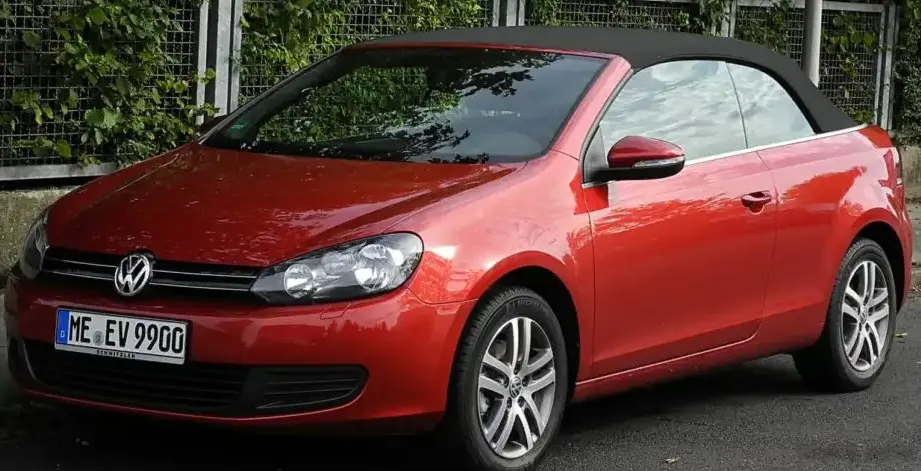
The Volkswagen Golf VI Cabriolet 2.0 TDI (140 hp) was a front-wheel-drive, two-door convertible produced between 2011 and 2015. Positioned as a more economical and practical alternative to some of its competitors, it represented the sixth generation of the Golf Cabriolet lineage, building upon the success of its predecessors while incorporating modern diesel technology. This variant occupied a mid-range position within the Golf VI Cabriolet lineup, offering a balance between performance, fuel efficiency, and equipment levels. It was primarily marketed in Europe, where demand for compact convertibles and diesel engines remained strong.
Technical Specifications
| Brand | Volkswagen |
| Model | Golf |
| Generation | Golf VI Cabriolet |
| Type (Engine) | 2.0 TDI (140 Hp) |
| Start of production | 2011 |
| End of production | 2015 |
| Powertrain Architecture | Internal Combustion engine |
| Body type | Cabriolet |
| Seats | 4 |
| Doors | 2 |
| Fuel consumption (urban) | 5.4 l/100 km (43.6 US mpg, 52.3 UK mpg, 18.5 km/l) |
| Fuel consumption (extra urban) | 4.1 l/100 km (57.4 US mpg, 68.9 UK mpg, 24.4 km/l) |
| Fuel consumption (combined) | 4.5 l/100 km (52.3 US mpg, 62.8 UK mpg, 22.2 km/l) |
| CO2 emissions | 119 g/km |
| Fuel Type | Diesel |
| Acceleration 0 – 100 km/h | 9.9 sec |
| Acceleration 0 – 62 mph | 9.9 sec |
| Acceleration 0 – 60 mph | 9.4 sec |
| Maximum speed | 207 km/h (128.62 mph) |
| Emission standard | Euro 5 |
| Weight-to-power ratio | 10.9 kg/Hp, 92 Hp/tonne |
| Weight-to-torque ratio | 4.8 kg/Nm, 210.4 Nm/tonne |
| Power | 140 Hp @ 4200 rpm |
| Power per litre | 71.1 Hp/l |
| Torque | 320 Nm @ 1750-2500 rpm (236.02 lb.-ft. @ 1750-2500 rpm) |
| Engine layout | Front, Transverse |
| Engine Model/Code | CFHC |
| Engine displacement | 1968 cm3 (120.09 cu. in.) |
| Number of cylinders | 4 |
| Engine configuration | Inline |
| Number of valves per cylinder | 4 |
| Fuel injection system | Diesel Commonrail |
| Engine aspiration | Turbocharger, Intercooler |
| Engine oil capacity | 4.3 l (4.54 US qt | 3.78 UK qt) |
| Kerb Weight | 1521 kg (3353.23 lbs.) |
| Max. weight | 1960 kg (4321.06 lbs.) |
| Max load | 439 kg (967.83 lbs.) |
| Trunk (boot) space – minimum | 250 l (8.83 cu. ft.) |
| Fuel tank capacity | 55 l (14.53 US gal | 12.1 UK gal) |
| Length | 4246 mm (167.17 in.) |
| Width | 1782 mm (70.16 in.) |
| Height | 1423 mm (56.02 in.) |
| Wheelbase | 2578 mm (101.5 in.) |
| Front track | 1535 mm (60.43 in.) |
| Rear (Back) track | 1508 mm (59.37 in.) |
| Minimum turning circle | 10.9 m (35.76 ft.) |
| Drivetrain Architecture | Front wheel drive |
| Number of gears | 6 gears, manual transmission |
| Front brakes | Ventilated discs |
| Assisting systems | ABS (Anti-lock braking system) |
| Steering type | Steering rack and pinion |
| Tires size | 205/55 R16 |
| Wheel rims size | 6.5J x 16 |
INTRODUCTION
The Golf VI Cabriolet, launched in 2011, represented a return to form for Volkswagen’s open-top Golf after a thirteen-year hiatus. Based on the Mk6 Golf platform (A6), it offered a more sophisticated and refined experience than its predecessors. The 2.0 TDI 140 hp variant was a popular choice, particularly in European markets, where diesel engines were favored for their fuel efficiency and torque. This model aimed to provide a practical and enjoyable convertible experience without sacrificing everyday usability. It was positioned as a step up from the base petrol engines, offering improved fuel economy and stronger acceleration compared to lower-powered options.
Powertrain & Engine Architecture
The heart of the Golf VI Cabriolet 2.0 TDI was the CFHC engine, a 1968cc inline-four cylinder diesel engine. This engine utilized common rail direct injection, delivering fuel directly into the combustion chamber at extremely high pressure. This technology, combined with a turbocharger and intercooler, allowed for a good balance of power and efficiency. The engine produced 140 horsepower at 4200 rpm and a substantial 320 Nm (236 lb-ft) of torque between 1750 and 2500 rpm. The engine featured four valves per cylinder and adhered to Euro 5 emission standards, incorporating a diesel particulate filter (DPF) to reduce harmful emissions. The 2.0 TDI was typically paired with a six-speed manual transmission, although a seven-speed DSG (Direct-Shift Gearbox) dual-clutch automatic was also available as an option. The engine’s transverse mounting and front-wheel-drive configuration were standard for the Golf VI.
Driving Characteristics
The 2.0 TDI 140 hp Golf VI Cabriolet offered a comfortable and refined driving experience. While not a sports car, the engine provided ample torque for relaxed cruising and confident overtaking. Acceleration from 0 to 62 mph (0-100 km/h) took around 9.9 seconds, which was respectable for a convertible in this class. The six-speed manual transmission allowed drivers to make the most of the engine’s torque band, while the optional DSG automatic provided smooth and quick gear changes. Compared to the more powerful 2.0 TDI variants (typically 170 hp), this version offered slightly less outright performance, but it compensated with improved fuel economy. The suspension was tuned for comfort, providing a reasonably smooth ride even on uneven surfaces. The convertible top, a multi-layered fabric design, offered good insulation from wind and road noise when raised.
Equipment & Trim Levels
The Golf VI Cabriolet 2.0 TDI 140 hp typically came with a good level of standard equipment. This included air conditioning, electric front windows, central locking, a CD stereo system, and alloy wheels. Higher trim levels, such as ‘Comfortline’ and ‘Highline’, added features like automatic climate control, a touchscreen infotainment system, parking sensors, and upgraded upholstery. Interior upholstery was typically cloth, but leather options were available. Optional extras included a wind deflector (to reduce wind buffeting with the top down), heated seats, and a panoramic sunroof. The dashboard layout was typical of the Mk6 Golf, with a functional and user-friendly design.
Chassis & Braking
The Golf VI Cabriolet utilized a MacPherson strut front suspension and a multi-link rear suspension, providing a good balance of ride comfort and handling. The front brakes were ventilated discs, while the rear brakes were typically solid discs, although some earlier models may have featured drum brakes depending on the specific trim level and market. Anti-lock Braking System (ABS) was standard. The chassis was reinforced compared to the standard Golf hatchback to compensate for the lack of a fixed roof, enhancing structural rigidity. Stabilizer bars were fitted to both the front and rear axles to reduce body roll during cornering.
Market Reception & Comparison
The Golf VI Cabriolet 2.0 TDI 140 hp was generally well-received by automotive critics. It was praised for its comfortable ride, refined engine, and practical interior. Fuel economy was a major selling point, with the 2.0 TDI achieving around 52.3 US mpg on the combined cycle. Compared to the petrol-powered Golf Cabriolets, the TDI offered significantly better fuel efficiency. Against competitors like the Peugeot 308 CC and Renault Megane Coupe Cabriolet, the Golf Cabriolet was often seen as offering a more premium feel and a more refined driving experience. However, some critics noted that the performance wasn’t as exhilarating as some of its rivals.
Legacy
The Golf VI Cabriolet 2.0 TDI 140 hp has proven to be a relatively reliable vehicle. The 2.0 TDI engine is known for its durability, although regular maintenance, including oil changes and DPF servicing, is crucial. Common issues can include problems with the turbocharger and the DPF, particularly on vehicles that have primarily been used for short journeys. In the used car market, these models remain popular due to their fuel efficiency, practicality, and relatively affordable price. They represent a good value proposition for buyers looking for a stylish and economical convertible.