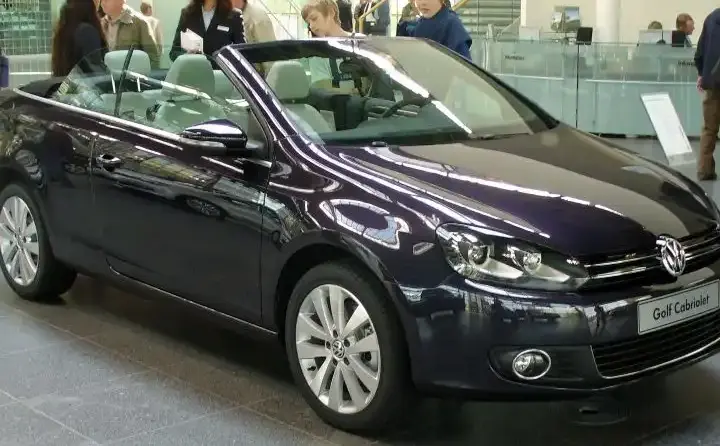
The Volkswagen Golf VI Cabriolet, specifically the 1.2 TSI (105 hp) variant produced from 2015 to 2016, represents a key iteration of Volkswagen’s popular open-top model. This version, part of the facelifted sixth-generation Golf (Mk6) Cabriolet range, aimed to offer an accessible entry point into the convertible market, balancing fuel efficiency with everyday usability. It sat within the 1HX0/A3 platform family, sharing underpinnings with several other Volkswagen Group vehicles. This particular trim was positioned as the entry-level engine option for the Cabriolet, appealing to buyers prioritizing economy and lower running costs over outright performance.
Technical Specifications
| Brand | Volkswagen |
| Model | Golf |
| Generation | Golf VI Cabriolet (facelift 2015) |
| Type (Engine) | 1.2 TSI (105 Hp) |
| Start of production | 2015 |
| End of production | 2016 |
| Powertrain Architecture | Internal Combustion engine |
| Body type | Cabriolet |
| Seats | 4 |
| Doors | 2 |
| Fuel consumption (urban) | 6.3 – 6.2 l/100 km (37.3 – 37.9 US mpg, 44.8 – 45.6 UK mpg, 15.9 – 16.1 km/l) |
| Fuel consumption (extra urban) | 4.5 – 4.4 l/100 km (52.3 – 53.5 US mpg, 62.8 – 64.2 UK mpg, 22.2 – 22.7 km/l) |
| Fuel consumption (combined) | 5.2 – 5.1 l/100 km (45.2 – 46.1 US mpg, 54.3 – 55.4 UK mpg, 19.2 – 19.6 km/l) |
| CO2 emissions | 119 – 117 g/km |
| Fuel Type | Petrol (Gasoline) |
| Acceleration 0 – 100 km/h | 11.5 sec |
| Acceleration 0 – 62 mph | 11.5 sec |
| Acceleration 0 – 60 mph | 10.9 sec |
| Maximum speed | 186 km/h (115.58 mph) |
| Emission standard | Euro 6 |
| Weight-to-power ratio | 12.6 kg/Hp, 79.5 Hp/tonne |
| Weight-to-torque ratio | 7.5 kg/Nm, 132.6 Nm/tonne |
| Power | 105 Hp @ 5000 rpm |
| Power per litre | 87.7 Hp/l |
| Torque | 175 Nm @ 1550-4100 rpm (129.07 lb.-ft. @ 1550-4100 rpm) |
| Engine layout | Front, Transverse |
| Engine Model/Code | CJZA |
| Engine displacement | 1197 cm3 (73.05 cu. in.) |
| Number of cylinders | 4 |
| Engine configuration | Inline |
| Number of valves per cylinder | 4 |
| Fuel injection system | Direct injection |
| Engine aspiration | Turbocharger, Intercooler |
| Engine oil capacity | 3.9 l (4.12 US qt | 3.43 UK qt) |
| Kerb Weight | 1320 kg (2910.1 lbs.) |
| Max. weight | 1850 kg (4078.55 lbs.) |
| Max load | 530 kg (1168.45 lbs.) |
| Trunk (boot) space – minimum | 250 l (8.83 cu. ft.) |
| Fuel tank capacity | 55 l (14.53 US gal | 12.1 UK gal) |
| Permitted trailer load with brakes (8%) | 1500 kg (3306.93 lbs.) |
| Permitted trailer load with brakes (12%) | 1200 kg (2645.55 lbs.) |
| Permitted trailer load without brakes | 690 kg (1521.19 lbs.) |
| Permitted towbar download | 75 kg (165.35 lbs.) |
| Length | 4247 mm (167.2 in.) |
| Width | 1782 mm (70.16 in.) |
| Width including mirrors | 2044 mm (80.47 in.) |
| Height | 1431 mm (56.34 in.) |
| Wheelbase | 2578 mm (101.5 in.) |
| Front track | 1535 mm (60.43 in.) |
| Rear (Back) track | 1505 mm (59.25 in.) |
| Ride height (ground clearance) | 138 mm (5.43 in.) |
| Minimum turning circle (turning diameter) | 10.9 m (35.76 ft.) |
| Drivetrain Architecture | The Internal combustion engine (ICE) drives the front wheels of the vehicle. |
| Drive wheel | Front wheel drive |
| Number of gears and type of gearbox | 6 gears, manual transmission |
| Front brakes | Ventilated discs |
| Rear brakes | Disc |
| Assisting systems | ABS (Anti-lock braking system) |
| Steering type | Steering rack and pinion |
| Tires size | 225/45 R17 |
| Wheel rims size | 7.5J x 17 |
Powertrain & Engine Architecture
The heart of this Golf Cabriolet is the CJZA engine, a 1.2-liter turbocharged four-cylinder petrol engine. This engine is part of Volkswagen’s EA111 family, known for its compact size and efficiency. The 1.2 TSI utilizes direct fuel injection and a single turbocharger with an intercooler to boost power and torque. The direct injection system precisely meters fuel into the combustion chamber, improving combustion efficiency and reducing emissions. The turbocharger provides increased air intake, enhancing power output. The engine produces 105 horsepower at 5000 rpm and 175 Nm (129 lb-ft) of torque between 1550 and 4100 rpm. The engine’s relatively low displacement and turbocharging contribute to its fuel efficiency. The engine is transversely mounted at the front of the vehicle, driving the front wheels. The standard transmission for this variant was a 6-speed manual gearbox, although a 7-speed DSG dual-clutch transmission was available as an option.
Driving Characteristics
The 1.2 TSI engine, paired with the manual transmission, provided adequate performance for everyday driving. Acceleration from 0 to 100 km/h (0-62 mph) took around 11.5 seconds, and top speed was 186 km/h (115.58 mph). While not particularly sporty, the engine offered sufficient power for cruising and overtaking on typical roads. The turbocharger provided a noticeable boost in power at higher engine speeds. The 6-speed manual transmission allowed drivers to maintain optimal engine speed for efficiency or performance. Compared to the more powerful 1.4 TSI or diesel variants, the 1.2 TSI felt less responsive, especially when fully loaded or climbing hills. However, its lighter weight and lower power output also contributed to better fuel economy.
Equipment & Trim Levels
The 1.2 TSI Cabriolet typically came with a reasonable level of standard equipment. This included air conditioning, electric front windows, a basic audio system, and alloy wheels. Safety features such as ABS, ESP (Electronic Stability Program), and multiple airbags were also standard. Optional extras included upgraded audio systems, leather upholstery, parking sensors, and a wind deflector to reduce wind noise when the roof was down. Trim levels varied depending on the market, but generally, this engine was offered in base or mid-range trims. The interior featured a functional and straightforward design, with durable materials. The dashboard layout was typical of the Golf VI, with clear instrumentation and easy-to-use controls.
Chassis & Braking
The Golf VI Cabriolet utilized a MacPherson strut front suspension and a multi-link rear suspension. This setup provided a good balance between ride comfort and handling. The suspension was tuned to prioritize comfort over sporty handling, making it suitable for everyday driving. The front brakes were ventilated discs, while the rear brakes were solid discs. ABS (Anti-lock Braking System) was standard, providing enhanced braking performance in emergency situations. The steering was a rack-and-pinion system, offering precise and responsive steering feel. The car’s weight distribution was relatively balanced, contributing to stable handling characteristics.
Market Reception & Comparison
The 1.2 TSI Cabriolet was generally well-received by critics as an affordable and fuel-efficient entry point into the convertible market. It was praised for its practicality, comfortable ride, and reasonable performance. However, some reviewers noted that the engine lacked the punch of the more powerful options. Compared to the 1.4 TSI, the 1.2 TSI offered better fuel economy but less performance. The diesel variants (such as the 1.6 TDI) provided even better fuel economy but were generally more expensive to purchase. In terms of reliability, the 1.2 TSI engine was generally considered to be reliable, although some owners reported issues with the turbocharger or fuel injectors.
Legacy
The Volkswagen Golf VI Cabriolet 1.2 TSI (105 hp) remains a popular choice in the used car market, particularly for buyers seeking an affordable and stylish convertible. Its fuel efficiency and relatively low running costs make it an attractive option for everyday use. While not the most powerful or luxurious version of the Golf Cabriolet, it offers a good balance of practicality, comfort, and affordability. The CJZA engine, while not without its potential issues, is generally considered to be durable and reliable when properly maintained. Today, these models represent a relatively accessible entry point into classic Volkswagen ownership, offering a taste of open-top motoring without a significant financial commitment.