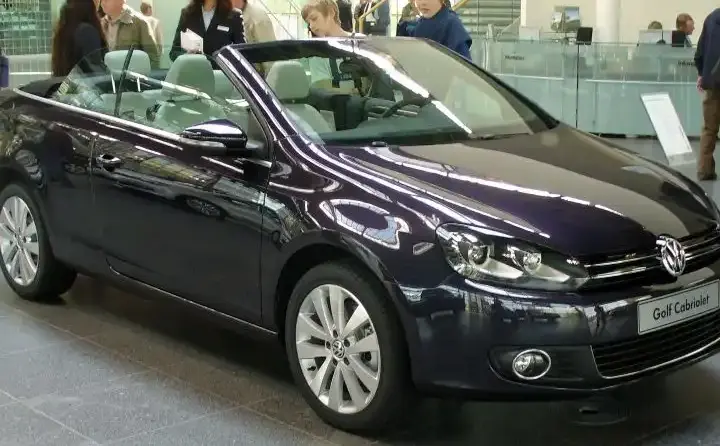
The Volkswagen Golf VI Cabriolet, specifically the 2.0 TDI variant produced during the 2015-2016 facelift, represented a compelling blend of open-air motoring and diesel efficiency within the Golf lineup. Positioned as a mid-range offering, it catered to buyers seeking a more economical and refined experience than the petrol-powered options, while offering a more practical and mature alternative to the sporty GTI. This iteration of the Golf Cabriolet, based on the Golf VI platform (1HX0/A3), was a key model for Volkswagen in the European market, where convertibles and diesel engines remained highly popular. Production spanned a relatively short period, reflecting Volkswagen’s ongoing model cycle and the impending arrival of the Golf VII.
Technical Specifications
| Brand | Volkswagen |
| Model | Golf |
| Generation | Golf VI Cabriolet (facelift 2015) |
| Type (Engine) | 2.0 TDI (150 Hp) |
| Start of production | 2015 |
| End of production | 2016 |
| Powertrain Architecture | Internal Combustion engine |
| Body type | Cabriolet |
| Seats | 4 |
| Doors | 2 |
| Fuel consumption (urban) | 5.0 – 4.9 l/100 km (47 – 48 US mpg, 56.5 – 57.6 UK mpg, 20 – 20.4 km/l) |
| Fuel consumption (extra urban) | 4.0 – 3.9 l/100 km (58.8 – 60.3 US mpg, 70.6 – 72.4 UK mpg, 25 – 25.6 km/l) |
| Fuel consumption (combined) | 4.3 – 4.2 l/100 km (54.7 – 56 US mpg, 65.7 – 67.3 UK mpg, 23.3 – 23.8 km/l) |
| CO2 emissions | 112 – 110 g/km |
| Fuel Type | Diesel |
| Acceleration 0 – 100 km/h | 9.2 sec |
| Acceleration 0 – 62 mph | 9.2 sec |
| Acceleration 0 – 60 mph | 8.7 sec |
| Maximum speed | 208 km/h (129.25 mph) |
| Emission standard | Euro 6 |
| Weight-to-power ratio | 9.5 kg/Hp, 104.9 Hp/tonne |
| Weight-to-torque ratio | 4.2 kg/Nm, 237.8 Nm/tonne |
| Power | 150 Hp @ 3500-4000 rpm |
| Torque | 340 Nm @ 1750-3000 rpm (250.77 lb.-ft. @ 1750-3000 rpm) |
| Engine layout | Front, Transverse |
| Engine Model/Code | CUUB |
| Engine displacement | 1968 cm3 (120.09 cu. in.) |
| Number of cylinders | 4 |
| Engine configuration | Inline |
| Number of valves per cylinder | 4 |
| Fuel injection system | Diesel Commonrail |
| Engine aspiration | Turbocharger, Intercooler |
| Engine oil capacity | 4.6 l (4.86 US qt | 4.05 UK qt) |
| Kerb Weight | 1430 kg (3152.61 lbs.) |
| Max. weight | 1970 kg (4343.11 lbs.) |
| Max load | 540 kg (1190.5 lbs.) |
| Trunk (boot) space – minimum | 250 l (8.83 cu. ft.) |
| Fuel tank capacity | 55 l (14.53 US gal | 12.1 UK gal) |
| Permitted trailer load with brakes (8%) | 1700 kg (3747.86 lbs.) |
| Permitted trailer load with brakes (12%) | 1500 kg (3306.93 lbs.) |
| Permitted trailer load without brakes | 750 kg (1653.47 lbs.) |
| Permitted towbar download | 75 kg (165.35 lbs.) |
| Length | 4247 mm (167.2 in.) |
| Width | 1782 mm (70.16 in.) |
| Width including mirrors | 2044 mm (80.47 in.) |
| Height | 1431 mm (56.34 in.) |
| Wheelbase | 2578 mm (101.5 in.) |
| Front track | 1535 mm (60.43 in.) |
| Rear (Back) track | 1505 mm (59.25 in.) |
| Ride height (ground clearance) | 138 mm (5.43 in.) |
| Minimum turning circle (turning diameter) | 10.9 m (35.76 ft.) |
| Drivetrain Architecture | The Internal combustion engine (ICE) drives the front wheels of the vehicle. |
| Drive wheel | Front wheel drive |
| Number of gears and type of gearbox | 6 gears, manual transmission |
| Front brakes | Ventilated discs |
| Rear brakes | Disc |
| Assisting systems | ABS (Anti-lock braking system) |
| Steering type | Steering rack and pinion |
| Tires size | 225/45 R17 |
| Wheel rims size | 7.5J x 17 |
Powertrain & Engine Architecture
The heart of the Golf VI Cabriolet 2.0 TDI was the CUUB engine code, a 1968cc inline-four cylinder diesel engine. This engine was a common sight in various Volkswagen Group vehicles of the era, known for its balance of power and fuel economy. It utilized a common rail direct injection system, delivering fuel at extremely high pressures for optimized combustion. A turbocharger with an intercooler was employed to boost power output, providing 150 horsepower at 3500-4000 rpm and a substantial 340 Nm (250.77 lb-ft) of torque between 1750 and 3000 rpm. The engine also featured four valves per cylinder, enhancing breathing and contributing to its overall efficiency. The 6-speed manual transmission was standard, providing a good spread of gears for both cruising and spirited driving.
Driving Characteristics
The 2.0 TDI engine in the Golf VI Cabriolet offered a distinctly different driving experience compared to the petrol variants. While lacking the outright acceleration of the GTI, it provided ample torque for everyday driving and comfortable highway cruising. The manual transmission allowed for precise control, but the gear ratios were tuned more for fuel efficiency than outright performance. Acceleration from 0-60 mph took around 8.7 seconds, and top speed was rated at 129.25 mph. The added weight of the convertible top mechanism and reinforced chassis, compared to the standard Golf hatchback, was noticeable, but the well-tuned suspension helped to maintain a reasonably composed ride.
Equipment & Trim Levels
The 2.0 TDI Cabriolet typically came equipped with a respectable level of standard features. Interior appointments included cloth upholstery, air conditioning, a basic audio system, and power windows. Optional extras included leather upholstery, upgraded audio systems, navigation, parking sensors, and alloy wheels. The trim level often dictated the availability of these options, with higher trims offering more standard equipment. The Golf VI Cabriolet’s interior design was functional and well-built, reflecting Volkswagen’s reputation for quality.
Chassis & Braking
The Golf VI Cabriolet’s chassis was reinforced to compensate for the lack of a fixed roof, providing increased rigidity. The front suspension utilized MacPherson struts, while the rear employed a multi-link setup, offering a good balance of comfort and handling. Brakes consisted of ventilated discs at the front and solid discs at the rear, providing adequate stopping power for the vehicle’s weight and performance. ABS (Anti-lock Braking System) was standard, enhancing safety in emergency braking situations.
Market Reception & Comparison
The Golf VI Cabriolet 2.0 TDI was generally well-received by automotive critics. It was praised for its fuel efficiency, comfortable ride, and practical open-top motoring experience. Compared to the petrol-powered Golf Cabriolet, the TDI offered significantly better fuel economy, making it a more attractive option for drivers covering long distances. However, some critics noted that the diesel engine lacked the refinement and responsiveness of the petrol alternatives. Compared to other convertibles in its class, the Golf Cabriolet offered a compelling value proposition, combining Volkswagen build quality with a relatively affordable price tag.
Legacy
The 2.0 TDI engine in the Golf VI Cabriolet has proven to be a relatively reliable powertrain, although, like all diesel engines, it is susceptible to issues related to the diesel particulate filter (DPF) if not properly maintained. The CUUB engine code is generally considered robust, and with regular servicing, it can provide many years of reliable service. On the used car market, the Golf VI Cabriolet 2.0 TDI remains a popular choice for buyers seeking an affordable and economical convertible. Its combination of practicality, fuel efficiency, and open-air enjoyment continues to appeal to a wide range of drivers.