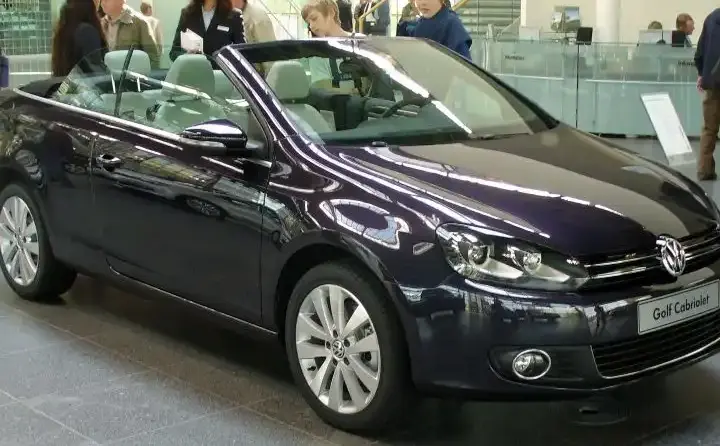
The Volkswagen Golf VI Cabriolet, specifically the 2.0 TDI variant with 150 horsepower and a dual-clutch gearbox (DSG), represented a compelling offering in the European market during its 2015-2016 production run. This model was part of the facelifted sixth generation of the Golf Cabriolet (based on the Golf Mk VI platform), offering open-air motoring with the practicality and refinement expected of the Golf nameplate. Positioned as a mid-range option within the Cabriolet lineup, it bridged the gap between the more economical diesel engines and the higher-performance petrol options.
Technical Specifications
| Brand | Volkswagen |
| Model | Golf |
| Generation | Golf VI Cabriolet (facelift 2015) |
| Type (Engine) | 2.0 TDI (150 Hp) DSG |
| Start of production | 2015 |
| End of production | 2016 |
| Powertrain Architecture | Internal Combustion engine |
| Body type | Cabriolet |
| Seats | 4 |
| Doors | 2 |
| Fuel consumption (urban) | 5.6 – 5.5 l/100 km (42 – 42.8 US mpg) |
| Fuel consumption (extra urban) | 4.3 – 4.2 l/100 km (54.7 – 56 US mpg) |
| Fuel consumption (combined) | 4.7 – 4.6 l/100 km (50 – 51.1 US mpg) |
| CO2 emissions | 125 – 122 g/km |
| Fuel Type | Diesel |
| Acceleration 0 – 100 km/h | 9.2 sec |
| Acceleration 0 – 62 mph | 9.2 sec |
| Acceleration 0 – 60 mph | 8.7 sec |
| Maximum speed | 206 km/h (128 mph) |
| Emission standard | Euro 6 |
| Weight-to-power ratio | 9.7 kg/Hp |
| Weight-to-torque ratio | 4.3 kg/Nm |
| Power | 150 Hp @ 3500-4000 rpm |
| Torque | 340 Nm @ 1750-3000 rpm (250.77 lb.-ft.) |
| Engine layout | Front, Transverse |
| Engine Model/Code | CUUB |
| Engine displacement | 1968 cm3 (120.09 cu. in.) |
| Number of cylinders | 4 |
| Engine configuration | Inline |
| Number of valves per cylinder | 4 |
| Fuel injection system | Diesel Commonrail |
| Engine aspiration | Turbocharger, Intercooler |
| Engine oil capacity | 4.6 l (4.86 US qt | 4.05 UK qt) |
| Kerb Weight | 1450 kg (3196.7 lbs.) |
| Max. weight | 1990 kg (4387.2 lbs.) |
| Max load | 540 kg (1190.5 lbs.) |
| Trunk (boot) space – minimum | 250 l (8.83 cu. ft.) |
| Fuel tank capacity | 55 l (14.53 US gal | 12.1 UK gal) |
| Permitted trailer load with brakes (8%) | 1700 kg (3747.86 lbs.) |
| Permitted trailer load with brakes (12%) | 1500 kg (3306.93 lbs.) |
| Permitted trailer load without brakes | 750 kg (1653.47 lbs.) |
| Permitted towbar download | 75 kg (165.35 lbs.) |
| Length | 4247 mm (167.2 in.) |
| Width | 1782 mm (70.16 in.) |
| Width including mirrors | 2044 mm (80.47 in.) |
| Height | 1431 mm (56.34 in.) |
| Wheelbase | 2578 mm (101.5 in.) |
| Front track | 1535 mm (60.43 in.) |
| Rear (Back) track | 1505 mm (59.25 in.) |
| Ride height (ground clearance) | 138 mm (5.43 in.) |
| Minimum turning circle | 10.9 m (35.76 ft.) |
| Drivetrain Architecture | Front wheel drive |
| Number of gears and type of gearbox | 6 gears, automatic transmission DSG |
| Front brakes | Ventilated discs |
| Rear brakes | Disc |
| Tires size | 225/45 R17 |
| Wheel rims size | 7.5J x 17 |
INTRODUCTION
The Golf VI Cabriolet facelift, launched in 2015, represented a significant update to the model, bringing it in line with the styling and technology of the Mk VII Golf range. The 2.0 TDI 150 hp DSG variant was a popular choice, particularly in Europe, where diesel engines dominated the market due to their fuel efficiency and lower running costs. This model offered a balance between performance, economy, and practicality, appealing to buyers seeking a stylish and versatile open-top car. It sat within the Golf VI Cabriolet range, above the lower-powered diesel options (like the 1.6 TDI) and below the more potent petrol variants (such as the 1.4 TSI).
Powertrain & Engine Architecture
At the heart of the Golf VI Cabriolet 2.0 TDI was the CUUB engine code, a 1968cc inline-four cylinder diesel engine. This engine utilized a common rail direct injection system, delivering fuel directly into the combustion chamber at extremely high pressure for improved efficiency and reduced emissions. A turbocharger with an intercooler was employed to boost power output, providing 150 horsepower at 3500-4000 rpm and a substantial 340 Nm (250.77 lb.-ft.) of torque between 1750 and 3000 rpm. The engine also featured four valves per cylinder, enhancing breathing and contributing to its overall performance. The engine was transversely mounted in the front of the vehicle. Paired with the engine was a six-speed dual-clutch gearbox (DSG). This transmission offered smooth, rapid gear changes and contributed to the car’s overall efficiency. The DSG transmission allowed for both fully automatic operation and manual gear selection via steering wheel-mounted paddles or the gear lever.
Driving Characteristics
The 2.0 TDI 150 hp DSG configuration provided a surprisingly capable driving experience. While not a sports car, the engine delivered ample torque for relaxed cruising and confident overtaking. The DSG transmission ensured that power was readily available, and the gear changes were quick and seamless. Acceleration from 0-62 mph took around 9.2 seconds, and the car had a top speed of 206 km/h (128 mph). Compared to the lower-powered 1.6 TDI, the 2.0 TDI offered a noticeable improvement in performance, particularly in terms of mid-range acceleration. However, it didn’t quite match the responsiveness of the petrol-powered models. The DSG transmission’s gear ratios were optimized for both fuel efficiency and performance, providing a good balance between the two. The front-wheel-drive layout offered predictable handling, although it could exhibit some torque steer under hard acceleration.
Equipment & Trim Levels
The Golf VI Cabriolet 2.0 TDI 150 hp DSG typically came with a good level of standard equipment. This included air conditioning, electric front windows, central locking, a CD/radio system, and alloy wheels. Higher trim levels added features such as automatic climate control, a touchscreen infotainment system, parking sensors, and leather upholstery. Optional extras included a wind deflector (to reduce wind noise when the roof was down), heated seats, and a panoramic sunroof. Interior upholstery was typically cloth, but leather options were available. The dashboard layout was typical of the Golf Mk VI, with a functional and user-friendly design.
Chassis & Braking
The Golf VI Cabriolet utilized a MacPherson strut front suspension and a multi-link rear suspension, providing a comfortable and controlled ride. The suspension was tuned to balance handling and comfort, making it suitable for both city driving and longer journeys. Braking duties were handled by ventilated discs at the front and solid discs at the rear. Anti-lock braking system (ABS) was standard, enhancing safety and stability during braking. The car’s weight of approximately 1450 kg (3196.7 lbs) meant that the brakes were adequately sized for its performance.
Market Reception & Comparison
The Golf VI Cabriolet 2.0 TDI 150 hp DSG was generally well-received by automotive critics. It was praised for its fuel efficiency, comfortable ride, and refined interior. However, some critics noted that the performance wasn’t as exciting as some of its petrol-powered rivals. Compared to the 1.6 TDI variant, the 2.0 TDI offered a significant improvement in performance, but at a slightly higher price point. The 2.0 TDI also offered better fuel economy than the higher-powered petrol models, making it a practical choice for drivers who covered long distances. Reliability was generally good, although, like all diesel engines, it was susceptible to issues with the diesel particulate filter (DPF) if not driven on longer journeys regularly.
Legacy
The Golf VI Cabriolet 2.0 TDI 150 hp DSG remains a popular choice in the used car market today. Its combination of fuel efficiency, practicality, and open-air motoring appeal continues to attract buyers. The CUUB engine is known for its durability, although regular maintenance is essential to ensure its longevity. The DSG transmission, while generally reliable, can require expensive repairs if not properly maintained. Overall, this variant represents a well-rounded and enjoyable driving experience, offering a good balance of performance, economy, and style.