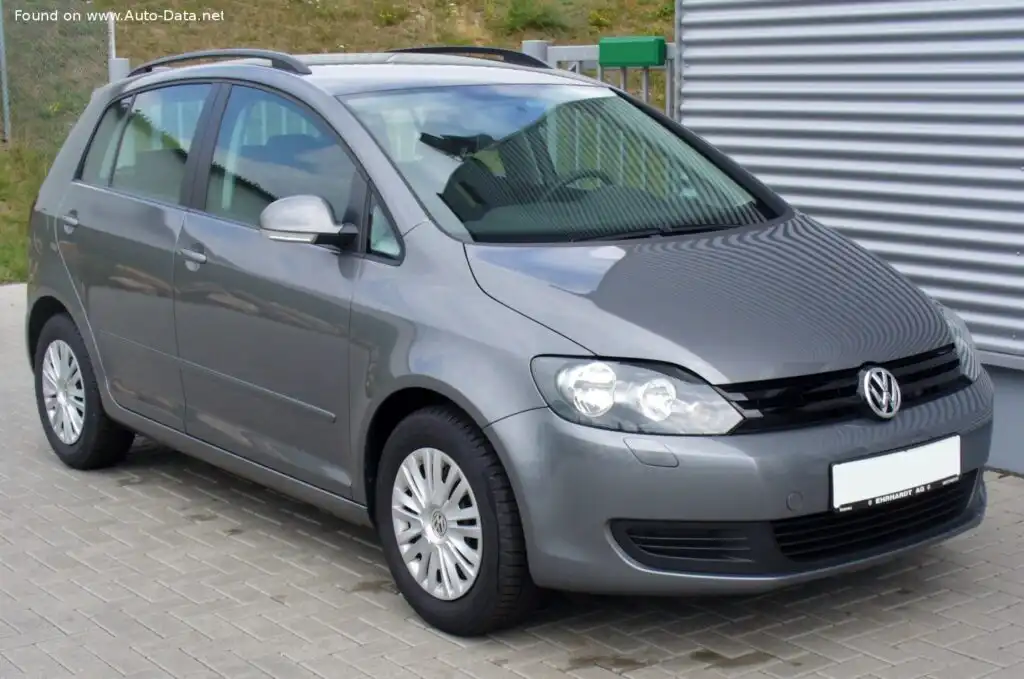
The Volkswagen Golf VI Plus 1.6 TDI (105 hp) with the Direct-Shift Gearbox (DSG) was a popular variant of the Golf Plus model, produced between May 2009 and January 2014. Positioned as a practical and fuel-efficient option within the Golf VI Plus range, it catered to buyers seeking a versatile compact MPV with the convenience of an automatic transmission. The Golf Plus, a stretched and slightly taller version of the standard Golf, offered increased interior space and a more commanding driving position. This particular 1.6 TDI DSG model aimed to balance affordability with reasonable performance and modern technology.
Technical Specifications
| Brand | Volkswagen |
| Model | Golf |
| Generation | Golf VI Plus |
| Type (Engine) | 1.6 TDI (105 Hp) DSG |
| Start of production | May, 2009 |
| End of production | January, 2014 |
| Powertrain Architecture | Internal Combustion engine |
| Body type | Minivan |
| Seats | 5 |
| Doors | 5 |
| Fuel consumption (urban) | 5.8 l/100 km (40.6 US mpg, 48.7 UK mpg, 17.2 km/l) |
| Fuel consumption (extra urban) | 4.4 l/100 km (53.5 US mpg, 64.2 UK mpg, 22.7 km/l) |
| Fuel consumption (combined) | 4.9 l/100 km (48 US mpg, 57.6 UK mpg, 20.4 km/l) |
| Fuel Type | Diesel |
| Acceleration 0 – 100 km/h | 12 sec |
| Acceleration 0 – 62 mph | 12 sec |
| Acceleration 0 – 60 mph | 11.4 sec |
| Maximum speed | 184 km/h (114.33 mph) |
| Weight-to-power ratio | 14 kg/Hp, 71.6 Hp/tonne |
| Weight-to-torque ratio | 5.9 kg/Nm, 170.4 Nm/tonne |
| Power | 105 Hp @ 4400 rpm |
| Power per litre | 65.7 Hp/l |
| Torque | 250 Nm @ 1500-2500 rpm (184.39 lb.-ft. @ 1500-2500 rpm) |
| Engine layout | Front, Transverse |
| Engine Model/Code | CAYC |
| Engine displacement | 1598 cm3 (97.52 cu. in.) |
| Number of cylinders | 4 |
| Engine configuration | Inline |
| Fuel injection system | Diesel Commonrail |
| Engine aspiration | Turbocharger, Intercooler |
| Engine oil capacity | 4.3 l (4.54 US qt | 3.78 UK qt) |
| Kerb Weight | 1467 kg (3234.18 lbs) |
| Max. weight | 2030 kg (4475.38 lbs) |
| Max load | 563 kg (1241.2 lbs) |
| Trunk (boot) space – minimum | 395 l (13.95 cu. ft.) |
| Trunk (boot) space – maximum | 1450 l (51.21 cu. ft.) |
| Fuel tank capacity | 55 l (14.53 US gal | 12.1 UK gal) |
| Length | 4204 mm (165.51 in.) |
| Width | 1759 mm (69.25 in.) |
| Height | 1592 mm (62.68 in.) |
| Wheelbase | 2578 mm (101.5 in.) |
| Front track | 1541 mm (60.67 in.) |
| Rear (Back) track | 1517 mm (59.72 in.) |
| Minimum turning circle | 10.8 m (35.43 ft.) |
| Drivetrain Architecture | The Internal combustion engine (ICE) drives the front wheels of the vehicle. |
| Drive wheel | Front wheel drive |
| Number of gears and type of gearbox | 7 gears, automatic transmission |
| Assisting systems | ABS (Anti-lock braking system) |
| Steering type | Steering rack and pinion |
| Power steering | Electric Steering |
INTRODUCTION
The Golf VI Plus, launched in 2009, was Volkswagen’s attempt to bridge the gap between the standard Golf and larger MPVs. It offered a more spacious and versatile alternative to the Golf hatchback, while remaining relatively compact and easy to maneuver. The 1.6 TDI with 105 horsepower and a seven-speed DSG transmission was a key volume seller, particularly in Europe, where fuel efficiency and lower running costs were highly valued. This variant represented an entry-level diesel option within the Plus range, sitting below the more powerful 2.0 TDI models.
Powertrain & Engine Architecture
The heart of this Golf Plus is the CAYC engine, a 1.6-liter inline-four cylinder diesel engine. This engine utilizes a common rail direct injection system, delivering fuel directly into the combustion chamber at extremely high pressure. This technology, combined with a turbocharger and intercooler, allows for a good balance of power and fuel economy. The engine produces 105 horsepower at 4400 rpm and 250 Nm (184 lb-ft) of torque between 1500 and 2500 rpm. The seven-speed DSG (Direct-Shift Gearbox) is a dual-clutch transmission that offers smooth and rapid gear changes, contributing to both performance and efficiency. Unlike a traditional automatic, the DSG pre-selects the next gear, minimizing interruption in power delivery. The engine’s design prioritized refinement and reduced noise, vibration, and harshness (NVH) compared to earlier diesel engines.
Driving Characteristics
The 1.6 TDI DSG Golf Plus offered a comfortable and practical driving experience. While not particularly sporty, the engine provided adequate power for everyday driving, including highway cruising and overtaking. The DSG transmission helped to keep the engine in its optimal power band, resulting in responsive acceleration. Compared to the manual transmission versions, the DSG offered greater convenience, especially in urban traffic. However, the 1.6 TDI lacked the punch of the more powerful 2.0 TDI models, and acceleration to 60 mph took around 12 seconds. The gear ratios were tuned for fuel efficiency, meaning the engine wasn’t always at its most responsive. The suspension was tuned for comfort, providing a relatively smooth ride, although it could feel a little soft when pushed hard through corners.
Equipment & Trim Levels
The Golf Plus 1.6 TDI DSG typically came with a reasonable level of standard equipment. This included air conditioning, electric front windows, central locking, a CD/radio system, and ABS brakes. Higher trim levels, such as Trendline and Comfortline, added features like alloy wheels, a multi-function steering wheel, cruise control, and parking sensors. Optional extras included a panoramic sunroof, navigation system, and upgraded audio systems. Interior upholstery was typically cloth, with the option of leather upgrades on higher trims. The dashboard layout was functional and well-designed, with clear instrumentation and intuitive controls.
Chassis & Braking
The Golf Plus utilized a MacPherson strut front suspension and a multi-link rear suspension, providing a good balance of ride comfort and handling. The front brakes were typically ventilated discs, while the rear brakes were often drum brakes, depending on the specific trim level and market. ABS (Anti-lock Braking System) was standard, enhancing safety during emergency braking. The steering was power-assisted, providing light and precise control. Stabilizer bars were fitted to both the front and rear axles to reduce body roll during cornering. The chassis was designed to accommodate the increased weight and dimensions of the Plus model compared to the standard Golf.
Market Reception & Comparison
The Golf Plus 1.6 TDI DSG was generally well-received by automotive critics as a practical and economical family car. It was praised for its spacious interior, comfortable ride, and fuel efficiency. However, some critics noted that the 1.6 TDI engine lacked the performance of its larger counterparts. Compared to the 2.0 TDI models, the 1.6 TDI offered lower running costs but sacrificed some performance. The DSG transmission was generally praised for its smoothness and responsiveness, but some owners reported occasional issues with reliability. Fuel economy was a key selling point, with combined figures averaging around 48 US mpg.
Legacy
The Volkswagen Golf VI Plus 1.6 TDI DSG remains a relatively common sight on used car markets today. The CAYC engine is generally considered to be reliable, although regular maintenance is essential. DSG transmissions, while offering performance benefits, can be prone to issues if not properly maintained, particularly regarding fluid changes. Overall, this variant represents a good value proposition for buyers seeking a practical, fuel-efficient, and well-equipped compact MPV. Its reputation for reliability and affordability has ensured its continued popularity in the used car market.