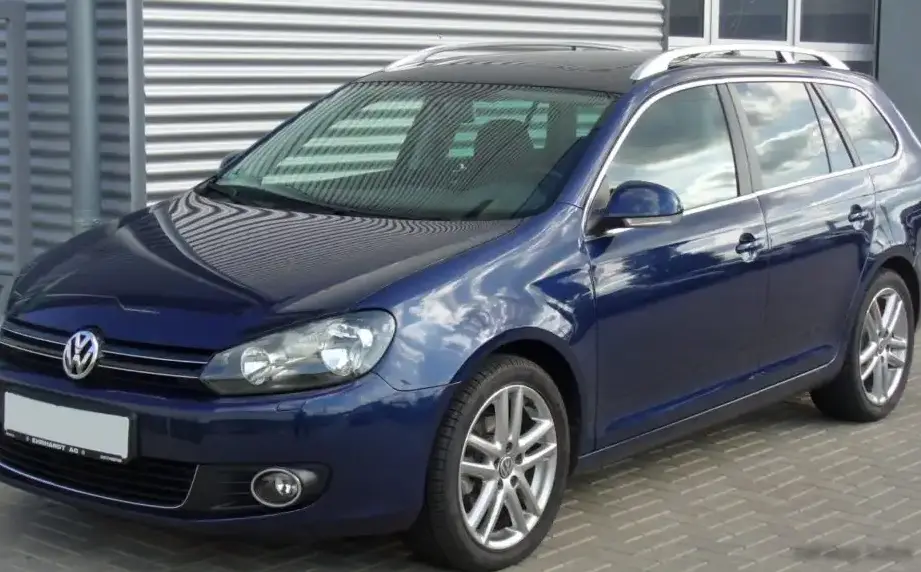
The Volkswagen Golf VI Variant 1.2 TSI (105 hp) was a front-wheel-drive, five-door station wagon produced between November 2009 and April 2013. Positioned as an entry-level offering within the Golf VI Variant range, it aimed to provide a balance of practicality, fuel efficiency, and affordability. This variant was part of the larger Golf Mk6 series (built between 2008 and 2013), which represented a significant refinement over its predecessor, focusing on build quality and technological advancements. The Golf VI Variant, in general, offered increased cargo capacity compared to the hatchback, making it a popular choice for families and those requiring more versatile space.
Technical Specifications
| Brand | Volkswagen |
| Model | Golf |
| Generation | Golf VI Variant |
| Type (Engine) | 1.2 TSI (105 Hp) |
| Start of production | November, 2009 |
| End of production | April, 2013 |
| Powertrain Architecture | Internal Combustion engine |
| Body type | Station wagon (estate) |
| Seats | 5 |
| Doors | 5 |
| Fuel consumption (economy) – urban (NEDC) | 7.2 l/100 km (32.7 US mpg, 39.2 UK mpg, 13.9 km/l) |
| Fuel consumption (economy) – extra urban (NEDC) | 5 l/100 km (47 US mpg, 56.5 UK mpg, 20 km/l) |
| Fuel consumption (economy) – combined (NEDC) | 5.8 l/100 km (40.6 US mpg, 48.7 UK mpg, 17.2 km/l) |
| CO2 emissions (NEDC) | 136 g/km |
| Fuel Type | Petrol (Gasoline) |
| Acceleration 0 – 100 km/h | 11.3 sec |
| Acceleration 0 – 62 mph | 11.3 sec |
| Acceleration 0 – 60 mph | 10.7 sec |
| Maximum speed | 190 km/h (118.06 mph) |
| Emission standard | Euro 5 |
| Weight-to-power ratio | 12.3 kg/Hp, 81.2 Hp/tonne |
| Weight-to-torque ratio | 7.4 kg/Nm, 135.3 Nm/tonne |
| Power | 105 Hp @ 5000 rpm |
| Power per litre | 87.7 Hp/l |
| Torque | 175 Nm @ 1550-4100 rpm (129.07 lb.-ft. @ 1550-4100 rpm) |
| Engine layout | Front, Transverse |
| Engine Model/Code | EA111 / CBZB |
| Engine displacement | 1197 cm3 (73.05 cu. in.) |
| Number of cylinders | 4 |
| Engine configuration | Inline |
| Cylinder Bore | 71 mm (2.8 in.) |
| Piston Stroke | 75.6 mm (2.98 in.) |
| Compression ratio | 10:1 |
| Number of valves per cylinder | 4 |
| Fuel injection system | Direct injection |
| Engine aspiration | Turbocharger, Intercooler |
| Valvetrain | DOHC |
| Engine oil capacity | 3.6 l (3.8 US qt | 3.17 UK qt) |
| Coolant | 5.6 l (5.92 US qt | 4.93 UK qt) |
| Kerb Weight | 1293 kg (2850.58 lbs.) |
| Max. weight | 1910 kg (4210.83 lbs.) |
| Max load | 617 kg (1360.25 lbs.) |
| Trunk (boot) space – minimum | 505 l (17.83 cu. ft.) |
| Trunk (boot) space – maximum | 1495 l (52.8 cu. ft.) |
| Fuel tank capacity | 55 l (14.53 US gal | 12.1 UK gal) |
| Max. roof load | 75 kg (165.35 lbs.) |
| Permitted trailer load with brakes (8%) | 1500 kg (3306.93 lbs.) |
| Permitted trailer load with brakes (12%) | 1200 kg (2645.55 lbs.) |
| Permitted trailer load without brakes | 680 kg (1499.14 lbs.) |
| Permitted towbar download | 75 kg (165.35 lbs.) |
| Length | 4534 mm (178.5 in.) |
| Width | 1781 mm (70.12 in.) |
| Width including mirrors | 2003 mm (78.86 in.) |
| Height | 1504 mm (59.21 in.) |
| Wheelbase | 2578 mm (101.5 in.) |
| Front track | 1535 mm (60.43 in.) |
| Rear (Back) track | 1508 mm (59.37 in.) |
| Minimum turning circle (turning diameter) | 10.9 m (35.76 ft.) |
| Approach angle | 13.3° |
| Departure angle | 11.9° |
| Ramp-over (brakeover) angle | 8.8° |
| Drivetrain Architecture | The Internal combustion engine (ICE) drives the front wheels of the vehicle. |
| Drive wheel | Front wheel drive |
| Number of gears and type of gearbox | 6 gears, manual transmission |
| Front suspension | Independent, type McPherson with coil spring and anti-roll bar |
| Rear suspension | Independent multi-link spring suspension with stabilizer |
| Front brakes | Ventilated discs |
| Rear brakes | Disc |
| Assisting systems | ABS (Anti-lock braking system) |
| Steering type | Steering rack and pinion |
| Power steering | Electric Steering |
| Tires size | 205/55 R16 |
| Wheel rims size | 6.5J x 16 |
Powertrain & Engine Architecture
The heart of the Golf VI Variant 1.2 TSI was the EA111 engine family, specifically the CBZB code. This 1.2-liter, four-cylinder engine utilized direct fuel injection and a turbocharger with an intercooler to achieve a respectable 105 horsepower. Direct injection allowed for precise fuel delivery, improving efficiency and reducing emissions. The engine featured a double overhead camshaft (DOHC) valvetrain, optimizing airflow into and out of the cylinders. The turbocharger, a key component, boosted power output by forcing more air into the engine. The six-speed manual transmission was the standard offering, chosen for its fuel efficiency and driver engagement. While a seven-speed DSG (Direct-Shift Gearbox) dual-clutch automatic was available on other Golf VI Variant models, it wasn’t typically paired with this specific 1.2 TSI engine.
Driving Characteristics
The 1.2 TSI engine, while adequate for everyday driving, wasn’t known for its blistering performance. Acceleration from 0-60 mph took around 10.7 seconds, and top speed was limited to 118 mph. The turbocharger did provide a noticeable boost in power at higher RPMs, but the engine felt somewhat strained when pushed hard, particularly when fully loaded. The six-speed manual transmission helped to keep the engine in its optimal power band, but drivers often found themselves shifting frequently to maintain momentum. Compared to the more powerful 1.4 TSI or 2.0 TDI variants, the 1.2 TSI offered a more economical but less engaging driving experience. The focus was clearly on fuel efficiency rather than outright speed.
Equipment & Trim Levels
The 1.2 TSI variant typically represented the entry point into the Golf VI Variant range. Standard equipment generally included air conditioning, electric front windows, a basic audio system, and ABS brakes. Safety features like front and side airbags were also standard. Interior upholstery was typically cloth, and the dashboard featured a functional but relatively simple design. Optional extras included alloy wheels, a more advanced audio system, parking sensors, and climate control. Higher trim levels, such as Trendline and Comfortline, added more features as standard, but the 1.2 TSI remained the most affordable option.
Chassis & Braking
The Golf VI Variant featured an independent suspension setup, with McPherson struts at the front and a multi-link system at the rear. This provided a comfortable ride quality and decent handling characteristics. The front brakes were ventilated discs, offering good stopping power, while the rear brakes were solid discs. The steering was electrically assisted, providing a light and precise feel. Stabilizer bars were fitted to both the front and rear axles to reduce body roll during cornering. The suspension tuning was geared towards comfort and practicality, rather than sporty handling.
Market Reception & Comparison
The Golf VI Variant 1.2 TSI was generally well-received as a practical and economical family car. Critics praised its fuel efficiency and spacious interior, but some found the engine to be underpowered, especially when carrying passengers or luggage. Compared to the 1.4 TSI, the 1.2 TSI offered lower running costs but sacrificed performance. The 2.0 TDI diesel variants provided superior torque and fuel economy, but at a higher purchase price. The 1.2 TSI appealed to buyers who prioritized affordability and fuel efficiency over outright performance.
Legacy
The EA111 1.2 TSI engine, while generally reliable, has been known to exhibit issues with carbon buildup on the intake valves over time, particularly if not regularly driven on longer journeys. This can lead to rough idling and reduced performance. Regular servicing and the use of quality fuel can help to mitigate this issue. Today, the Golf VI Variant 1.2 TSI represents a relatively affordable entry point into Volkswagen ownership. Its fuel efficiency and practicality continue to make it a popular choice for budget-conscious buyers, but potential owners should be aware of the potential for carbon buildup and ensure the vehicle has been well-maintained.