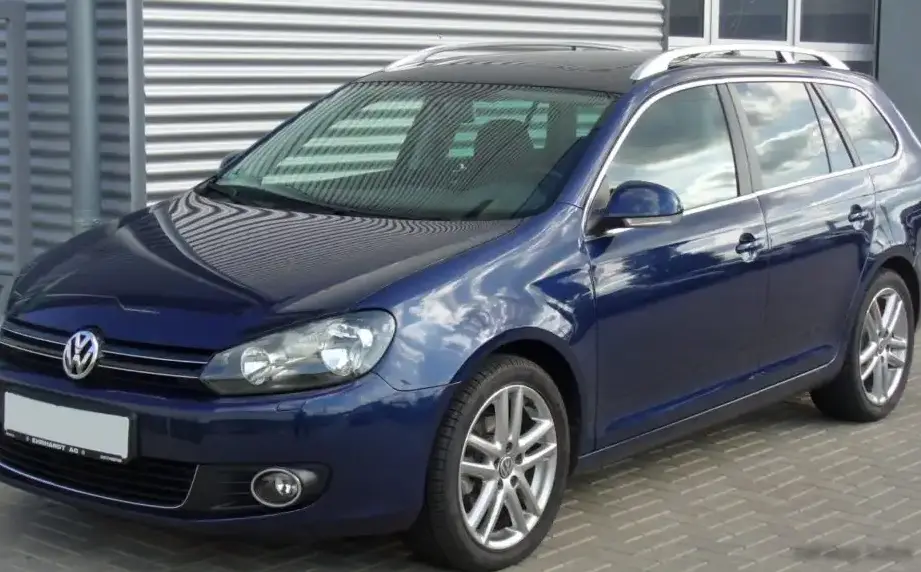
The Volkswagen Golf VI Variant 1.2 TSI BMT (105 hp) was a front-wheel-drive, five-door station wagon produced between 2009 and 2013. Positioned as an entry-level offering within the Golf VI Variant range, it aimed to provide a balance of fuel efficiency and practicality for family buyers. This variant was a key part of Volkswagen’s strategy to offer a diverse Golf lineup, catering to a wide range of customer needs and budgets. It utilized the Volkswagen Group’s A6 platform (internally known as the PQ35), shared with models like the Audi A3 and SEAT Leon.
Technical Specifications
| Brand | Volkswagen |
| Model | Golf |
| Generation | Golf VI Variant |
| Type (Engine) | 1.2 TSI BMT (105 Hp) |
| Start of production | 2009 |
| End of production | 2013 |
| Powertrain Architecture | Internal Combustion engine |
| Body type | Station wagon (estate) |
| Seats | 5 |
| Doors | 5 |
| Fuel consumption (economy) – urban (NEDC) | 6.6 l/100 km (35.6 US mpg, 42.8 UK mpg, 15.2 km/l) |
| Fuel consumption (economy) – extra urban (NEDC) | 4.6 l/100 km (51.1 US mpg, 61.4 UK mpg, 21.7 km/l) |
| Fuel consumption (economy) – combined (NEDC) | 5.3 l/100 km (44.4 US mpg, 53.3 UK mpg, 18.9 km/l) |
| CO2 emissions (NEDC) | 123 g/km |
| Fuel Type | Petrol (Gasoline) |
| Acceleration 0 – 100 km/h | 11.3 sec |
| Acceleration 0 – 62 mph | 11.3 sec |
| Acceleration 0 – 60 mph | 10.7 sec |
| Maximum speed | 190 km/h (118.06 mph) |
| Emission standard | Euro 5 |
| Weight-to-power ratio | 12.4 kg/Hp, 80.8 Hp/tonne |
| Weight-to-torque ratio | 7.4 kg/Nm, 134.6 Nm/tonne |
| Power | 105 Hp @ 5000 rpm |
| Power per litre | 87.7 Hp/l |
| Torque | 175 Nm @ 1550-4100 rpm (129.07 lb.-ft. @ 1550-4100 rpm) |
| Engine layout | Front, Transverse |
| Engine Model/Code | CBZB |
| Engine displacement | 1197 cm3 (73.05 cu. in.) |
| Number of cylinders | 4 |
| Engine configuration | Inline |
| Cylinder Bore | 71 mm (2.8 in.) |
| Piston Stroke | 75.6 mm (2.98 in.) |
| Compression ratio | 10.5:1 |
| Number of valves per cylinder | 2 |
| Fuel injection system | Direct injection |
| Engine aspiration | Turbocharger, Intercooler |
| Valvetrain | SOHC |
| Engine oil capacity | 3.6 l (3.8 US qt | 3.17 UK qt) |
| Kerb Weight | 1300 kg (2866.01 lbs.) |
| Max. weight | 1890 kg (4166.74 lbs.) |
| Max load | 590 kg (1300.73 lbs.) |
| Trunk (boot) space – minimum | 505 l (17.83 cu. ft.) |
| Trunk (boot) space – maximum | 1495 l (52.8 cu. ft.) |
| Fuel tank capacity | 55 l (14.53 US gal | 12.1 UK gal) |
| Max. roof load | 75 kg (165.35 lbs.) |
| Permitted trailer load with brakes (8%) | 1500 kg (3306.93 lbs.) |
| Permitted trailer load with brakes (12%) | 1200 kg (2645.55 lbs.) |
| Permitted trailer load without brakes | 680 kg (1499.14 lbs.) |
| Permitted towbar download | 75 kg (165.35 lbs.) |
| Length | 4534 mm (178.5 in.) |
| Width | 1781 mm (70.12 in.) |
| Width including mirrors | 2003 mm (78.86 in.) |
| Height | 1504 mm (59.21 in.) |
| Wheelbase | 2578 mm (101.5 in.) |
| Front track | 1535 mm (60.43 in.) |
| Rear (Back) track | 1508 mm (59.37 in.) |
| Ride height (ground clearance) | 141 mm (5.55 in.) |
| Minimum turning circle (turning diameter) | 10.9 m (35.76 ft.) |
| Front suspension | Independent type McPherson, Transverse stabilizer |
| Rear suspension | Independent multi-link suspension, Transverse stabilizer |
| Front brakes | Ventilated discs |
| Rear brakes | Disc |
| Drive wheel | Front wheel drive |
| Number of gears and type of gearbox | 6 gears, manual transmission |
INTRODUCTION
The Golf VI Variant, launched in 2009, represented the sixth generation of Volkswagen’s iconic Golf model, but in the more practical station wagon body style. The 1.2 TSI BMT (BlueMotion Technology) 105 hp variant was introduced as a fuel-efficient option aimed at buyers prioritizing economy over outright performance. It sat below the more powerful 1.4 TSI and 2.0 TDI models in the lineup, offering a lower price point and appealing to those with more modest driving needs. The “BMT” designation signified the inclusion of Volkswagen’s fuel-saving technologies, including start/stop functionality and regenerative braking.
Powertrain & Engine Architecture
The heart of the Golf VI Variant 1.2 TSI BMT was the CBZB engine code, a 1.2-liter turbocharged four-cylinder gasoline engine. This engine featured direct fuel injection, a single overhead camshaft (SOHC) valvetrain, and a turbocharger with an intercooler to boost power and efficiency. The direct injection system allowed for precise fuel delivery, optimizing combustion and reducing emissions. The turbocharger provided increased power output compared to a naturally aspirated engine of similar displacement. The BMT system included an automatic engine start/stop function, which shut off the engine when the vehicle was stationary (at traffic lights, for example) to conserve fuel. The engine was transversely mounted at the front of the vehicle, driving the front wheels. The six-speed manual transmission was the standard offering, providing a good balance between fuel economy and driver control.
Driving Characteristics
The 105 hp 1.2 TSI BMT Golf VI Variant wasn’t designed for sporty driving. Acceleration from 0-60 mph took around 10.7 seconds, and top speed was limited to 190 km/h (118 mph). The engine delivered its peak torque of 175 Nm (129 lb-ft) between 1550 and 4100 rpm, providing adequate pulling power for everyday driving situations. However, it required downshifting to maintain momentum when overtaking or climbing hills. The six-speed manual transmission helped to keep the engine in its optimal power band, but the overall driving experience was more focused on comfort and fuel efficiency than performance. Compared to the 1.4 TSI or 2.0 TDI variants, the 1.2 TSI felt noticeably less powerful, but it offered a smoother and quieter ride.
Equipment & Trim Levels
The 1.2 TSI BMT variant typically came with a reasonable level of standard equipment. This included air conditioning, electric front windows, a CD stereo system, and alloy wheels. Safety features such as ABS (Anti-lock Braking System), airbags, and electronic stability control were also standard. Optional extras included a touchscreen infotainment system, parking sensors, and upgraded upholstery. Trim levels varied depending on the market, but generally offered progressively more features as you moved up the range. Interior upholstery was typically cloth, with a functional and durable design. The dashboard layout was typical of the Golf VI, with a clear and easy-to-read instrument cluster.
Chassis & Braking
The Golf VI Variant 1.2 TSI BMT featured independent suspension on both the front and rear axles. The front suspension utilized a McPherson strut design, while the rear suspension employed a multi-link setup. This provided a comfortable ride and good handling characteristics. The front brakes were ventilated discs, while the rear brakes were solid discs. The steering was power-assisted, providing light and precise control. The suspension was tuned to prioritize comfort over sporty handling, making it well-suited for everyday driving. Stabilizer bars were fitted to both the front and rear axles to reduce body roll during cornering.
Market Reception & Comparison
The Golf VI Variant 1.2 TSI BMT was generally well-received by critics as a practical and fuel-efficient family car. It was praised for its comfortable ride, spacious interior, and low running costs. However, some reviewers noted that the engine lacked power, particularly when fully loaded. Compared to the 1.4 TSI, the 1.2 TSI offered lower fuel consumption but significantly less performance. The 2.0 TDI provided even more power and torque, but at the expense of fuel economy. The 1.2 TSI BMT appealed to buyers who prioritized economy and practicality over performance, making it a popular choice for families and commuters.
Legacy
The 1.2 TSI engine, while generally reliable, has been known to exhibit some issues with carbon buildup on the intake valves over time, particularly if not regularly driven on longer journeys. Regular servicing and the use of quality fuel can help to mitigate this risk. Today, used Golf VI Variant 1.2 TSI BMT models represent a relatively affordable option for buyers seeking a practical and fuel-efficient station wagon. They continue to be popular due to their reputation for reliability and low running costs, although potential buyers should be aware of the potential for carbon buildup and ensure that the vehicle has been properly maintained.