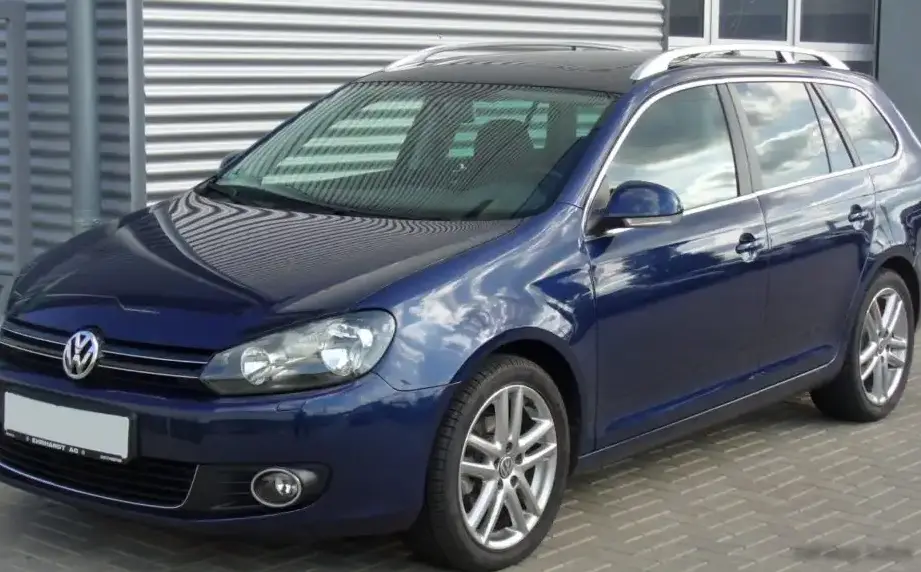
The Volkswagen Golf VI Variant 1.4, producing 80 horsepower, was a mainstay of the Golf Mk6 estate (wagon) range from May 2009 to April 2013. Positioned as the entry-level engine option in many European markets, it offered a balance of affordability and practicality within the broader Golf VI lineup, which spanned hatchback, estate, and even coupe body styles. This variant was particularly popular in countries where estate cars held a significant market share, offering a cost-effective and fuel-efficient option for families and individuals needing increased cargo capacity. It sat on the Volkswagen Group’s ubiquitous PQ35 platform, also known as the A5 platform, shared with models like the Audi A3, SEAT Leon, and Škoda Octavia.
Technical Specifications
| Brand | Volkswagen |
| Model | Golf |
| Generation | Golf VI Variant |
| Type (Engine) | 1.4 (80 Hp) |
| Start of production | May, 2009 |
| End of production | April, 2013 |
| Powertrain Architecture | Internal Combustion engine |
| Body type | Station wagon (estate) |
| Seats | 5 |
| Doors | 5 |
| Fuel consumption (economy) – urban (NEDC) | 8.5 l/100 km (27.7 US mpg, 33.2 UK mpg, 11.8 km/l) |
| Fuel consumption (economy) – extra urban (NEDC) | 5.1 l/100 km (46.1 US mpg, 55.4 UK mpg, 19.6 km/l) |
| Fuel consumption (economy) – combined (NEDC) | 6.4 l/100 km (36.8 US mpg, 44.1 UK mpg, 15.6 km/l) |
| CO2 emissions (NEDC) | 149 g/km |
| Fuel Type | Petrol (Gasoline) |
| Acceleration 0 – 100 km/h | 14.9 sec |
| Acceleration 0 – 62 mph | 14.9 sec |
| Acceleration 0 – 60 mph | 14.2 sec |
| Maximum speed | 173 km/h (107.5 mph) |
| Emission standard | Euro 5 |
| Weight-to-power ratio | 15.7 kg/Hp, 63.7 Hp/tonne |
| Weight-to-torque ratio | 9.5 kg/Nm, 105.1 Nm/tonne |
| Power | 80 Hp @ 5000 rpm |
| Power per litre | 57.6 Hp/l |
| Torque | 132 Nm @ 3800 rpm (97.36 lb.-ft. @ 3800 rpm) |
| Engine layout | Front, Transverse |
| Engine Model/Code | EA111 / CGGA |
| Engine displacement | 1390 cm3 (84.82 cu. in.) |
| Number of cylinders | 4 |
| Engine configuration | Inline |
| Cylinder Bore | 76.5 mm (3.01 in.) |
| Piston Stroke | 75.6 mm (2.98 in.) |
| Compression ratio | 10.5:1 |
| Number of valves per cylinder | 4 |
| Fuel injection system | Multi-port manifold injection |
| Engine aspiration | Naturally aspirated engine |
| Valvetrain | DOHC |
| Engine oil capacity | 3.2 l (3.38 US qt | 2.82 UK qt) |
| Kerb Weight | 1256 kg (2769.01 lbs.) |
| Max. weight | 1870 kg (4122.64 lbs.) |
| Max load | 614 kg (1353.64 lbs.) |
| Trunk (boot) space – minimum | 505 l (17.83 cu. ft.) |
| Trunk (boot) space – maximum | 1495 l (52.8 cu. ft.) |
| Fuel tank capacity | 55 l (14.53 US gal | 12.1 UK gal) |
| Max. roof load | 75 kg (165.35 lbs.) |
| Permitted trailer load with brakes (8%) | 1200 kg (2645.55 lbs.) |
| Permitted trailer load with brakes (12%) | 800 kg (1763.7 lbs.) |
| Permitted trailer load without brakes | 660 kg (1455.05 lbs.) |
| Permitted towbar download | 75 kg (165.35 lbs.) |
| Length | 4534 mm (178.5 in.) |
| Width | 1781 mm (70.12 in.) |
| Width including mirrors | 2003 mm (78.86 in.) |
| Height | 1504 mm (59.21 in.) |
| Wheelbase | 2578 mm (101.5 in.) |
| Front track | 1535 mm (60.43 in.) |
| Rear (Back) track | 1508 mm (59.37 in.) |
| Minimum turning circle | 10.9 m (35.76 ft.) |
| Front suspension | Independent, type McPherson with coil spring and anti-roll bar |
| Rear suspension | Independent multi-link spring suspension with stabilizer |
| Front brakes | Ventilated discs |
| Rear brakes | Disc |
| Drive wheel | Front wheel drive |
| Number of gears and type of gearbox | 5 gears, manual transmission |
Powertrain & Engine Architecture
The heart of the Golf VI Variant 1.4 (80 Hp) is the EA111 engine family, specifically the CGGA engine code. This 1.4-liter inline-four cylinder engine utilizes a naturally aspirated configuration and multi-point fuel injection. The engine features a double overhead camshaft (DOHC) valvetrain with four valves per cylinder, contributing to reasonable efficiency and a relatively smooth power delivery. The CGGA engine, while not known for its outright performance, was designed for fuel economy and reliability. It’s a relatively simple engine mechanically, which aids in lower maintenance costs. The five-speed manual transmission was the most common pairing, although a six-speed automatic transmission was also available, albeit less frequently specified. The automatic transmission, while offering convenience, did impact fuel economy and acceleration compared to the manual.
Driving Characteristics
The 1.4-liter 80 hp engine in the Golf VI Variant delivered modest performance. Acceleration from 0-60 mph took around 14.2 seconds, and top speed was limited to 107.5 mph. In real-world driving, this meant the engine required frequent downshifts, especially when fully loaded or tackling inclines. The automatic transmission, when equipped, further dulled the performance, with noticeable delays in response. Compared to the more powerful 1.6-liter or 2.0-liter TDI diesel options, or even the 1.4 TSI turbocharged petrol engine, the 1.4 80 hp felt noticeably underpowered. However, its strength lay in its fuel efficiency and ease of driving in urban environments. The gear ratios in the five-speed manual were spaced to prioritize economy, rather than outright acceleration.
Equipment & Trim Levels
The 1.4 80 hp Golf VI Variant typically came with a base level of equipment, often designated as ‘S’ or ‘Life’ trim depending on the market. Standard features generally included air conditioning, electric front windows, a basic audio system, and ABS brakes. Higher trim levels, such as ‘Comfortline’ or ‘Highline’, added features like alloy wheels, cruise control, a multi-function steering wheel, and upgraded interior trim. Optional extras included a sunroof, parking sensors, and a more sophisticated infotainment system. Interior upholstery was typically cloth, with a functional, if somewhat basic, dashboard layout.
Chassis & Braking
The Golf VI Variant 1.4 utilized a McPherson strut front suspension and a multi-link rear suspension, providing a comfortable and controlled ride. Front brakes were ventilated discs, while rear brakes were solid discs. The suspension setup was tuned for comfort rather than sporty handling, reflecting the car’s positioning as a practical family vehicle. Stabilizer bars were fitted to both the front and rear axles to reduce body roll during cornering. The relatively light weight of the 1.4-liter engine contributed to balanced handling, although it didn’t offer the same level of responsiveness as higher-powered variants.
Market Reception & Comparison
The Golf VI Variant 1.4 (80 Hp) was generally well-received as an affordable and practical estate car. Critics praised its fuel efficiency and comfortable ride, but noted its lack of outright performance. Compared to the diesel variants, the 1.4 petrol offered lower torque and a less refined driving experience. However, it was often cheaper to purchase and maintain, and avoided the potential issues associated with diesel particulate filters. Against competitors like the Ford Focus Estate and Opel/Vauxhall Astra Estate, the Golf offered a more premium feel and a reputation for reliability.
Legacy
The EA111 1.4-liter engine, while not a powerhouse, proved to be a relatively reliable unit when properly maintained. Common issues included occasional oil leaks and potential problems with the throttle body. Today, the Golf VI Variant 1.4 (80 Hp) represents an affordable entry point into Volkswagen ownership. Used examples are readily available, and parts are relatively inexpensive. While not a performance car, it remains a practical and economical choice for those seeking a spacious and reliable estate car.