Technical Specifications
| Brand | Volkswagen |
| Model | Golf |
| Generation | Golf VI Variant |
| Type (Engine) | 1.4 TSI (160 Hp) DSG |
| Start of production | May, 2009 |
| End of production | April, 2013 |
| Powertrain Architecture | Internal Combustion engine |
| Body type | Station wagon (estate) |
| Seats | 5 |
| Doors | 5 |
| Fuel consumption (economy) – urban (NEDC) | 7.7 l/100 km (30.5 US mpg, 36.7 UK mpg, 13 km/l) |
| Fuel consumption (economy) – extra urban (NEDC) | 5.3 l/100 km (44.4 US mpg, 53.3 UK mpg, 18.9 km/l) |
| Fuel consumption (economy) – combined (NEDC) | 6.1 l/100 km (38.6 US mpg, 46.3 UK mpg, 16.4 km/l) |
| CO2 emissions (NEDC) | 143 g/km |
| Fuel Type | Petrol (Gasoline) |
| Acceleration 0 – 100 km/h | 8.4 sec |
| Acceleration 0 – 62 mph | 8.4 sec |
| Acceleration 0 – 60 mph | 8 sec |
| Maximum speed | 220 km/h (136.7 mph) |
| Emission standard | Euro 5 |
| Weight-to-power ratio | 8.7 kg/Hp, 115.5 Hp/tonne |
| Weight-to-torque ratio | 5.8 kg/Nm, 173.3 Nm/tonne |
| Power | 160 Hp @ 5800 rpm |
| Power per litre | 115.1 Hp/l |
| Torque | 240 Nm @ 1500-4500 rpm (177.01 lb.-ft. @ 1500-4500 rpm) |
| Engine layout | Front, Transverse |
| Engine Model/Code | EA111 / CAVD, CTHD, CTKA |
| Engine displacement | 1390 cm3 (84.82 cu. in.) |
| Number of cylinders | 4 |
| Engine configuration | Inline |
| Cylinder Bore | 76.5 mm (3.01 in.) |
| Piston Stroke | 75.6 mm (2.98 in.) |
| Compression ratio | 10:1 |
| Number of valves per cylinder | 4 |
| Fuel injection system | Direct injection |
| Engine aspiration | Turbocharging and Supercharger, Intercooler |
| Valvetrain | DOHC |
| Engine oil capacity | 3.6 l (3.8 US qt | 3.17 UK qt) |
| Coolant | 5.6 l (5.92 US qt | 4.93 UK qt) |
| Kerb Weight | 1385 kg (3053.4 lbs.) |
| Max. weight | 1970 kg (4343.11 lbs.) |
| Max load | 585 kg (1289.7 lbs.) |
| Trunk (boot) space – minimum | 505 l (17.83 cu. ft.) |
| Trunk (boot) space – maximum | 1495 l (52.8 cu. ft.) |
| Fuel tank capacity | 55 l (14.53 US gal | 12.1 UK gal) |
| Max. roof load | 75 kg (165.35 lbs.) |
| Permitted trailer load with brakes (8%) | 1700 kg (3747.86 lbs.) |
| Permitted trailer load with brakes (12%) | 1400 kg (3086.47 lbs.) |
| Permitted trailer load without brakes | 730 kg (1609.37 lbs.) |
| Permitted towbar download | 75 kg (165.35 lbs.) |
| Length | 4534 mm (178.5 in.) |
| Width | 1781 mm (70.12 in.) |
| Width including mirrors | 2003 mm (78.86 in.) |
| Height | 1504 mm (59.21 in.) |
| Wheelbase | 2578 mm (101.5 in.) |
| Front track | 1535 mm (60.43 in.) |
| Rear (Back) track | 1508 mm (59.37 in.) |
| Minimum turning circle (turning diameter) | 10.9 m (35.76 ft.) |
| Approach angle | 13.3° |
| Departure angle | 11.9° |
| Ramp-over (brakeover) angle | 8.8° |
| Drivetrain Architecture | The Internal combustion engine (ICE) drives the front wheels of the vehicle. |
| Drive wheel | Front wheel drive |
| Number of gears and type of gearbox | 7 gears, automatic transmission DSG |
| Front suspension | Independent, type McPherson with coil spring and anti-roll bar |
| Rear suspension | Independent multi-link spring suspension with stabilizer |
| Front brakes | Ventilated discs |
| Rear brakes | Disc |
| Assisting systems | ABS (Anti-lock braking system) |
| Steering type | Steering rack and pinion |
| Power steering | Electric Steering |
| Tires size | 205/55 R16; 225/45 R17 |
| Wheel rims size | 6.5J x 16; 7J x 17 |
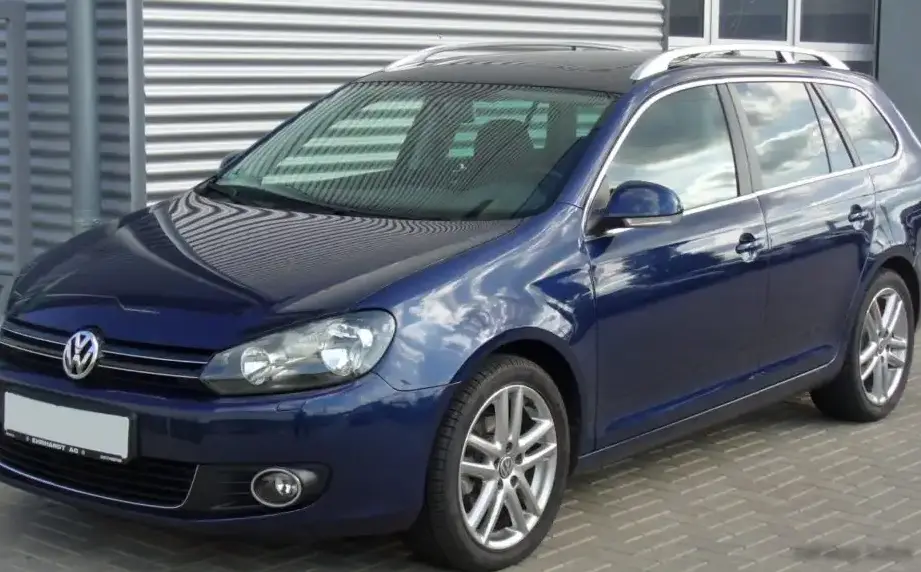
The Volkswagen Golf VI Variant 1.4 TSI (160 hp) DSG, launched in 2009, represented a significant step forward in combining practicality with performance in the compact estate segment. Built on the A5 platform (internally designated 1HX0 for the Variant), this model offered a more spacious alternative to the Golf hatchback while retaining the brand’s reputation for build quality and refinement. The 1.4 TSI engine, coupled with the DSG transmission, was intended to appeal to drivers seeking a comfortable and efficient driving experience without sacrificing responsiveness. This variant sat comfortably in the middle of the Golf VI Variant range, offering more power and a more sophisticated transmission than the base models, but at a lower price point than the higher-performance GTI or diesel variants.
Powertrain & Engine Architecture
The heart of this Golf Variant is the EA111 1.4-liter turbocharged and supercharged four-cylinder engine. Volkswagen’s innovative approach combined a Roots-type supercharger for low-end torque and a turbocharger for higher-RPM power. This ‘twincharger’ system, utilizing direct fuel injection, allowed the engine to deliver a relatively high output of 160 horsepower at 5800 rpm and 240 Nm (177 lb-ft) of torque between 1500 and 4500 rpm. The engine code varied depending on the specific market and year, with CAVD, CTHD, and CTKA being common designations. The direct injection system, operating at pressures up to 150 bar, ensured precise fuel delivery and optimized combustion. The seven-speed DSG dual-clutch transmission provided quick and seamless gear changes, enhancing both acceleration and fuel economy. The DSG’s programming was tuned for a balance between comfort and sportiness, offering both automatic and manual shift modes.
Driving Characteristics
The 1.4 TSI DSG Golf VI Variant offered a surprisingly sprightly driving experience. While not as overtly sporty as the Golf GTI, the combination of the twincharged engine and the DSG transmission provided ample power for everyday driving and overtaking maneuvers. Acceleration from 0 to 100 km/h (0-62 mph) took approximately 8.4 seconds. The DSG transmission’s quick shifts minimized power interruption, resulting in a smooth and responsive feel. Compared to the manual transmission versions of the 1.4 TSI, the DSG offered greater convenience, particularly in urban traffic. However, some drivers noted that the DSG could occasionally exhibit slight hesitation at low speeds. The gear ratios were optimized for both fuel efficiency and performance, with a relatively tall seventh gear for highway cruising.
Equipment & Trim Levels
The Golf VI Variant 1.4 TSI DSG typically came equipped with a respectable level of standard features. These included air conditioning, power windows, central locking, a CD/MP3 stereo system, and alloy wheels. Higher trim levels, such as Trendline and Comfortline, added features like automatic climate control, a multi-function steering wheel, parking sensors, and upgraded upholstery. Optional extras included a sunroof, navigation system, and leather seats. Interior upholstery was typically cloth, but leather options were available. The dashboard layout was typical of the Golf VI, with a functional and ergonomic design.
Chassis & Braking
The Golf VI Variant’s chassis was designed to provide a comfortable and stable ride. The front suspension utilized a McPherson strut setup with coil springs and an anti-roll bar, while the rear featured an independent multi-link suspension. This configuration offered a good balance between ride comfort and handling precision. Braking duties were handled by ventilated discs at the front and solid discs at the rear, equipped with ABS (Anti-lock Braking System). The braking system provided adequate stopping power for everyday driving conditions. Stabilizer bars were fitted to both the front and rear axles to reduce body roll during cornering.
Market Reception & Comparison
The Golf VI Variant 1.4 TSI DSG was generally well-received by automotive critics. It was praised for its refined engine, smooth-shifting transmission, and practical estate body style. Fuel economy was also a strong point, with combined figures around 6.1 l/100 km (38.6 US mpg). Compared to the 1.6-liter petrol and diesel variants, the 1.4 TSI offered significantly more performance. However, it was more expensive to purchase and potentially more complex to maintain. The 2.0-liter TDI diesel models offered even better fuel economy and torque, but at the cost of increased engine noise and emissions. The GTI provided a more engaging driving experience, but at a higher price point and with increased running costs.
Legacy
The Volkswagen Golf VI Variant 1.4 TSI DSG remains a popular choice in the used car market. The EA111 engine, while known for its complexity, is generally reliable if properly maintained. Regular oil changes and adherence to the manufacturer’s service schedule are crucial. The DSG transmission can be prone to issues if not serviced correctly, so it’s important to check the transmission’s service history. Overall, this variant offers a good balance of practicality, performance, and fuel efficiency, making it a compelling option for buyers seeking a versatile and well-rounded estate car.