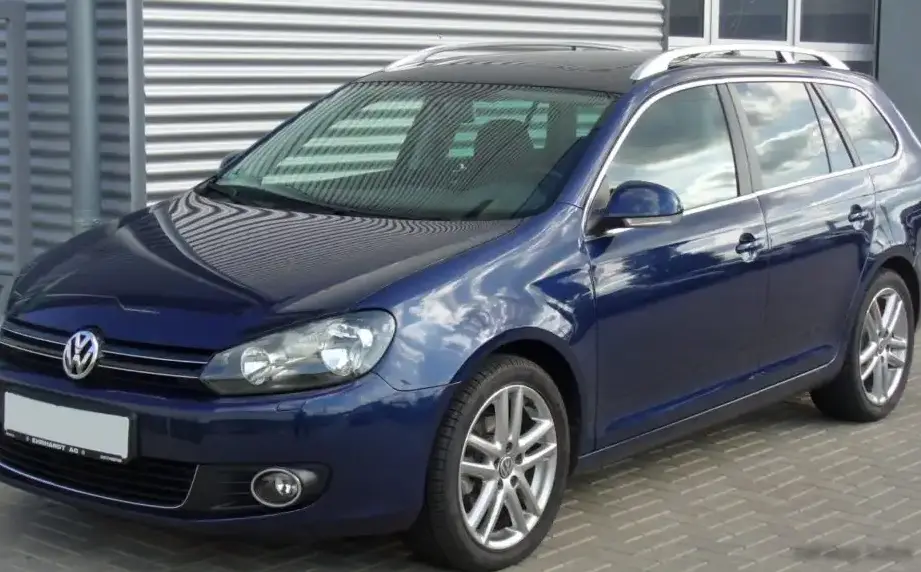
The Volkswagen Golf VI Variant 2.0 TDI (140 hp) DSG, produced between 2009 and 2013, represents a practical and efficient offering within the sixth generation of the Golf family. As a station wagon (estate) variant, it catered to buyers needing increased cargo capacity without sacrificing the Golf’s renowned driving dynamics and build quality. This specific configuration – the 2.0-liter turbocharged diesel engine paired with the dual-clutch DSG automatic transmission – occupied a mid-range position in the Golf VI Variant lineup, offering a balance between performance, fuel economy, and price. It was positioned above the lower-powered diesel options and below the more potent, performance-oriented trims.
Technical Specifications
| Brand | Volkswagen |
| Model | Golf |
| Generation | Golf VI Variant |
| Type (Engine) | 2.0 TDI (140 Hp) DSG |
| Start of production | 2009 |
| End of production | 2013 |
| Powertrain Architecture | Internal Combustion engine |
| Body type | Station wagon (estate) |
| Seats | 5 |
| Doors | 5 |
| Fuel consumption (economy) – urban (NEDC) | 6.9 l/100 km (34.1 US mpg, 40.9 UK mpg, 14.5 km/l) |
| Fuel consumption (economy) – extra urban (NEDC) | 4.5 l/100 km (52.3 US mpg, 62.8 UK mpg, 22.2 km/l) |
| Fuel consumption (economy) – combined (NEDC) | 5.4 l/100 km (43.6 US mpg, 52.3 UK mpg, 18.5 km/l) |
| CO2 emissions (NEDC) | 139 g/km |
| Fuel Type | Diesel |
| Acceleration 0 – 100 km/h | 9.7 sec |
| Acceleration 0 – 62 mph | 9.7 sec |
| Acceleration 0 – 60 mph | 9.2 sec |
| Maximum speed | 208 km/h (129.25 mph) |
| Emission standard | Euro 5 |
| Weight-to-power ratio | 10.3 kg/Hp, 96.8 Hp/tonne |
| Weight-to-torque ratio | 4.5 kg/Nm, 221.3 Nm/tonne |
| Power | 140 Hp @ 4200 rpm |
| Torque | 320 Nm @ 1750-2500 rpm (236.02 lb.-ft. @ 1750-2500 rpm) |
| Engine layout | Front, Transverse |
| Engine Model/Code | CBDB, CFHC, CLCB |
| Engine displacement | 1968 cm3 (120.09 cu. in.) |
| Number of cylinders | 4 |
| Engine configuration | Inline |
| Cylinder Bore | 81 mm (3.19 in.) |
| Piston Stroke | 95.5 mm (3.76 in.) |
| Compression ratio | 18:1 |
| Number of valves per cylinder | 4 |
| Fuel injection system | Diesel Commonrail |
| Engine aspiration | Turbocharger, Intercooler |
| Valvetrain | DOHC |
| Engine oil capacity | 4.3 l (4.54 US qt | 3.78 UK qt) |
| Kerb Weight | 1446 kg (3187.88 lbs.) |
| Max. weight | 2050 kg (4519.48 lbs.) |
| Max load | 604 kg (1331.59 lbs.) |
| Trunk (boot) space – minimum | 505 l (17.83 cu. ft.) |
| Trunk (boot) space – maximum | 1495 l (52.8 cu. ft.) |
| Fuel tank capacity | 55 l (14.53 US gal | 12.1 UK gal) |
| Max. roof load | 75 kg (165.35 lbs.) |
| Permitted trailer load with brakes (8%) | 1700 kg (3747.86 lbs.) |
| Permitted trailer load with brakes (12%) | 1500 kg (3306.93 lbs.) |
| Permitted trailer load without brakes | 750 kg (1653.47 lbs.) |
| Permitted towbar download | 75 kg (165.35 lbs.) |
| Length | 4534 mm (178.5 in.) |
| Width | 1781 mm (70.12 in.) |
| Width including mirrors | 2003 mm (78.86 in.) |
| Height | 1504 mm (59.21 in.) |
| Wheelbase | 2578 mm (101.5 in.) |
| Front track | 1535 mm (60.43 in.) |
| Rear (Back) track | 1508 mm (59.37 in.) |
| Ride height (ground clearance) | 141 mm (5.55 in.) |
| Minimum turning circle (turning diameter) | 10.9 m (35.76 ft.) |
| Drivetrain Architecture | The Internal combustion engine (ICE) drives the front wheels of the vehicle. |
| Drive wheel | Front wheel drive |
| Number of gears and type of gearbox | 6 gears, automatic transmission DSG |
| Front suspension | Independent type McPherson, Transverse stabilizer |
| Rear suspension | Independent multi-link suspension, Transverse stabilizer |
| Front brakes | Ventilated discs |
| Rear brakes | Disc |
Powertrain & Engine Architecture
The heart of this Golf Variant is the 2.0-liter four-cylinder diesel engine, identified by engine codes CBDB, CFHC, or CLCB depending on the specific production year and market. This engine utilizes a common rail direct injection system, delivering fuel directly into the combustion chamber at extremely high pressure for optimized combustion. A turbocharger with an intercooler is employed to increase power output and improve efficiency. The engine features a double overhead camshaft (DOHC) valvetrain with four valves per cylinder, enhancing breathing and contributing to its 140 horsepower output at 4200 rpm and 320 Nm (236 lb-ft) of torque available between 1750 and 2500 rpm. The engine’s design prioritized torque delivery for everyday drivability. Paired with this engine is the Volkswagen’s renowned 6-speed DSG (Direct-Shift Gearbox) automatic transmission. This dual-clutch transmission offers quick, seamless gear changes and contributes to improved fuel efficiency compared to traditional automatic transmissions.
Driving Characteristics
The 2.0 TDI with the DSG transmission provides a comfortable and refined driving experience. While not a performance-oriented setup, the 140 hp engine and DSG gearbox deliver adequate acceleration, achieving 0-60 mph in approximately 9.2 seconds. The DSG transmission’s quick shifts and well-chosen gear ratios ensure responsive acceleration in most driving situations. Compared to the lower-powered 1.6 TDI variants, the 2.0 TDI offers noticeably more power and torque, making overtaking and highway cruising less strenuous. However, it doesn’t match the more spirited performance of the Golf GTD or the petrol-powered GTI models. The DSG transmission, while efficient, can sometimes exhibit slight hesitation at low speeds, a characteristic common to early DSG units. The suspension setup, typical for the Golf VI, provides a good balance between comfort and handling.
Equipment & Trim Levels
The Golf VI Variant 2.0 TDI (140 hp) DSG typically came equipped with a reasonable level of standard features. These included air conditioning, power windows, power mirrors, a CD/MP3 stereo system, and alloy wheels. Higher trim levels, such as Trendline or Comfortline, added features like automatic climate control, a multi-function steering wheel, parking sensors, and upgraded interior upholstery. Optional extras included a sunroof, navigation system, and leather seats. Interior materials were generally of good quality, reflecting Volkswagen’s reputation for build quality. The dashboard layout was functional and ergonomically designed, providing easy access to controls.
Chassis & Braking
The Golf VI Variant’s chassis features an independent McPherson strut suspension at the front and an independent multi-link suspension at the rear. This setup provides a comfortable ride and good handling characteristics. The front brakes are ventilated discs, while the rear brakes are solid discs, providing adequate stopping power for the vehicle’s weight. Anti-lock Braking System (ABS) is standard. Stabilizer bars are fitted to both the front and rear axles to reduce body roll during cornering. The steering is power-assisted, providing a light and precise feel.
Market Reception & Comparison
The Golf VI Variant 2.0 TDI (140 hp) DSG was generally well-received by automotive critics. It was praised for its fuel efficiency, comfortable ride, and practical interior space. Critics noted that while the engine wasn’t particularly exciting, it provided ample power for everyday driving. Compared to the 1.6 TDI variants, the 2.0 TDI offered a significant improvement in performance, making it a more appealing option for those who frequently drive on highways or carry passengers and luggage. Fuel economy was a strong point, with combined figures around 5.4 l/100 km (43.6 US mpg). Reliability was generally good, although some owners reported issues with the DSG transmission, particularly early units.
Legacy
The Volkswagen Golf VI Variant 2.0 TDI (140 hp) DSG remains a popular choice in the used car market. Its combination of practicality, fuel efficiency, and reliability makes it an attractive option for buyers seeking a versatile family vehicle. The 2.0 TDI engine, while not the most technologically advanced, has proven to be relatively durable when properly maintained. However, potential buyers should be aware of the potential for DSG transmission issues and ensure that the vehicle has been regularly serviced. The Golf VI Variant continues to be regarded as a well-rounded and capable estate car, offering a compelling alternative to other vehicles in its class.