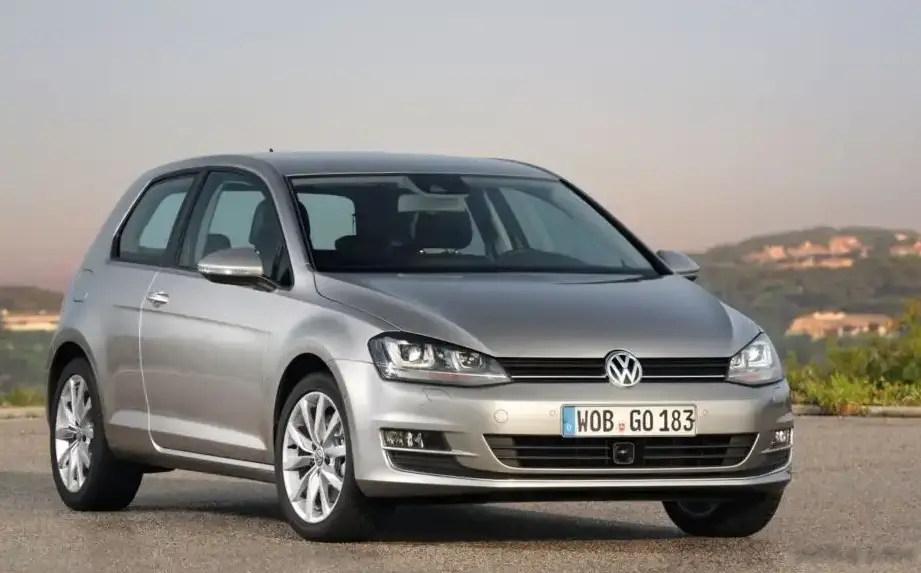
The Volkswagen Golf VII 1.4 TSI (122 hp) DSG, produced from 2012 to 2014, represents a key iteration within the seventh generation of Volkswagen’s iconic Golf hatchback. This 3-door variant occupied a significant position in the European market as an entry-level to mid-range offering, balancing fuel efficiency with respectable performance. It was part of the broader A7 platform strategy, designed to offer a modern, versatile, and technologically advanced compact car. The Golf VII aimed to build upon the success of its predecessors, offering improved refinement, safety features, and a wider range of engine options.
Technical Specifications
| Brand | Volkswagen |
| Model | Golf |
| Generation | Golf VII (3-door) |
| Type (Engine) | 1.4 TSI (122 Hp) DSG |
| Start of production | 2012 |
| End of production | 2014 |
| Powertrain Architecture | Internal Combustion engine |
| Body type | Hatchback |
| Seats | 5 |
| Doors | 3 |
| Fuel consumption (economy) – urban (NEDC) | 6.2 l/100 km (37.9 US mpg, 45.6 UK mpg, 16.1 km/l) |
| Fuel consumption (economy) – extra urban (NEDC) | 4.3 l/100 km (54.7 US mpg, 65.7 UK mpg, 23.3 km/l) |
| Fuel consumption (economy) – combined (NEDC) | 5 l/100 km (47 US mpg, 56.5 UK mpg, 20 km/l) |
| CO2 emissions (NEDC) | 116 g/km |
| Fuel Type | Petrol (Gasoline) |
| Acceleration 0 – 100 km/h | 9.3 sec |
| Acceleration 0 – 62 mph | 9.3 sec |
| Acceleration 0 – 60 mph | 8.8 sec |
| Maximum speed | 203 km/h (126.14 mph) |
| Emission standard | Euro 5 |
| Weight-to-power ratio | 9.6 kg/Hp, 103.9 Hp/tonne |
| Weight-to-torque ratio | 5.9 kg/Nm, 170.4 Nm/tonne |
| Power | 122 Hp @ 5000 rpm |
| Power per litre | 87.8 Hp/l |
| Torque | 200 Nm @ 1800-4000 rpm (147.51 lb.-ft. @ 1800-4000 rpm) |
| Engine layout | Front, Transverse |
| Engine Model/Code | CMBA |
| Engine displacement | 1390 cm3 (84.82 cu. in.) |
| Number of cylinders | 4 |
| Engine configuration | Inline |
| Cylinder Bore | 74.5 mm (2.93 in.) |
| Piston Stroke | 80 mm (3.15 in.) |
| Compression ratio | 10:1 |
| Number of valves per cylinder | 4 |
| Fuel injection system | Direct injection |
| Engine aspiration | Turbocharger, Intercooler |
| Valvetrain | DOHC |
| Engine oil capacity | 4 l (4.23 US qt | 3.52 UK qt) |
| Kerb Weight | 1174 kg (2588.23 lbs.) |
| Max. weight | 1750 kg (3858.09 lbs.) |
| Max load | 576 kg (1269.86 lbs.) |
| Trunk (boot) space – minimum | 380 l (13.42 cu. ft.) |
| Trunk (boot) space – maximum | 1270 l (44.85 cu. ft.) |
| Fuel tank capacity | 50 l (13.21 US gal | 11 UK gal) |
| Max. roof load | 75 kg (165.35 lbs.) |
| Permitted trailer load with brakes (12%) | 1700 kg (3747.86 lbs.) |
| Permitted trailer load without brakes | 620 kg (1366.87 lbs.) |
| Permitted towbar download | 80 kg (176.37 lbs.) |
| Length | 4255 mm (167.52 in.) |
| Width | 1799 mm (70.83 in.) |
| Width including mirrors | 2027 mm (79.8 in.) |
| Height | 1452 mm (57.17 in.) |
| Wheelbase | 2637 mm (103.82 in.) |
| Front track | 1549 mm (60.98 in.) |
| Rear (Back) track | 1520 mm (59.84 in.) |
| Ride height (ground clearance) | 142 mm (5.59 in.) |
| Minimum turning circle (turning diameter) | 10.9 m (35.76 ft.) |
| Front suspension | Independent, type McPherson with coil spring and anti-roll bar |
| Rear suspension | Independent multi-link spring suspension with stabilizer |
| Front brakes | Ventilated discs |
| Rear brakes | Disc |
| Number of gears and type of gearbox | 7 gears, automatic transmission DSG |
INTRODUCTION
The Volkswagen Golf VII 1.4 TSI (122 hp) DSG, launched in 2012, was a crucial model in the seventh-generation Golf lineup. Positioned as a mainstream offering, it aimed to provide a balance of performance, economy, and practicality for a broad range of buyers. The Golf VII represented a significant leap forward from the Mk6, utilizing the modular transverse matrix (MQB) platform, which allowed for greater flexibility in design and engineering. This 3-door version catered to those seeking a more sporty and compact aesthetic. The 1.4 TSI engine, coupled with the dual-clutch DSG transmission, was a popular choice, offering a blend of efficiency and convenience.
Powertrain & Engine Architecture
At the heart of this Golf variant lies the 1.4-liter TSI (Turbocharged Stratified Injection) engine, specifically the CMBA engine code. This engine is a four-cylinder, inline configuration with a displacement of 1390cc. It features direct fuel injection, delivering fuel directly into the combustion chamber for improved efficiency and power. The engine utilizes a turbocharger with an intercooler to boost power output. The valvetrain is a dual overhead camshaft (DOHC) design with four valves per cylinder, optimizing airflow for enhanced performance. The 122 hp output is achieved at 5000 rpm, while peak torque of 200 Nm (147.51 lb-ft) is available between 1800 and 4000 rpm. The engine is paired with a 7-speed dual-clutch transmission (DSG), known for its quick and smooth gear changes. This DSG unit provides both automatic and manual shifting modes, enhancing the driving experience.
Driving Characteristics
The 1.4 TSI 122 hp DSG Golf VII offers a comfortable and refined driving experience. While not overtly sporty, the engine provides adequate power for everyday driving and highway cruising. Acceleration from 0 to 60 mph takes approximately 8.8 seconds, and the top speed is 126.14 mph. The DSG transmission contributes to smooth and responsive gear changes, enhancing both acceleration and fuel efficiency. Compared to the more powerful Golf variants, such as those with the 1.8 TSI or GTI engines, this version feels less eager to accelerate. However, it offers a more economical and relaxed driving experience. The gear ratios are tuned for a balance between fuel economy and performance, with taller gears for highway cruising and shorter gears for quicker acceleration. The steering is precise and well-weighted, providing good feedback to the driver.
Equipment & Trim Levels
The Golf VII 1.4 TSI DSG typically came equipped with a respectable level of standard features. These included air conditioning, power windows, power mirrors, a CD/MP3 stereo system, and alloy wheels. Safety features such as ABS, electronic stability control, and multiple airbags were also standard. Depending on the specific market and optional packages selected, additional features could include a touchscreen infotainment system, Bluetooth connectivity, parking sensors, and automatic climate control. Interior upholstery was typically cloth, with options for upgraded materials. Trim levels varied by region, but generally, this variant sat in the mid-range of the Golf VII lineup, offering a good balance of features and affordability.
Chassis & Braking
The Golf VII 1.4 TSI DSG utilizes an independent suspension system on both the front and rear axles. The front suspension features a McPherson strut design with coil springs and an anti-roll bar, while the rear suspension employs a multi-link setup with a stabilizer bar. This configuration provides a comfortable ride and good handling characteristics. The braking system consists of ventilated discs on the front wheels and solid discs on the rear wheels. ABS (Anti-lock Braking System) is standard, enhancing braking performance and stability. The chassis is designed to provide a good balance between rigidity and weight, contributing to the car’s overall handling and safety.
Market Reception & Comparison
The Golf VII 1.4 TSI DSG was generally well-received by automotive critics. It was praised for its refined driving experience, fuel efficiency, and comfortable interior. However, some critics noted that the 122 hp engine could feel underpowered when fully loaded or driving uphill. Compared to other trims in the Golf VII lineup, such as the 1.6 TDI diesel or the 1.8 TSI petrol, this variant offered a compromise between performance and economy. The 1.6 TDI provided superior fuel economy but less power, while the 1.8 TSI offered more performance but at a higher price point. In terms of reliability, the 1.4 TSI engine has been known to experience occasional issues with the turbocharger and direct injection system, but overall, it is considered a relatively reliable engine.
Legacy
The Volkswagen Golf VII 1.4 TSI DSG remains a popular choice in the used car market. Its combination of practicality, fuel efficiency, and reliability makes it an attractive option for buyers seeking a well-rounded compact hatchback. While the engine may require occasional maintenance, such as carbon buildup removal, it is generally considered a durable and long-lasting powertrain. The DSG transmission, if properly maintained, can provide years of smooth and reliable operation. The Golf VII’s enduring popularity is a testament to its well-engineered design and its ability to meet the needs of a wide range of drivers.