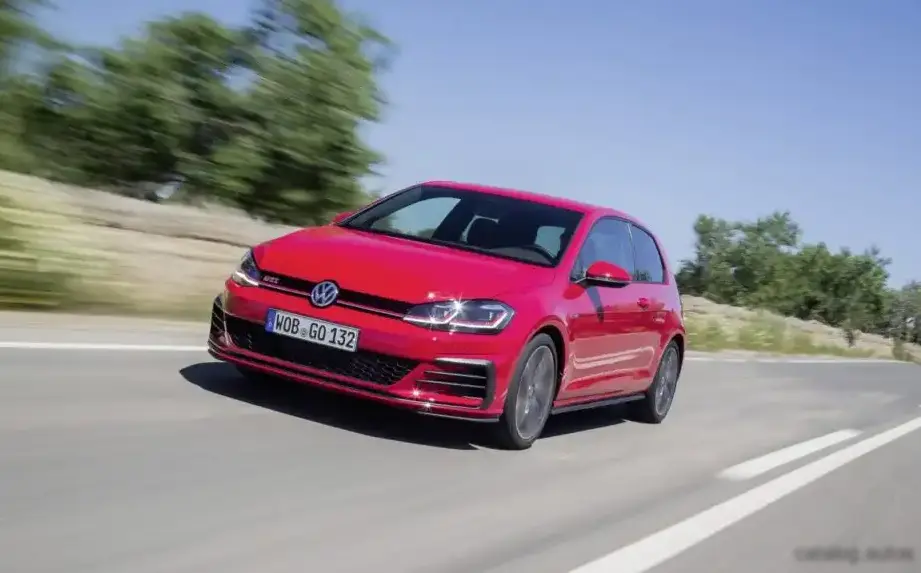
The Volkswagen Golf VII, specifically the 3-door hatchback facelift model produced from March 2017 to August 2018, represents a significant evolution of the iconic Golf lineage. This variant, designated the GTI Performance 2.0 TSI (245 Hp), occupied the upper echelon of the Golf VII range, positioned as a more focused and potent alternative to the standard GTI. It was built on the MQB (Modular Transverse Matrix) platform, also known as the 1HX0/A3 platform, shared with other Volkswagen Group vehicles like the Audi A3 and SEAT Leon. The facelift brought styling updates, enhanced technology, and refinements to the already capable GTI formula, solidifying its position as a benchmark in the hot hatch segment.
Technical Specifications
| Brand | Volkswagen |
| Model | Golf |
| Generation | Golf VII (3-door, facelift 2017) |
| Type (Engine) | GTI Performance 2.0 TSI (245 Hp) |
| Start of production | March, 2017 |
| End of production | August, 2018 |
| Powertrain Architecture | Internal Combustion engine |
| Body type | Hatchback |
| Seats | 5 |
| Doors | 3 |
| Fuel consumption (economy) – urban (NEDC) | 8.6-8.7 l/100 km (27.4 – 27 US mpg, 32.8 – 32.5 UK mpg, 11.6 – 11.5 km/l) |
| Fuel consumption (economy) – extra urban (NEDC) | 5.3-5.4 l/100 km (44.4 – 43.6 US mpg, 53.3 – 52.3 UK mpg, 18.9 – 18.5 km/l) |
| Fuel consumption (economy) – combined (NEDC) | 6.5-6.6 l/100 km (36.2 – 35.6 US mpg, 43.5 – 42.8 UK mpg, 15.4 – 15.2 km/l) |
| CO2 emissions (NEDC) | 148-150 g/km |
| Fuel Type | Petrol (Gasoline) |
| Acceleration 0 – 100 km/h | 6.2 sec |
| Acceleration 0 – 62 mph | 6.2 sec |
| Acceleration 0 – 60 mph | 5.9 sec |
| Maximum speed | 250 km/h (155.34 mph) |
| Emission standard | Euro 6 |
| Weight-to-power ratio | 5.4 kg/Hp, 186.7 Hp/tonne |
| Weight-to-torque ratio | 3.5 kg/Nm, 282 Nm/tonne |
| Power | 245 Hp @ 5000-6200 rpm |
| Power per litre | 123.5 Hp/l |
| Torque | 370 Nm @ 1600-4300 rpm (272.9 lb.-ft. @ 1600-4300 rpm) |
| Engine layout | Front, Transverse |
| Engine Model/Code | EA888 / DLBA |
| Engine displacement | 1984 cm3 (121.07 cu. in.) |
| Number of cylinders | 4 |
| Engine configuration | Inline |
| Cylinder Bore | 82.5 mm (3.25 in.) |
| Piston Stroke | 92.8 mm (3.65 in.) |
| Compression ratio | 9.6:1 |
| Number of valves per cylinder | 4 |
| Fuel injection system | Direct injection |
| Engine aspiration | Turbocharger, Intercooler |
| Valvetrain | DOHC |
| Engine oil capacity | 5.7 l (6.02 US qt | 5.02 UK qt) |
| Kerb Weight | 1312 kg (2892.46 lbs.) |
| Max. weight | 1860 kg (4100.6 lbs.) |
| Max load | 548 kg (1208.13 lbs.) |
| Trunk (boot) space – minimum | 380 l (13.42 cu. ft.) |
| Trunk (boot) space – maximum | 1270 l (44.85 cu. ft.) |
| Fuel tank capacity | 50 l (13.21 US gal | 11 UK gal) |
| Max. roof load | 75 kg (165.35 lbs.) |
| Permitted trailer load with brakes (8%) | 1800 kg (3968.32 lbs.) |
| Permitted trailer load with brakes (12%) | 1600 kg (3527.4 lbs.) |
| Permitted trailer load without brakes | 690 kg (1521.19 lbs.) |
| Permitted towbar download | 80 kg (176.37 lbs.) |
| Length | 4268 mm (168.03 in.) |
| Width | 1799 mm (70.83 in.) |
| Width including mirrors | 2027 mm (79.8 in.) |
| Height | 1482 mm (58.35 in.) |
| Wheelbase | 2626 mm (103.39 in.) |
| Front track | 1527-1550 mm (60.12 – 61.02 in.) |
| Rear (Back) track | 1503-1521 mm (59.17 – 59.88 in.) |
| Ride height (ground clearance) | 133 mm (5.24 in.) |
| Minimum turning circle (turning diameter) | 10.9 m (35.76 ft.) |
| Drivetrain Architecture | The Internal combustion engine (ICE) drives the front wheels of the vehicle. |
| Drive wheel | Front wheel drive |
| Number of gears and type of gearbox | 6 gears, manual transmission |
| Front suspension | Independent, type McPherson with coil spring and anti-roll bar |
| Rear suspension | Independent multi-link spring suspension with stabilizer |
| Front brakes | Ventilated discs |
| Rear brakes | Disc |
| Assisting systems | ABS (Anti-lock braking system) |
| Steering type | Steering rack and pinion |
| Power steering | Electric Steering |
| Tires size | 225/45 R17; 225/40 R18; 225/35 R19 |
| Wheel rims size | 7.5J x 17; 7.5J x 18; 7.5J x 19 |
Powertrain & Engine Architecture
At the heart of the GTI Performance lies the EA888 2.0-liter turbocharged inline-four cylinder engine, specifically the DLBA engine code. This engine is a direct-injection powerplant, utilizing a sophisticated fuel system for precise fuel delivery and optimized combustion. The DLBA variant was tuned to produce 245 horsepower at 5000-6200 rpm and 370 Nm (272.9 lb-ft) of torque between 1600 and 4300 rpm. The turbocharger, coupled with an intercooler, provides significant boost, contributing to the engine’s responsive nature. The engine features a dual overhead camshaft (DOHC) valvetrain with four valves per cylinder, enhancing breathing and overall efficiency. The 6-speed manual transmission was standard, offering precise gear changes and a direct connection to the engine.
Driving Characteristics
The 245 hp output, combined with the manual transmission, delivered a spirited driving experience. Acceleration from 0 to 60 mph was achieved in approximately 5.9 seconds, and the car boasted a top speed of 155.34 mph (250 km/h). The engine’s torque curve provided strong pull throughout the rev range, making it easy to accelerate in various driving situations. Compared to the standard GTI, the Performance model offered a noticeably more engaging and responsive feel. While the standard GTI prioritized everyday usability, the Performance variant leaned towards a more focused, driver-centric experience. The manual gearbox allowed for full control over the power delivery, enhancing the sense of connection with the car.
Equipment & Trim Levels
The GTI Performance came standard with a comprehensive list of features, including sport seats upholstered in the classic “Clark” plaid fabric, a leather-wrapped sport steering wheel, and stainless steel pedal caps. Infotainment was typically handled by Volkswagen’s Composition Media or Discover Pro system, depending on options selected, offering features like touchscreen display, navigation, and smartphone integration. Exterior styling cues included unique 18-inch alloy wheels (larger 19-inch wheels were optional), red brake calipers, and a subtle rear spoiler. Optional extras included adaptive chassis control (DCC), which allowed drivers to adjust the suspension stiffness, and a panoramic sunroof.
Chassis & Braking
The GTI Performance featured a sport-tuned suspension with a McPherson strut front axle and a multi-link rear axle. The suspension was lowered compared to the standard Golf, contributing to improved handling and reduced body roll. Brakes consisted of ventilated discs at all four corners, providing ample stopping power. The ABS (Anti-lock Braking System) was standard, enhancing safety and control during emergency braking situations. The steering utilized an electric power steering system, offering precise and responsive steering feel.
Market Reception & Comparison
The GTI Performance was generally well-received by automotive critics, who praised its engaging driving dynamics, powerful engine, and well-equipped interior. It was often compared favorably to rivals like the Ford Focus ST and the Renault Mégane RS. Fuel economy was respectable for a performance hatchback, with combined figures ranging from 35.6 to 36.2 US mpg. Reliability was generally good, although like any performance car, regular maintenance was crucial. Compared to the standard GTI, the Performance model offered a more focused driving experience but came at a slightly higher price point.
Legacy
The Volkswagen Golf VII GTI Performance has established itself as a desirable used car, appreciated for its blend of performance, practicality, and refinement. The EA888 engine, in this tune, is known for its durability and tunability, making it a popular choice for enthusiasts. While maintenance costs can be higher than those of less powerful Golf variants, the GTI Performance offers a rewarding driving experience that continues to appeal to a wide range of drivers. Its position as a benchmark hot hatch remains secure, and it is often cited as a prime example of Volkswagen’s engineering prowess.