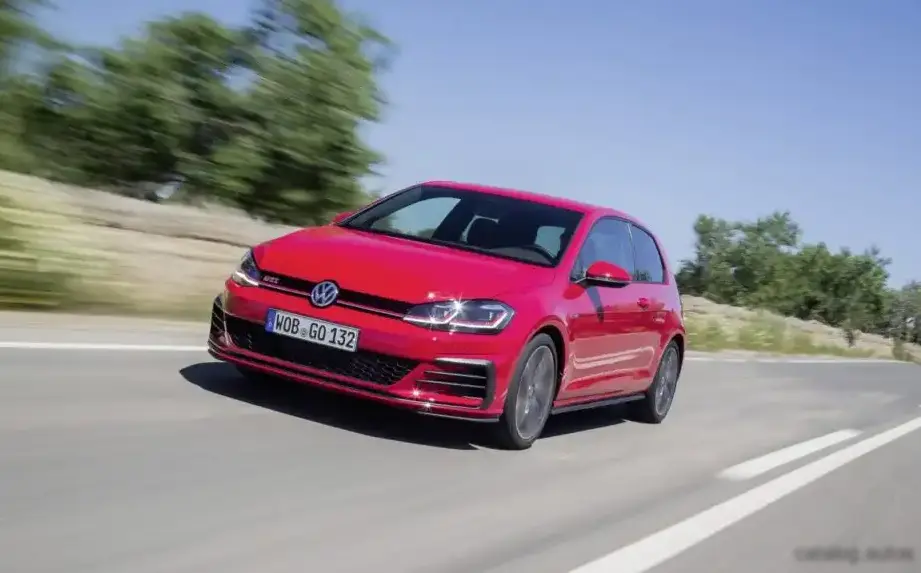
The Volkswagen Golf VII, specifically the 3-door hatchback facelift model produced from March 2017 to August 2018, represents a significant evolution of the iconic Golf lineage. This variant, designated the GTI Performance 2.0 TSI with a 7-speed Dual Clutch Gearbox (DSG), occupied the upper echelon of the Golf VII range, positioned as a performance-oriented offering above the standard GTI but below the more track-focused GTI Clubsport. It was primarily marketed in Europe and other global markets where the 3-door hatchback body style remained popular, offering a blend of practicality, sporty handling, and a potent turbocharged engine.
Technical Specifications
| Brand | Volkswagen |
| Model | Golf |
| Generation | Golf VII (3-door, facelift 2017) |
| Type (Engine) | GTI Performance 2.0 TSI (245 Hp) DSG |
| Start of production | March, 2017 |
| End of production | August, 2018 |
| Powertrain Architecture | Internal Combustion engine |
| Body type | Hatchback |
| Seats | 5 |
| Doors | 3 |
| Fuel consumption (economy) – urban (NEDC) | 8.2 l/100 km (28.7 US mpg, 34.4 UK mpg, 12.2 km/l) |
| Fuel consumption (economy) – extra urban (NEDC) | 5.2 l/100 km (45.2 US mpg, 54.3 UK mpg, 19.2 km/l) |
| Fuel consumption (economy) – combined (NEDC) | 6.3 l/100 km (37.3 US mpg, 44.8 UK mpg, 15.9 km/l) |
| CO2 emissions (NEDC) | 144 g/km |
| Fuel Type | Petrol (Gasoline) |
| Acceleration 0 – 100 km/h | 6.2 sec |
| Acceleration 0 – 62 mph | 6.2 sec |
| Acceleration 0 – 60 mph | 5.9 sec |
| Maximum speed | 248 km/h (154.1 mph) |
| Emission standard | Euro 6 |
| Weight-to-power ratio | 5.5 kg/Hp, 182.8 Hp/tonne |
| Weight-to-torque ratio | 3.6 kg/Nm, 276.1 Nm/tonne |
| Power | 245 Hp @ 5000-6200 rpm |
| Power per litre | 123.5 Hp/l |
| Torque | 370 Nm @ 1600-4300 rpm (272.9 lb.-ft. @ 1600-4300 rpm) |
| Engine layout | Front, Transverse |
| Engine Model/Code | EA888 / DLBA |
| Engine displacement | 1984 cm3 (121.07 cu. in.) |
| Number of cylinders | 4 |
| Engine configuration | Inline |
| Cylinder Bore | 82.5 mm (3.25 in.) |
| Piston Stroke | 92.8 mm (3.65 in.) |
| Compression ratio | 9.6:1 |
| Number of valves per cylinder | 4 |
| Fuel injection system | Direct injection |
| Engine aspiration | Turbocharger, Intercooler |
| Valvetrain | DOHC |
| Engine oil capacity | 5.7 l (6.02 US qt | 5.02 UK qt) |
| Kerb Weight | 1340 kg (2954.19 lbs.) |
| Max. weight | 1890 kg (4166.74 lbs.) |
| Max load | 550 kg (1212.54 lbs.) |
| Trunk (boot) space – minimum | 380 l (13.42 cu. ft.) |
| Trunk (boot) space – maximum | 1270 l (44.85 cu. ft.) |
| Fuel tank capacity | 50 l (13.21 US gal | 11 UK gal) |
| Max. roof load | 75 kg (165.35 lbs.) |
| Permitted trailer load with brakes (8%) | 1800 kg (3968.32 lbs.) |
| Permitted trailer load with brakes (12%) | 1600 kg (3527.4 lbs.) |
| Permitted trailer load without brakes | 700 kg (1543.24 lbs.) |
| Permitted towbar download | 80 kg (176.37 lbs.) |
| Length | 4268 mm (168.03 in.) |
| Width | 1799 mm (70.83 in.) |
| Width including mirrors | 2027 mm (79.8 in.) |
| Height | 1482 mm (58.35 in.) |
| Wheelbase | 2626 mm (103.39 in.) |
| Front track | 1527-1550 mm (60.12 – 61.02 in.) |
| Rear (Back) track | 1503-1521 mm (59.17 – 59.88 in.) |
| Ride height (ground clearance) | 133 mm (5.24 in.) |
| Minimum turning circle (turning diameter) | 10.9 m (35.76 ft.) |
| Drivetrain Architecture | The Internal combustion engine (ICE) drives the front wheels of the vehicle. |
| Drive wheel | Front wheel drive |
| Number of gears and type of gearbox | 7 gears, automatic transmission DSG |
| Front suspension | Independent, type McPherson with coil spring and anti-roll bar |
| Rear suspension | Independent multi-link spring suspension with stabilizer |
| Front brakes | Ventilated discs |
| Rear brakes | Disc |
| Assisting systems | ABS (Anti-lock braking system) |
| Steering type | Steering rack and pinion |
| Power steering | Electric Steering |
| Tires size | 225/45 R17; 225/40 R18; 225/35 R19 |
| Wheel rims size | 7.5J x 17; 7.5J x 18; 7.5J x 19 |
INTRODUCTION
The Golf VII GTI Performance, introduced during the facelift of the seventh-generation Golf, built upon the already successful GTI formula by increasing power output and incorporating performance-enhancing features. The 2.0 TSI engine, coded DLBA, was a key component, delivering 245 horsepower and 370 Nm of torque. This variant was designed to appeal to enthusiasts seeking a more engaging driving experience without sacrificing the Golf’s everyday usability. The 3-door configuration, while less common in the US market, was popular in Europe for its sportier aesthetic and slightly reduced weight.
Powertrain & Engine Architecture
At the heart of the GTI Performance lies the EA888 2.0-liter turbocharged four-cylinder engine. The DLBA engine code signifies specific internal upgrades over the standard GTI’s engine, including a larger turbocharger, revised pistons, and strengthened connecting rods. These modifications allowed for increased boost pressure and higher power output. The engine utilizes direct fuel injection, ensuring precise fuel delivery and optimized combustion. The valvetrain employs a dual overhead camshaft (DOHC) design with four valves per cylinder, maximizing airflow and contributing to the engine’s responsiveness. The 7-speed DSG dual-clutch transmission provides rapid and seamless gear changes, enhancing acceleration and overall driving enjoyment. The DSG’s programming was also specifically tuned for the Performance model, offering quicker shift times and a more aggressive shift pattern. A start/stop system was included as standard equipment, contributing to improved fuel efficiency in urban driving conditions.
Driving Characteristics
The 245 hp and 370 Nm of torque delivered by the GTI Performance’s engine translate into brisk acceleration. The 0-62 mph (0-100 km/h) sprint takes approximately 6.2 seconds. The DSG transmission plays a crucial role in maximizing this performance, providing near-instantaneous shifts and keeping the engine within its optimal power band. Compared to the standard GTI, the Performance model feels noticeably more responsive, particularly during overtaking maneuvers. While the manual transmission offered in other Golf VII variants provided a more direct connection to the drivetrain, the DSG’s efficiency and speed made it a compelling choice for many drivers. The chassis, tuned for a balance between comfort and handling, provides a stable and predictable driving experience. The progressive steering system offers precise control and reduces steering effort at low speeds.
Equipment & Trim Levels
The GTI Performance came standard with a comprehensive list of features, including sport seats upholstered in the classic GTI “Clark” plaid fabric, stainless steel pedal caps, and a leather-wrapped multi-function steering wheel. Exterior styling cues included unique 18-inch alloy wheels (though 17- and 19-inch options were available), red brake calipers, and a subtle rear spoiler. Optional extras included adaptive chassis control (DCC), which allowed drivers to adjust the suspension stiffness, and a premium sound system. The infotainment system featured a touchscreen display with navigation and smartphone integration. Interior trim options were relatively limited, focusing on a sporty and functional aesthetic.
Chassis & Braking
The GTI Performance utilizes an independent suspension setup at all four corners. The front suspension employs a McPherson strut design with a coil spring and anti-roll bar, while the rear features a multi-link setup with a stabilizer bar. This configuration provides a good balance between ride comfort and handling precision. Braking duties are handled by ventilated discs at the front and solid discs at the rear. The anti-lock braking system (ABS) and electronic stability control (ESC) are standard features, enhancing safety and control. The brake calipers were painted red, serving as a visual differentiator from other Golf VII models.
Market Reception & Comparison
The Golf VII GTI Performance was generally well-received by automotive critics, who praised its performance, handling, and overall refinement. It was often compared favorably to rivals such as the Ford Focus ST and the Renault Mégane RS. Compared to the standard GTI, the Performance model offered a noticeable increase in power and a more engaging driving experience. However, the higher price tag and slightly firmer ride were potential drawbacks for some buyers. Fuel economy was respectable for a performance hatchback, with combined figures around 6.3 l/100 km (37.3 US mpg). Reliability was generally good, although owners should be mindful of potential issues with the DSG transmission, such as mechatronic unit failures.
Legacy
The Golf VII GTI Performance remains a popular choice in the used car market, particularly among enthusiasts seeking a well-rounded and capable performance hatchback. The EA888 engine, in its DLBA configuration, is known for its durability and tunability. Regular maintenance, including oil changes and DSG transmission servicing, is crucial for ensuring long-term reliability. The GTI Performance’s blend of performance, practicality, and refinement has cemented its place as a modern classic in the hot hatch segment. Its influence can be seen in subsequent generations of the Golf GTI, which continue to build upon the Performance model’s legacy.