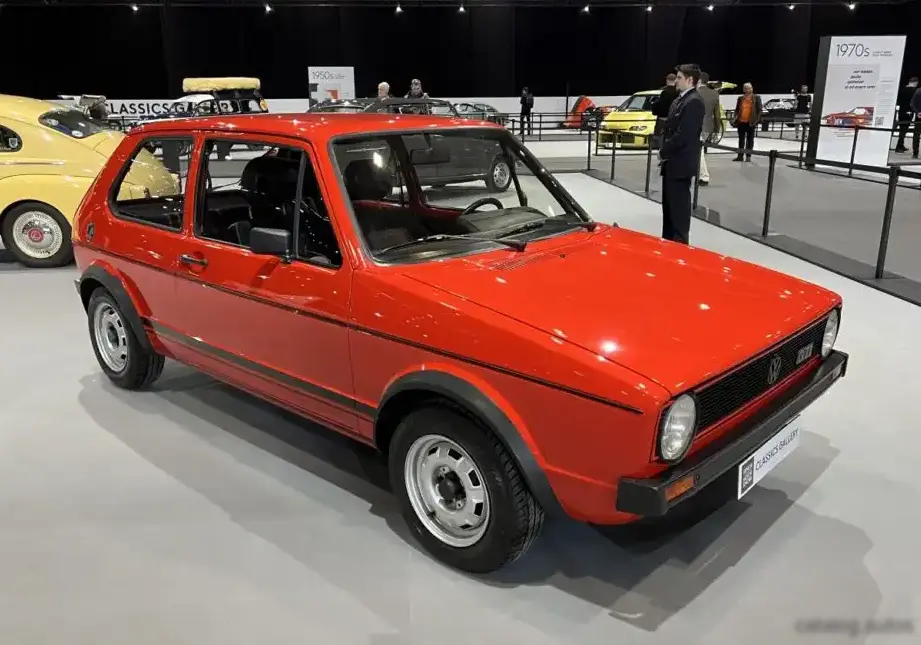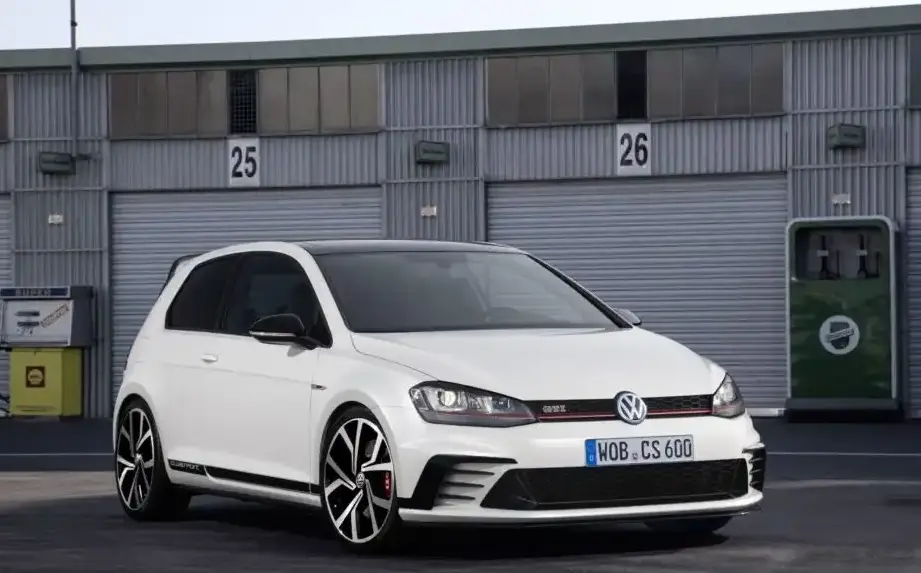
The Volkswagen Golf VII GTI Clubsport, specifically the 3-door variant equipped with the 2.0 TSI 265 horsepower engine and a dual-clutch gearbox (DSG), represents a performance-focused iteration of the seventh-generation Golf. Produced for a limited time between January and December 2016, it was designed as a celebration of the Golf GTI’s legacy and a bridge between the standard GTI and the more extreme GTI Clubsport S. This model occupied the upper echelon of the Golf VII GTI range, offering increased power and a more aggressive aesthetic compared to the standard GTI, but without the hardcore, track-focused nature of the Clubsport S.
Technical Specifications
| Brand | Volkswagen |
| Model | Golf |
| Generation | Golf VII (3-door) |
| Type (Engine) | GTI Clubsport 2.0 TSI (265 Hp) DSG |
| Start of production | January, 2016 |
| End of production | December, 2016 |
| Powertrain Architecture | Internal Combustion engine |
| Body type | Hatchback |
| Seats | 5 |
| Doors | 3 |
| Fuel consumption (economy) – urban (NEDC) | 8.5 l/100 km (27.7 US mpg, 33.2 UK mpg, 11.8 km/l) |
| Fuel consumption (economy) – extra urban (NEDC) | 5.9 l/100 km (39.9 US mpg, 47.9 UK mpg, 16.9 km/l) |
| Fuel consumption (economy) – combined (NEDC) | 6.9 l/100 km (34.1 US mpg, 40.9 UK mpg, 14.5 km/l) |
| CO2 emissions (NEDC) | 158 g/km |
| Fuel Type | Petrol (Gasoline) |
| Acceleration 0 – 100 km/h | 6.3 sec |
| Acceleration 0 – 62 mph | 6.3 sec |
| Acceleration 0 – 60 mph | 6 sec (Calculated) |
| Maximum speed | 250 km/h (155.34 mph), Electronically limited |
| Emission standard | Euro 6 |
| Weight-to-power ratio | 5 kg/Hp, 200.8 Hp/tonne |
| Weight-to-torque ratio | 3.8 kg/Nm, 265.2 Nm/tonne |
| Power | 265 Hp @ 5350-6600 rpm |
| Power per litre | 133.6 Hp/l |
| Torque | 350 Nm @ 1700-5300 rpm (258.15 lb.-ft. @ 1700-5300 rpm) |
| Engine layout | Front, Transverse |
| Engine Model/Code | EA888 / CJXE |
| Engine displacement | 1984 cm3 (121.07 cu. in.) |
| Number of cylinders | 4 |
| Engine configuration | Inline |
| Cylinder Bore | 82.5 mm (3.25 in.) |
| Piston Stroke | 92.8 mm (3.65 in.) |
| Compression ratio | 9.6:1 |
| Number of valves per cylinder | 4 |
| Fuel injection system | Direct injection and Multi-port manifold injection |
| Engine aspiration | Turbocharger, Intercooler |
| Valvetrain | DOHC |
| Engine oil capacity | 5.7 l (6.02 US qt | 5.02 UK qt) |
| Kerb Weight | 1320 kg (2910.1 lbs.) |
| Max. weight | 1870 kg (4122.64 lbs.) |
| Max load | 550 kg (1212.54 lbs.) |
| Trunk (boot) space – minimum | 380 l (13.42 cu. ft.) |
| Trunk (boot) space – maximum | 1270 l (44.85 cu. ft.) |
| Fuel tank capacity | 50 l (13.21 US gal | 11 UK gal) |
| Max. roof load | 75 kg (165.35 lbs.) |
| Permitted trailer load with brakes (12%) | 1600 kg (3527.4 lbs.) |
| Permitted trailer load without brakes | 700 kg (1543.24 lbs.) |
| Permitted towbar download | 80 kg (176.37 lbs.) |
| Length | 4268 mm (168.03 in.) |
| Width | 1799 mm (70.83 in.) |
| Width including mirrors | 2027 mm (79.8 in.) |
| Height | 1442 mm (56.77 in.) |
| Wheelbase | 2631 mm (103.58 in.) |
| Front track | 1538 mm (60.55 in.) |
| Rear (Back) track | 1516 mm (59.69 in.) |
| Ride height (ground clearance) | 133 mm (5.24 in.) |
| Minimum turning circle | 10.9 m (35.76 ft.) |
| Drivetrain Architecture | Front wheel drive |
| Number of gears and type of gearbox | 6 gears, automatic transmission DSG |
| Front suspension | Independent, type McPherson with coil spring and anti-roll bar |
| Rear suspension | Independent multi-link spring suspension with stabilizer |
| Front brakes | Ventilated discs |
| Rear brakes | Ventilated discs |
INTRODUCTION
The Golf VII GTI Clubsport was launched as a limited-edition model to commemorate the 40th anniversary of the Golf GTI. It slotted between the standard GTI and the even more focused Clubsport S, offering a compelling blend of performance and everyday usability. The 3-door configuration was favored by enthusiasts for its sportier appearance and slightly reduced weight. The 2.0 TSI engine, paired with the DSG transmission, provided a significant power boost over the standard GTI, enhancing both acceleration and overall driving experience. This variant was primarily sold in Europe, with limited availability in other markets.
Powertrain & Engine Architecture
At the heart of the GTI Clubsport lies the EA888 2.0-liter turbocharged four-cylinder engine, specifically the CJXE engine code. This engine is a direct-injection, turbocharged unit featuring an integrated exhaust manifold for improved turbo response. It produces 265 horsepower at 5350-6600 rpm and 350 Nm (258 lb-ft) of torque between 1700 and 5300 rpm. The engine utilizes both direct and multi-port fuel injection, optimizing combustion efficiency and reducing emissions. The dual-clutch DSG (Direct-Shift Gearbox) transmission, a six-speed unit, provides rapid and seamless gear changes, contributing to the car’s brisk acceleration. The DSG is programmed with sportier shift points compared to the standard GTI, further enhancing the driving experience.
Driving Characteristics
The GTI Clubsport 2.0 TSI DSG delivers a noticeably more engaging driving experience than the standard GTI. The increased power output and the quick-shifting DSG transmission result in a 0-60 mph time of around 6 seconds and a limited top speed of 155 mph. The DSG transmission’s programming prioritizes performance, holding gears longer and downshifting quickly under braking. While the standard GTI offers a more relaxed driving experience, the Clubsport demands more attention and rewards the driver with a more visceral connection to the road. The suspension is tuned for a balance between comfort and handling, providing a firm but not overly harsh ride.
Equipment & Trim Levels
The GTI Clubsport came standard with a comprehensive list of features, including sport seats upholstered in a unique cloth/Alcantara combination, a leather-wrapped steering wheel with red stitching, and stainless steel pedal caps. Exterior styling cues included a more aggressive front bumper with larger air intakes, a rear spoiler, and unique alloy wheel designs. Optional extras included adaptive dampers (DCC), a panoramic sunroof, and a premium sound system. The interior featured a sportier aesthetic compared to the standard GTI, with subtle red accents throughout the cabin.
Chassis & Braking
The GTI Clubsport features a McPherson strut front suspension and a multi-link rear suspension, both with stiffer springs and dampers compared to the standard GTI. The brakes consist of ventilated discs all around, providing ample stopping power. The electronic stability control (ESC) system is calibrated to allow for a greater degree of wheel slip in Sport mode, enhancing driving enjoyment. The steering is precise and well-weighted, providing good feedback to the driver.
Market Reception & Comparison
The GTI Clubsport was generally well-received by automotive critics, who praised its increased performance and engaging driving dynamics. Compared to the standard GTI, the Clubsport offered a significant power boost and a more focused driving experience. However, some critics noted that the Clubsport S, with its even more aggressive tuning and reduced weight, offered a more rewarding experience for serious enthusiasts. Fuel economy was comparable to other high-performance hatchbacks, averaging around 34 mpg in combined driving. Reliability was generally good, although the DSG transmission required regular maintenance to ensure optimal performance.
Legacy
The Golf VII GTI Clubsport remains a desirable model in the used car market, particularly among GTI enthusiasts. The 2.0 TSI engine and DSG transmission are known for their reliability when properly maintained. The limited production run and unique styling cues contribute to its collectibility. The Clubsport represents a high point in the Golf VII GTI lineage, offering a compelling blend of performance, practicality, and style. It served as a stepping stone towards the even more extreme Clubsport S, solidifying the Golf GTI’s reputation as one of the best hot hatches of all time.