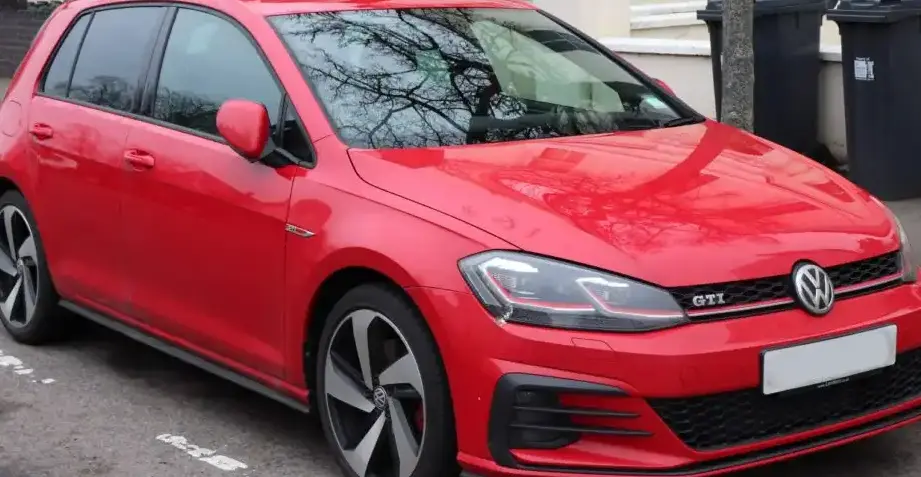
The Volkswagen Golf VII 1.4 TGI, produced from April 2013 to 2017, represents a unique offering within the seventh generation Golf lineup. This five-door hatchback distinguishes itself through its bi-fuel capability, designed to run on both gasoline and Compressed Natural Gas (CNG). Positioned as an economy-focused variant, the 1.4 TGI aimed to appeal to environmentally conscious buyers and those seeking lower running costs, particularly in European markets where CNG infrastructure was more developed. It occupied a niche between the base gasoline models and the more powerful TSI variants, offering a compromise between performance and efficiency.
Technical Specifications
| Brand | Volkswagen |
| Model | Golf |
| Generation | Golf VII (5-door) |
| Type (Engine) | 1.4 TGI (110 Hp) |
| Start of production | April, 2013 |
| End of production | 2017 |
| Powertrain Architecture | Internal Combustion engine |
| Body type | Hatchback |
| Seats | 5 |
| Doors | 5 |
| Fuel consumption (urban) | 6.9 l/100 km (34.1 US mpg, 40.9 UK mpg, 14.5 km/l) |
| Fuel consumption (extra urban) | 4.4 l/100 km (53.5 US mpg, 64.2 UK mpg, 22.7 km/l) |
| Fuel consumption (combined) | 5.3 l/100 km (44.4 US mpg, 53.3 UK mpg, 18.9 km/l) |
| CO2 emissions | 124 g/km |
| Fuel Type | Petrol / CNG |
| Acceleration 0 – 100 km/h | 10.9 sec |
| Acceleration 0 – 62 mph | 10.9 sec |
| Acceleration 0 – 60 mph | 10.4 sec |
| Maximum speed | 194 km/h (120.55 mph) |
| Emission standard | Euro 6 |
| Weight-to-power ratio | 12.6 kg/Hp, 79.6 Hp/tonne |
| Weight-to-torque ratio | 6.9 kg/Nm, 144.7 Nm/tonne |
| Power | 110 Hp @ 4800-6000 rpm |
| Power per litre | 78.9 Hp/l |
| Torque | 200 Nm @ 1500-3500 rpm (147.51 lb.-ft. @ 1500-3500 rpm) |
| Engine layout | Front, Transverse |
| Engine Model/Code | CPWA |
| Engine displacement | 1395 cm3 (85.13 cu. in.) |
| Number of cylinders | 4 |
| Engine configuration | Inline |
| Number of valves per cylinder | 4 |
| Fuel injection system | Direct injection |
| Engine aspiration | Turbocharger |
| Engine oil capacity | 4 l (4.23 US qt | 3.52 UK qt) |
| Kerb Weight | 1382 kg (3046.79 lbs.) |
| Max. weight | 1850 kg (4078.55 lbs.) |
| Max load | 468 kg (1031.76 lbs.) |
| Trunk (boot) space – minimum | 291 l (10.28 cu. ft.) |
| Trunk (boot) space – maximum | 1181 l (41.71 cu. ft.) |
| Fuel tank capacity | 50 l (13.21 US gal | 11 UK gal) |
| Length | 4255 mm (167.52 in.) |
| Width | 1799 mm (70.83 in.) |
| Height | 1452 mm (57.17 in.) |
| Wheelbase | 2637 mm (103.82 in.) |
| Front track | 1549 mm (60.98 in.) |
| Rear (Back) track | 1520 mm (59.84 in.) |
| Minimum turning circle | 10.9 m (35.76 ft.) |
| Drivetrain Architecture | The Internal combustion engine (ICE) drives the front wheels of the vehicle. |
| Drive wheel | Front wheel drive |
| Number of gears and type of gearbox | 6 gears, manual transmission |
| Front brakes | Ventilated discs |
| Rear brakes | Disc |
| Assisting systems | ABS (Anti-lock braking system) |
| Steering type | Steering rack and pinion |
| Tires size | 195/65 R15 |
| Wheel rims size | 6J x 15 |
Powertrain & Engine Architecture
At the heart of the Golf VII 1.4 TGI lies the CPWA engine code, a 1.4-liter inline-four cylinder gasoline engine. This engine is a member of Volkswagen’s EA211 engine family, known for its compact design and efficiency. The key feature of the TGI variant is its ability to switch between gasoline and CNG operation. When running on CNG, the engine’s compression ratio is slightly higher to take advantage of the fuel’s higher octane rating. The engine utilizes direct fuel injection, delivering fuel directly into the combustion chamber for improved efficiency and reduced emissions. A single turbocharger provides forced induction, boosting power output to 110 horsepower and 200 Nm (147.51 lb-ft) of torque. The six-speed manual transmission was standard, providing a balance between fuel economy and driver engagement. The transmission’s gear ratios were tuned to maximize efficiency in both gasoline and CNG modes.
Driving Characteristics
The 1.4 TGI offers a driving experience geared towards practicality and fuel economy rather than outright performance. Acceleration from 0-60 mph takes approximately 10.4 seconds, and top speed is rated at 194 km/h (120.55 mph). Compared to the 1.4 TSI gasoline version, the TGI feels slightly less responsive, particularly when running on CNG, due to the fuel’s lower energy density. However, the difference is not substantial, and the TGI still provides adequate power for everyday driving. The manual transmission allows for precise control, and the engine’s torque is readily available from low RPMs, making it easy to navigate city traffic. Switching between gasoline and CNG is seamless, with the engine automatically adjusting to the selected fuel source.
Equipment & Trim Levels
The Golf VII 1.4 TGI typically came equipped with a reasonable level of standard features. These included air conditioning, power windows, central locking, and an audio system with USB connectivity. Safety features such as ABS, ESP (Electronic Stability Program), and multiple airbags were also standard. Interior upholstery was typically cloth, with options for upgraded materials available. Trim levels varied depending on the market, but generally offered options such as alloy wheels, parking sensors, and a touchscreen infotainment system. The TGI variant often included specific instrumentation to monitor CNG fuel levels and switching status.
Chassis & Braking
The Golf VII 1.4 TGI utilizes a standard Golf VII chassis setup. The front suspension consists of MacPherson struts, while the rear suspension employs a multi-link system. This configuration provides a good balance between ride comfort and handling. Brakes are ventilated discs on the front axle and solid discs on the rear. ABS (Anti-lock Braking System) is standard, enhancing braking performance and stability. The suspension tuning is geared towards comfort, making it well-suited for everyday driving. Stabilizer bars are fitted to both the front and rear axles to reduce body roll during cornering.
Market Reception & Comparison
The Golf VII 1.4 TGI was generally well-received by critics as a practical and economical option. Its bi-fuel capability was seen as a significant advantage in markets with established CNG infrastructure. Fuel economy figures were impressive, particularly when running on CNG. Compared to the gasoline-only Golf variants, the TGI offered lower running costs, but at the expense of some performance. The 1.4 TSI offered more power and a more engaging driving experience, while the 1.6 TDI diesel provided even better fuel economy. However, the TGI occupied a unique niche, appealing to buyers who wanted a compromise between these options.
Legacy
The 1.4 TGI powertrain has proven to be relatively reliable, with few widespread issues reported. The EA211 engine family is known for its durability, and the CNG conversion is generally well-engineered. On the used car market, the Golf VII 1.4 TGI represents a good value proposition for buyers seeking an economical and environmentally friendly hatchback. However, potential buyers should be aware of the availability of CNG refueling stations in their area. The Golf VII 1.4 TGI remains a testament to Volkswagen’s commitment to alternative fuel technologies and its ability to offer practical and efficient vehicles.