Technical Specifications
| Brand | Volkswagen |
| Model | Golf |
| Generation | Golf VII (5-door) |
| Type (Engine) | 1.4 TGI (110 Hp) DSG |
| Start of production | April, 2013 |
| End of production | 2017 |
| Powertrain Architecture | Internal Combustion engine |
| Body type | Hatchback |
| Seats | 5 |
| Doors | 5 |
| Fuel consumption (urban) | 6.4 l/100 km (36.8 US mpg, 44.1 UK mpg, 15.6 km/l) |
| Fuel consumption (extra urban) | 4.3 l/100 km (54.7 US mpg, 65.7 UK mpg, 23.3 km/l) |
| Fuel consumption (combined) | 5.1 l/100 km (46.1 US mpg, 55.4 UK mpg, 19.6 km/l) |
| CO2 emissions | 119 g/km |
| Fuel Type | Petrol / CNG |
| Acceleration 0 – 100 km/h | 10.9 sec |
| Acceleration 0 – 62 mph | 10.9 sec |
| Acceleration 0 – 60 mph | 10.4 sec |
| Maximum speed | 194 km/h (120.55 mph) |
| Emission standard | Euro 6 |
| Weight-to-power ratio | 12.7 kg/Hp, 78.9 Hp/tonne |
| Weight-to-torque ratio | 7 kg/Nm, 143.4 Nm/tonne |
| Power | 110 Hp @ 4800-6000 rpm |
| Power per litre | 78.9 Hp/l |
| Torque | 200 Nm @ 1500-3500 rpm (147.51 lb.-ft. @ 1500-3500 rpm) |
| Engine layout | Front, Transverse |
| Engine Model/Code | CPWA |
| Engine displacement | 1395 cm3 (85.13 cu. in.) |
| Number of cylinders | 4 |
| Engine configuration | Inline |
| Number of valves per cylinder | 4 |
| Fuel injection system | Direct injection |
| Engine aspiration | Turbocharger |
| Engine oil capacity | 4 l (4.23 US qt | 3.52 UK qt) |
| Kerb Weight | 1395 kg (3075.45 lbs.) |
| Max. weight | 1860 kg (4100.6 lbs.) |
| Max load | 465 kg (1025.15 lbs.) |
| Trunk (boot) space – minimum | 291 l (10.28 cu. ft.) |
| Trunk (boot) space – maximum | 1181 l (41.71 cu. ft.) |
| Fuel tank capacity | 50 l (13.21 US gal | 11 UK gal) |
| Length | 4255 mm (167.52 in.) |
| Width | 1799 mm (70.83 in.) |
| Height | 1452 mm (57.17 in.) |
| Wheelbase | 2637 mm (103.82 in.) |
| Front track | 1549 mm (60.98 in.) |
| Rear (Back) track | 1520 mm (59.84 in.) |
| Minimum turning circle | 10.9 m (35.76 ft.) |
| Drivetrain Architecture | The Internal combustion engine (ICE) drives the front wheels of the vehicle. |
| Drive wheel | Front wheel drive |
| Number of gears and type of gearbox | 7 gears, automatic transmission DSG |
| Front brakes | Ventilated discs |
| Rear brakes | Disc |
| Assisting systems | ABS (Anti-lock braking system) |
| Steering type | Steering rack and pinion |
| Tires size | 195/65 R15 |
| Wheel rims size | 6J x 15 |
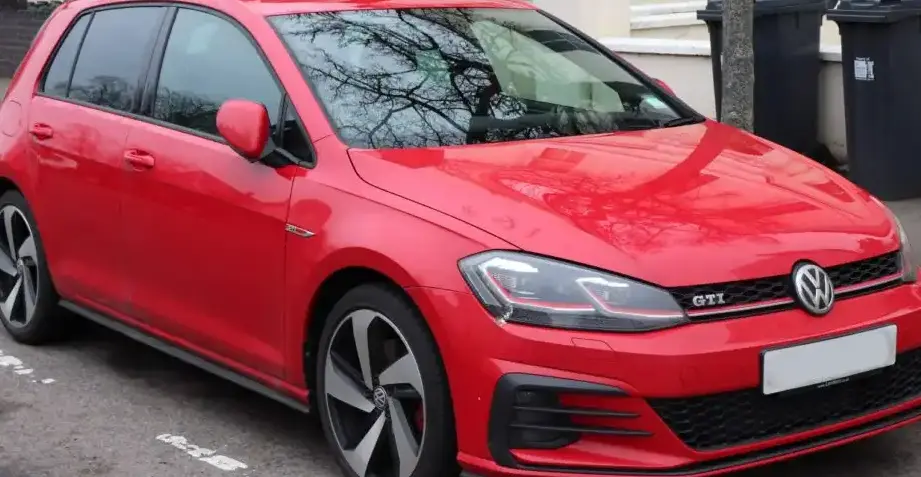
The Volkswagen Golf VII 1.4 TGI DSG, launched in 2013, was a key component of Volkswagen’s strategy to offer more environmentally friendly vehicle options. It utilized a 1.4-liter turbocharged engine modified to run on both gasoline and Compressed Natural Gas (CNG). This bi-fuel capability allowed drivers to switch between fuel sources depending on availability and cost, offering significant potential fuel savings in regions with established CNG infrastructure. The ‘TGI’ designation specifically denoted Volkswagen’s CNG models. This variant sat within the Golf VII range, which spanned a wide variety of engine and trim options, appealing to a broader customer base.
Powertrain & Engine Architecture
At the heart of the 1.4 TGI was the CPWA engine code, a 1.4-liter inline-four cylinder engine. This engine was a modified version of the standard 1.4 TSI (Turbocharged Stratified Injection) unit, adapted to accommodate CNG operation. The key difference lay in the fuel injection system, which incorporated separate injectors for both gasoline and CNG. When running on CNG, the engine management system automatically adjusted parameters to optimize combustion for the different fuel characteristics. The engine employed direct injection for both fuel types, enhancing efficiency and reducing emissions. The turbocharger, a crucial component for boosting power output, was a single-scroll unit. The 7-speed DSG (Direct-Shift Gearbox) automatic transmission was standard, providing smooth and efficient gear changes. This transmission featured two clutches, allowing for quicker shifts and improved fuel economy compared to traditional automatic transmissions.
Driving Characteristics
The 110 hp output and 200 Nm (147 lb-ft) of torque delivered by the 1.4 TGI DSG resulted in a driving experience that prioritized fuel efficiency over outright performance. Acceleration from 0-60 mph took around 10.4 seconds, and top speed was 120.55 mph. Compared to the 1.4 TSI petrol version, the TGI offered similar performance, but with a noticeable difference in power delivery when running on CNG. The DSG transmission was well-matched to the engine, providing responsive shifts and helping to keep the engine within its optimal power band. While not as sporty as the Golf GTI or even the higher-output TSI models, the 1.4 TGI offered a comfortable and refined driving experience suitable for everyday commuting and longer journeys. The gear ratios were tuned for economy, meaning the engine could feel slightly strained when accelerating hard or climbing hills.
Equipment & Trim Levels
The 1.4 TGI DSG typically came with a reasonable level of standard equipment. This included air conditioning, power windows, central locking, and an infotainment system with a touchscreen display. Safety features such as ABS, ESP (Electronic Stability Program), and multiple airbags were also standard. Interior upholstery was typically cloth, with options for upgraded materials available. Trim levels varied depending on the market, but common options included alloy wheels, parking sensors, and a multi-function steering wheel. The CNG tank, typically located under the floor in the spare wheel well, reduced luggage capacity compared to the standard Golf, but the rear seats still folded down to provide additional space.
Chassis & Braking
The Golf VII 1.4 TGI utilized the standard Golf VII chassis and suspension setup. This consisted of independent suspension at the front (MacPherson struts) and a multi-link suspension at the rear. The braking system featured ventilated discs at the front and solid discs at the rear. ABS (Anti-lock Braking System) was standard, providing enhanced braking performance and stability. The suspension was tuned for comfort, providing a smooth ride over most road surfaces. Stabilizer bars were fitted to both the front and rear axles to reduce body roll during cornering.
Market Reception & Comparison
The Golf VII 1.4 TGI was generally well-received by critics, particularly for its fuel efficiency and environmental credentials. However, its higher purchase price compared to the standard petrol models and the limited availability of CNG refueling stations were often cited as drawbacks. Compared to the 1.4 TSI petrol version, the TGI offered comparable performance but with lower running costs in regions where CNG was readily available and competitively priced. The 1.4 TGI was also positioned as a more economical alternative to the diesel-powered Golf models, offering lower CO2 emissions and reduced reliance on fossil fuels.
Legacy
The Volkswagen Golf VII 1.4 TGI represents an important step in Volkswagen’s development of alternative fuel vehicles. While CNG infrastructure hasn’t expanded as rapidly as initially anticipated in some markets, the 1.4 TGI remains a viable option for environmentally conscious drivers. The CPWA engine, when properly maintained, is generally considered reliable. Common issues include those associated with the turbocharger and fuel injection system, but these are not unique to the TGI variant. On the used car market, the 1.4 TGI typically commands a slightly lower price than comparable petrol or diesel models, reflecting the limited demand for CNG vehicles. However, its fuel efficiency and lower running costs can make it an attractive option for those with access to CNG refueling stations.