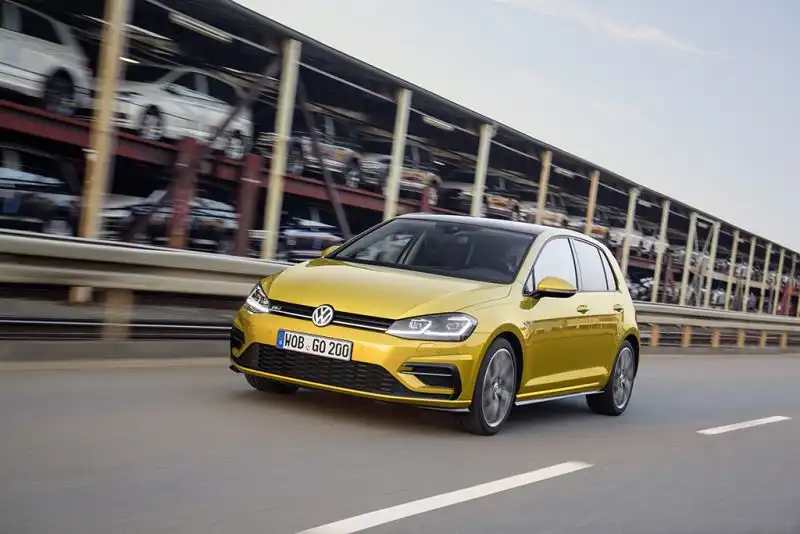
The Volkswagen Golf VII, specifically the 5-door hatchback produced from 2017 to 2019 with the 1.0 TSI 110 horsepower engine and a 7-speed dual-clutch gearbox (DSG), represents a significant iteration in the Golf lineage. This variant arrived as part of the facelift for the seventh-generation Golf (Mk7), known internally as the 5G model. Positioned as an entry-level to mid-range offering, it aimed to provide a balance of fuel efficiency, modern technology, and everyday usability within the broader Golf lineup. It was primarily marketed in Europe and other global markets where smaller displacement, turbocharged engines were gaining popularity due to tightening emissions regulations and consumer demand for fuel economy.
Technical Specifications
| Brand | Volkswagen |
| Model | Golf |
| Generation | Golf VII (5-door, facelift 2017) |
| Type (Engine) | 1.0 TSI (110 Hp) DSG |
| Start of production | 2017 |
| End of production | 2019 |
| Powertrain Architecture | Internal Combustion engine |
| Body type | Hatchback |
| Seats | 5 |
| Doors | 5 |
| Fuel consumption (urban) | 5.6-5.7 l/100 km (42 – 41.3 US mpg) |
| Fuel consumption (extra urban) | 4.2-4.3 l/100 km (56 – 54.7 US mpg) |
| Fuel consumption (combined) | 4.7-4.8 l/100 km (50 – 49 US mpg) |
| CO2 emissions | 107-109 g/km |
| Fuel Type | Petrol (Gasoline) |
| Acceleration 0 – 100 km/h | 9.9 sec |
| Acceleration 0 – 62 mph | 9.9 sec |
| Acceleration 0 – 60 mph | 9.4 sec |
| Maximum speed | 196 km/h (121.79 mph) |
| Emission standard | Euro 6 |
| Weight-to-power ratio | 10.6 kg/Hp |
| Weight-to-torque ratio | 5.8 kg/Nm |
| Power | 110 Hp @ 5000-5500 rpm |
| Torque | 200 Nm @ 2000-3500 rpm (147.51 lb.-ft. @ 2000-3500 rpm) |
| Engine layout | Front, Transverse |
| Engine Model/Code | CHZC |
| Engine displacement | 999 cm3 (60.96 cu. in.) |
| Number of cylinders | 3 |
| Engine configuration | Inline |
| Number of valves per cylinder | 4 |
| Fuel injection system | Direct injection |
| Engine aspiration | Turbocharger, Intercooler |
| Engine oil capacity | 4 l (4.23 US qt | 3.52 UK qt) |
| Kerb Weight | 1161 kg (2559.57 lbs.) |
| Max. weight | 1740 kg (3836.04 lbs.) |
| Max load | 579 kg (1276.48 lbs.) |
| Trunk (boot) space – minimum | 380 l (13.42 cu. ft.) |
| Trunk (boot) space – maximum | 1270 l (44.85 cu. ft.) |
| Fuel tank capacity | 50 l (13.21 US gal | 11 UK gal) |
| Max. roof load | 75 kg (165.35 lbs.) |
| Permitted trailer load with brakes (8%) | 1500 kg (3306.93 lbs.) |
| Permitted trailer load with brakes (12%) | 1300 kg (2866.01 lbs.) |
| Permitted trailer load without brakes | 610 kg (1344.82 lbs.) |
| Permitted towbar download | 80 kg (176.37 lbs.) |
| Length | 4258 mm (167.64 in.) |
| Width | 1799 mm (70.83 in.) |
| Height | 1492 mm (58.74 in.) |
| Wheelbase | 2620 mm (103.15 in.) |
| Front track | 1549 mm (60.98 in.) |
| Rear (Back) track | 1521 mm (59.88 in.) |
| Minimum turning circle | 10.9 m (35.76 ft.) |
| Drive wheel | Front wheel drive |
| Number of gears and type of gearbox | 7 gears, automatic transmission DSG |
| Front brakes | Ventilated discs |
| Rear brakes | Disc |
| Tires size | 205/55 R16 |
| Wheel rims size | 6.5 J x 16 |
INTRODUCTION
The 1.0 TSI with DSG transmission was introduced with the 2017 facelift of the Golf VII. This version aimed to broaden the Golf’s appeal by offering a more affordable and fuel-efficient option. The Mk7 Golf, built on the Volkswagen Group’s MQB platform (A7 chassis), had already established itself as a benchmark in the compact class. The facelift brought styling updates, improved technology, and a revised engine range, with the 1.0 TSI being a key part of that strategy. This variant occupied the lower end of the performance spectrum, serving as an alternative to the more powerful 1.4 TSI and 1.8 TSI models, as well as the diesel options.
Powertrain & Engine Architecture
The heart of this Golf variant is the CHZC engine, a 999cc, three-cylinder turbocharged gasoline engine. This engine is part of Volkswagen’s EA211 family, known for its compact size and efficiency. The CHZC utilizes direct fuel injection, delivering fuel directly into the combustion chamber for improved combustion efficiency and reduced emissions. It also features an intercooler to cool the intake air, increasing its density and further enhancing performance. The turbocharger, a key component, provides a significant boost in power despite the engine’s small displacement. The 7-speed DSG (Direct-Shift Gearbox) is a dual-clutch transmission that offers quick and smooth gear changes, contributing to both performance and fuel economy. The DSG operates with two separate clutches, allowing for pre-selection of the next gear, resulting in near-seamless shifts.
Driving Characteristics
The 1.0 TSI 110 hp/DSG combination delivers adequate performance for everyday driving. While not particularly sporty, it provides sufficient power for merging onto highways and overtaking slower traffic. Acceleration from 0 to 60 mph takes approximately 9.4 seconds, and the top speed is around 122 mph. The DSG transmission is well-tuned, providing responsive shifts and keeping the engine within its optimal power band. Compared to the more powerful Golf variants, this version feels less eager to accelerate, but it compensates with significantly better fuel economy. The gear ratios are optimized for efficiency, with taller gearing in higher gears to reduce engine speed at cruising speeds. The three-cylinder engine can be a bit rougher in its operation compared to the four-cylinder engines, but this is generally well-damped by the vehicle’s sound insulation.
Equipment & Trim Levels
The 1.0 TSI DSG Golf typically came equipped with a reasonable level of standard features. These generally included air conditioning, a touchscreen infotainment system with Bluetooth connectivity, alloy wheels, and a suite of safety features such as ABS, ESC (Electronic Stability Control), and multiple airbags. Higher trim levels, such as Comfortline and Highline, added features like automatic climate control, parking sensors, a larger touchscreen display, and more premium interior materials. Optional extras included a panoramic sunroof, adaptive cruise control, and a navigation system. Interior upholstery was typically cloth, with leather options available on higher trims.
Chassis & Braking
The Golf VII’s chassis is well-engineered, providing a comfortable and controlled ride. The front suspension utilizes MacPherson struts, while the rear suspension employs a multi-link setup. This configuration offers a good balance between ride comfort and handling precision. The 1.0 TSI models typically featured disc brakes on all four wheels, providing adequate stopping power. ABS (Anti-lock Braking System) and ESC (Electronic Stability Control) were standard, enhancing safety and stability. The suspension tuning was generally softer on the 1.0 TSI models compared to the higher-performance variants, prioritizing comfort over outright handling.
Market Reception & Comparison
The 1.0 TSI DSG Golf was generally well-received by critics as a practical and economical option. It was praised for its fuel efficiency and comfortable ride. However, some reviewers noted that the engine could feel strained when fully loaded or driving uphill. Compared to the 1.4 TSI, the 1.0 TSI offered lower running costs but less performance. The 1.8 TSI provided a more engaging driving experience but at the expense of fuel economy. The diesel variants offered even better fuel economy but faced increasing scrutiny due to emissions concerns. The 1.0 TSI struck a balance, appealing to buyers who prioritized efficiency and affordability.
Legacy
The 1.0 TSI engine has proven to be a relatively reliable powertrain, although some owners have reported issues with the turbocharger and direct injection system. Regular maintenance, including oil changes and timely replacement of wear items, is crucial for ensuring long-term reliability. In the used car market, the 1.0 TSI DSG Golf represents a good value proposition, offering a well-equipped and fuel-efficient compact hatchback at an affordable price. Its popularity has contributed to a relatively strong resale value, making it a sensible choice for budget-conscious buyers.