Technical Specifications
| Brand | Volkswagen |
| Model | Golf |
| Generation | Golf VII (5-door, facelift 2017) |
| Type (Engine) | 1.4 TGI (110 Hp) Blue Motion DGS |
| Start of production | 2017 |
| End of production | May, 2018 |
| Powertrain Architecture | Internal Combustion engine |
| Body type | Hatchback |
| Seats | 5 |
| Doors | 5 |
| Fuel consumption (urban) | 6.6 l/100 km (35.6 US mpg, 42.8 UK mpg, 15.2 km/l) |
| Fuel consumption (urban CNG) | 4.4 kg/100 km |
| Fuel consumption (extra urban) | 4.6 l/100 km (51.1 US mpg, 61.4 UK mpg, 21.7 km/l) |
| Fuel consumption (extra urban CNG) | 3.1 kg/100 km |
| Fuel consumption (combined) | 5.3 l/100 km (44.4 US mpg, 53.3 UK mpg, 18.9 km/l) |
| Fuel consumption (combined CNG) | 3.5 kg/100 km |
| CO2 emissions | 122 g/km |
| CO2 emissions (CNG) | 95 g/km |
| Fuel Type | Petrol / CNG |
| Acceleration 0 – 100 km/h | 10.6 sec |
| Acceleration 0 – 62 mph | 10.6 sec |
| Acceleration 0 – 60 mph | 10.1 sec |
| Maximum speed | 195 km/h (121.17 mph) |
| Emission standard | Euro 6 |
| Weight-to-power ratio | 11.5 kg/Hp, 87.2 Hp/tonne |
| Weight-to-torque ratio | 6.3 kg/Nm, 158.6 Nm/tonne |
| Power | 110 Hp @ 4800-6000 rpm |
| Power per litre | 78.9 Hp/l |
| Torque | 200 Nm @ 1500-3500 rpm (147.51 lb.-ft. @ 1500-3500 rpm) |
| Engine layout | Front, Transverse |
| Engine Model/Code | CPWA, CZBA |
| Engine displacement | 1395 cm3 (85.13 cu. in.) |
| Number of cylinders | 4 |
| Engine configuration | Inline |
| Number of valves per cylinder | 4 |
| Fuel injection system | Direct injection |
| Engine aspiration | Turbocharger |
| Engine oil capacity | 4 l (4.23 US qt | 3.52 UK qt) |
| Kerb Weight | 1261 kg (2780.03 lbs.) |
| Max. weight | 1870 kg (4122.64 lbs.) |
| Max load | 609 kg (1342.62 lbs.) |
| Trunk (boot) space – minimum | 380 l (13.42 cu. ft.) |
| Trunk (boot) space – maximum | 1270 l (44.85 cu. ft.) |
| Fuel tank capacity | 50 l (13.21 US gal | 11 UK gal) |
| CNG cylinder capacity | 15 kg |
| Max. roof load | 75 kg (165.35 lbs.) |
| Permitted trailer load with brakes (8%) | 1700 kg (3747.86 lbs.) |
| Permitted trailer load with brakes (12%) | 1400 kg (3086.47 lbs.) |
| Permitted trailer load without brakes | 660 kg (1455.05 lbs.) |
| Permitted towbar download | 80 kg (176.37 lbs.) |
| Length | 4258 mm (167.64 in.) |
| Width | 1799 mm (70.83 in.) |
| Height | 1492 mm (58.74 in.) |
| Wheelbase | 2620 mm (103.15 in.) |
| Front track | 1549 mm (60.98 in.) |
| Rear (Back) track | 1521 mm (59.88 in.) |
| Minimum turning circle | 10.9 m (35.76 ft.) |
| Drivetrain Architecture | The Internal combustion engine (ICE) drives the front wheels. |
| Drive wheel | Front wheel drive |
| Number of gears and type of gearbox | 7 gears, automatic transmission DSG |
| Front brakes | Ventilated discs |
| Rear brakes | Disc |
| Assisting systems | ABS (Anti-lock braking system) |
| Steering type | Steering rack and pinion |
| Power steering | Electric Steering |
| Tires size | 205/55 R16 |
| Wheel rims size | 6 J x 15 |
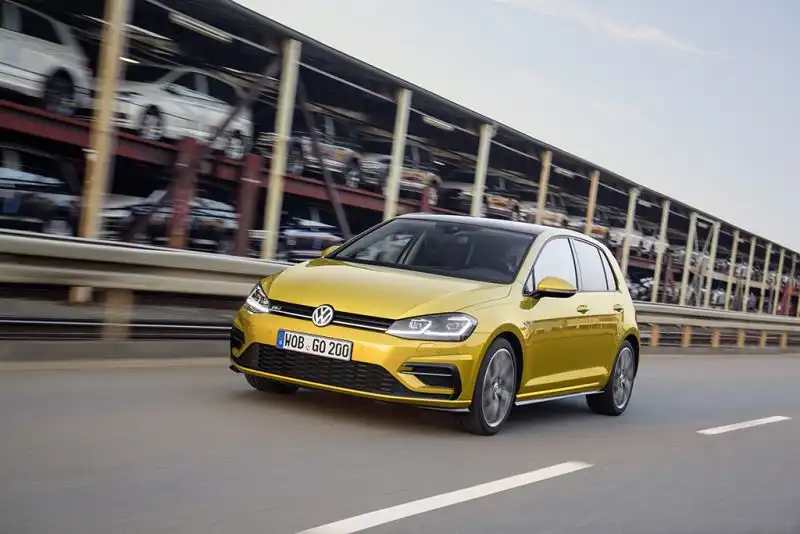
The Volkswagen Golf VII facelift, introduced in 2017, brought with it updated styling, enhanced technology, and refined engine options. The 1.4 TGI BlueMotion DGS variant was a key part of this update, offering a bi-fuel capability – running on either gasoline or compressed natural gas (CNG). This model was designed to appeal to environmentally conscious drivers and those seeking lower running costs, particularly in regions with established CNG refueling networks. The “TGI” designation signified Volkswagen’s natural gas vehicles, while “BlueMotion” denoted fuel-saving technologies. The DGS (Direkt-Schalt-Getriebe) transmission is Volkswagen’s marketing name for their 7-speed dual-clutch gearbox.
Powertrain & Engine Architecture
At the heart of the Golf 1.4 TGI BlueMotion DGS lies the CPWA or CZBA engine code, a 1.4-liter turbocharged inline-four cylinder engine. This engine utilizes direct fuel injection, a technology that improves combustion efficiency and power output. The turbocharger provides forced induction, boosting power and torque. The engine is specifically designed to run on both gasoline and CNG, with a switchover occurring automatically depending on fuel availability. When running on CNG, the engine management system adjusts parameters to optimize combustion for the alternative fuel. The 7-speed DSG transmission is a crucial component, offering quick and smooth gear changes. It features two clutches, allowing for pre-selection of the next gear, resulting in seamless shifts and improved fuel economy compared to a traditional automatic transmission.
Driving Characteristics
The 110 horsepower and 200 Nm (147 lb-ft) of torque produced by the 1.4 TGI engine, coupled with the 7-speed DSG, provided adequate performance for everyday driving. Acceleration from 0-60 mph took around 10.1 seconds, and the top speed was 195 km/h (121 mph). While not particularly sporty, the engine delivered a usable amount of power for merging onto highways and overtaking. The DSG transmission contributed to a responsive driving experience, with quick shifts and minimal torque interruption. Compared to the more powerful TSI variants, the 1.4 TGI felt less eager to accelerate, but it offered a smoother and more relaxed driving experience. The fuel economy benefits of running on CNG were significant, making it an attractive option for drivers covering high mileage.
Equipment & Trim Levels
The 1.4 TGI BlueMotion DGS typically came with a reasonable level of standard equipment. This included air conditioning, power windows, central locking, and an infotainment system with a touchscreen display. Safety features such as ABS, ESP (Electronic Stability Program), and multiple airbags were also standard. Higher trim levels offered additional features such as alloy wheels, parking sensors, a multi-function steering wheel, and upgraded upholstery. Optional extras included a navigation system, climate control, and a panoramic sunroof. Interior upholstery was typically cloth, with the option of leather upgrades on higher trims.
Chassis & Braking
The Golf VII chassis was well-regarded for its balance and handling. The 1.4 TGI BlueMotion DGS variant utilized a standard suspension setup, with MacPherson struts at the front and a multi-link suspension at the rear. The braking system consisted of ventilated discs at the front and solid discs at the rear. ABS (Anti-lock Braking System) was standard, providing enhanced braking performance and stability. The suspension was tuned for comfort, providing a smooth ride over most road surfaces. Stabilizer bars were fitted to both the front and rear axles to reduce body roll during cornering.
Market Reception & Comparison
The Golf 1.4 TGI BlueMotion DGS received generally positive reviews from automotive critics. It was praised for its fuel efficiency, smooth DSG transmission, and comfortable ride. However, some critics noted that the engine lacked the punch of the more powerful TSI variants. Compared to the 1.6 TDI diesel, the 1.4 TGI offered similar fuel economy but with the added benefit of lower emissions when running on CNG. The 1.4 TSI petrol engine provided more performance but at the cost of higher fuel consumption. The 1.4 TGI appealed to a niche market of drivers who prioritized fuel economy and environmental friendliness.
Legacy
The Volkswagen Golf VII 1.4 TGI BlueMotion DGS represents an interesting chapter in Volkswagen’s exploration of alternative fuels. While CNG infrastructure remains limited in many regions, the model demonstrated the potential for reducing emissions and running costs. These models, when well-maintained, have proven to be relatively reliable. The DSG transmission, while complex, is generally durable if serviced according to Volkswagen’s recommendations. On the used car market, these models often command a slightly lower price than their petrol or diesel counterparts, reflecting the limited availability of CNG refueling stations and the potential for higher maintenance costs associated with the bi-fuel system. However, for drivers with access to CNG, the 1.4 TGI BlueMotion DGS remains a compelling and economical choice.