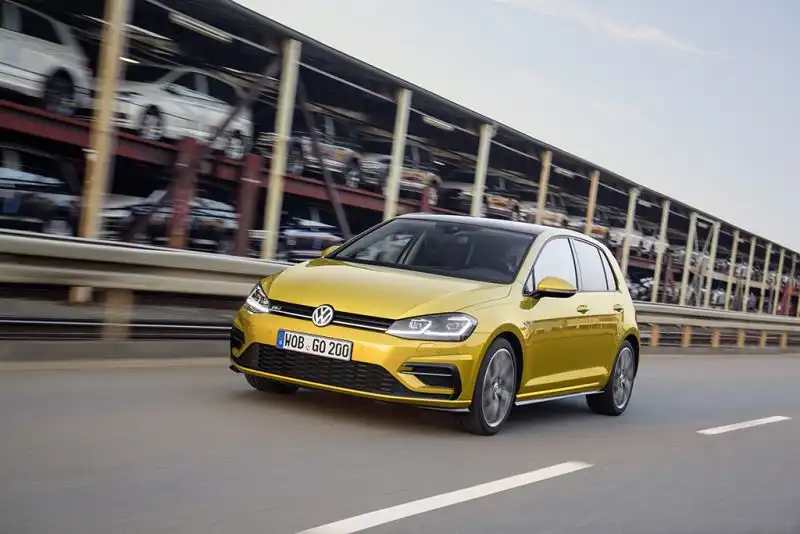
The Volkswagen Golf VII, specifically the 5-door hatchback produced during the 2017-2018 model years with the 1.4 TSI 125 horsepower engine paired with a 7-speed Dual Clutch Gearbox (DSG), represents a significant iteration of Volkswagen’s iconic compact car. This variant arrived as part of the facelift for the seventh generation (Mk7) Golf, known internally as the 5G model. Positioned as a mid-range offering, it aimed to balance fuel efficiency, everyday usability, and a more engaging driving experience than the base-level engine options. Production of this specific configuration was relatively short-lived, ending in March 2018, as Volkswagen continued to refine its engine lineup.
Technical Specifications
| Brand | Volkswagen |
| Model | Golf |
| Generation | Golf VII (5-door, facelift 2017) |
| Type (Engine) | 1.4 TSI (125 Hp) DSG |
| Start of production | 2017 |
| End of production | March, 2018 |
| Powertrain Architecture | Internal Combustion engine |
| Body type | Hatchback |
| Seats | 5 |
| Doors | 5 |
| Fuel consumption (urban) | 6.1-6.3 l/100 km (38.6 – 37.3 US mpg) |
| Fuel consumption (extra urban) | 4.3-4.5 l/100 km (54.7 – 52.3 US mpg) |
| Fuel consumption (combined) | 5.0-5.2 l/100 km (47 – 45.2 US mpg) |
| CO2 emissions | 116-121 g/km |
| Fuel Type | Petrol (Gasoline) |
| Acceleration 0 – 100 km/h | 9.1 sec |
| Acceleration 0 – 62 mph | 9.1 sec |
| Acceleration 0 – 60 mph | 8.6 sec |
| Maximum speed | 204 km/h (126.76 mph) |
| Emission standard | Euro 6 |
| Weight-to-power ratio | 9.6 kg/Hp |
| Weight-to-torque ratio | 6 kg/Nm |
| Power | 125 Hp @ 5000-6000 rpm |
| Torque | 200 Nm @ 1400-4000 rpm (147.51 lb.-ft. @ 1400-4000 rpm) |
| Engine layout | Front, Transverse |
| Engine Model/Code | CZCA |
| Engine displacement | 1395 cm3 (85.13 cu. in.) |
| Number of cylinders | 4 |
| Engine configuration | Inline |
| Number of valves per cylinder | 4 |
| Fuel injection system | Direct injection |
| Engine aspiration | Turbocharger, Intercooler |
| Engine oil capacity | 4 l (4.23 US qt | 3.52 UK qt) |
| Kerb Weight | 1195 kg (2634.52 lbs.) |
| Max. weight | 1770 kg (3902.18 lbs.) |
| Max load | 575 kg (1267.66 lbs.) |
| Trunk (boot) space – minimum | 380 l (13.42 cu. ft.) |
| Trunk (boot) space – maximum | 1270 l (44.85 cu. ft.) |
| Fuel tank capacity | 50 l (13.21 US gal | 11 UK gal) |
| Length | 4258 mm (167.64 in.) |
| Width | 1799 mm (70.83 in.) |
| Height | 1492 mm (58.74 in.) |
| Wheelbase | 2620 mm (103.15 in.) |
| Drive wheel | Front wheel drive |
| Number of gears and type of gearbox | 7 gears, automatic transmission DSG |
| Front brakes | Ventilated discs |
| Rear brakes | Disc |
| Tires size | 205/50 R17; 225/45 R17 |
Powertrain & Engine Architecture
The heart of this Golf variant is the 1.4-liter turbocharged four-cylinder engine, designated CZCA. This engine is part of Volkswagen’s EA211 engine family, known for its compact design and efficiency. The CZCA utilizes direct fuel injection, delivering fuel directly into the combustion chamber for improved combustion efficiency and reduced emissions. A single turbocharger with an intercooler provides forced induction, boosting power output. The engine features four valves per cylinder and a timing chain, contributing to its durability. The 125 horsepower peak is achieved between 5000 and 6000 rpm, while the 200 Nm (147.51 lb-ft) of torque is readily available from 1400 to 4000 rpm. This broad torque curve is a key characteristic of the engine, providing good responsiveness in everyday driving situations.
The engine is mated to a 7-speed Dual Clutch Gearbox (DSG). This transmission offers quick and smooth gear changes, enhancing both performance and fuel economy. The DSG operates in two clutches, pre-selecting the next gear for near-instantaneous shifts. The transmission’s gear ratios are tuned to prioritize fuel efficiency while still providing adequate acceleration.
Driving Characteristics
The 1.4 TSI 125 hp/DSG combination delivers a balanced driving experience. Acceleration from 0-60 mph takes approximately 8.6 seconds, making it adequately quick for most daily driving scenarios. While not as sporty as the Golf GTI or R models, it offers sufficient power for overtaking and merging onto highways. The DSG transmission contributes to a smooth and refined driving experience, with minimal hesitation during gear changes. The broad torque curve ensures that the engine feels responsive at lower speeds, making it easy to navigate city traffic. Compared to the 1.0 TSI engine, the 1.4 TSI offers a noticeable increase in power and torque, resulting in more confident acceleration. However, it doesn’t quite match the performance of the 1.8 TSI or diesel variants.
Equipment & Trim Levels
The 1.4 TSI 125 hp DSG Golf VII typically came equipped with a reasonable level of standard features. These included air conditioning, power windows, power mirrors, a touchscreen infotainment system with Bluetooth connectivity, and alloy wheels. Higher trim levels, such as Comfortline and Highline, added features like automatic climate control, parking sensors, rain-sensing wipers, and upgraded interior upholstery. Optional extras included a panoramic sunroof, navigation system, and advanced driver-assistance systems like adaptive cruise control and lane-keeping assist.
Chassis & Braking
The Golf VII utilizes a MacPherson strut front suspension and a multi-link rear suspension, providing a comfortable and controlled ride. The suspension is tuned to balance handling and comfort, making it suitable for a wide range of driving conditions. Braking duties are handled by ventilated discs at the front and solid discs at the rear. Anti-lock Braking System (ABS) is standard, enhancing safety during emergency braking situations. The steering is electrically assisted, providing a light and precise feel.
Market Reception & Comparison
The 1.4 TSI 125 hp DSG Golf VII was generally well-received by automotive critics. It was praised for its fuel efficiency, comfortable ride, and refined driving experience. However, some critics noted that the engine could feel slightly strained when fully loaded or driving uphill. Compared to the 1.6 TDI diesel variant, the 1.4 TSI offered slightly lower fuel economy but a more responsive engine. The 1.8 TSI provided more power but at a higher price point. The 1.4 TSI represented a sweet spot for many buyers seeking a balance between performance, economy, and price.
Legacy
The CZCA engine, when paired with the 7-speed DSG, has proven to be a relatively reliable powertrain. While some owners have reported minor issues with the DSG transmission, such as occasional jerky shifts, these are often addressed with software updates. The engine itself is generally robust, with good long-term durability. In the used car market, this Golf variant remains a popular choice due to its affordability, fuel efficiency, and practicality. It represents a well-rounded and dependable compact car that continues to offer good value for money.