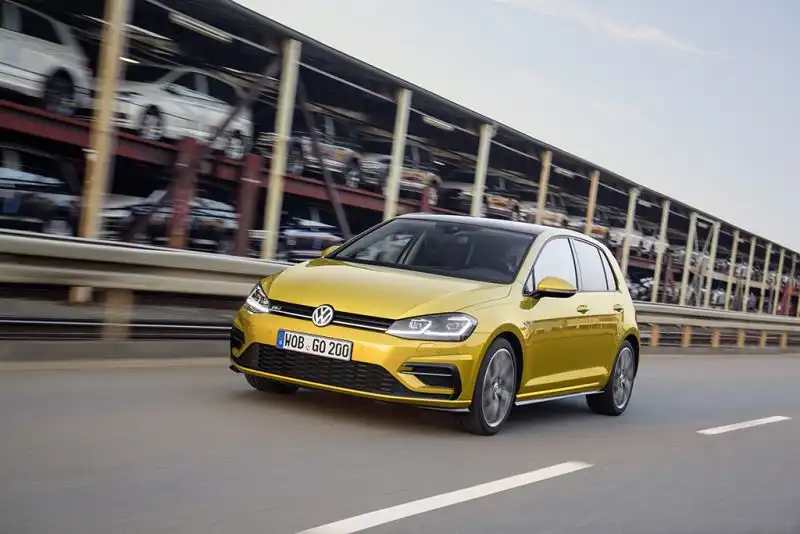
The Volkswagen Golf VII, specifically the 5-door hatchback produced from March 2017 to 2019, represents a significant mid-cycle refresh of the seventh-generation Golf. This variant, designated the 1.5 TSI ACT with 150 horsepower and a 7-speed dual-clutch transmission (DSG), occupied a key position in the Golf lineup, offering a balance of performance, fuel efficiency, and modern technology. It was designed to appeal to buyers seeking a refined and practical compact car with a more engaging driving experience than the base models, while remaining more accessible than the higher-performance GTI or diesel variants.
Technical Specifications
| Brand | Volkswagen |
| Model | Golf |
| Generation | Golf VII (5-door, facelift 2017) |
| Type (Engine) | 1.5 TSI ACT (150 Hp) DSG |
| Start of production | March, 2017 |
| End of production | 2019 |
| Powertrain Architecture | Internal Combustion engine |
| Body type | Hatchback |
| Seats | 5 |
| Doors | 5 |
| Fuel consumption (urban) | 6.6-6.9 l/100 km (35.6 – 34.1 US mpg, 42.8 – 40.9 UK mpg, 15.2 – 14.5 km/l) |
| Fuel consumption (extra urban) | 4.3-4.5 l/100 km (54.7 – 52.3 US mpg, 65.7 – 62.8 UK mpg, 23.3 – 22.2 km/l) |
| Fuel consumption (combined) | 5.1-5.2 l/100 km (46.1 – 45.2 US mpg, 55.4 – 54.3 UK mpg, 19.6 – 19.2 km/l) |
| CO2 emissions | 116-119 g/km |
| Fuel Type | Petrol (Gasoline) |
| Acceleration 0 – 100 km/h | 8.3 sec |
| Acceleration 0 – 62 mph | 8.3 sec |
| Acceleration 0 – 60 mph | 7.9 sec |
| Maximum speed | 216 km/h (134.22 mph) |
| Emission standard | Euro 6d-TEMP |
| Weight-to-power ratio | 8.9 kg/Hp, 111.9 Hp/tonne |
| Weight-to-torque ratio | 5.4 kg/Nm, 186.6 Nm/tonne |
| Power | 150 Hp |
| Power per litre | 100.1 Hp/l |
| Torque | 250 Nm @ 1500-3500 rpm (184.39 lb.-ft. @ 1500-3500 rpm) |
| Engine layout | Front, Transverse |
| Engine Model/Code | EA211evo / DADA |
| Engine displacement | 1498 cm3 (91.41 cu. in.) |
| Number of cylinders | 4 |
| Engine configuration | Inline |
| Number of valves per cylinder | 4 |
| Fuel injection system | Direct injection |
| Engine aspiration | Turbocharger, Intercooler |
| Engine oil capacity | 4.3 l (4.54 US qt | 3.78 UK qt) |
| Kerb Weight | 1340 kg (2954.19 lbs.) |
| Max. weight | 1830 kg (4034.46 lbs.) |
| Max load | 490 kg (1080.27 lbs.) |
| Trunk (boot) space – minimum | 380 l (13.42 cu. ft.) |
| Trunk (boot) space – maximum | 1270 l (44.85 cu. ft.) |
| Fuel tank capacity | 50 l (13.21 US gal | 11 UK gal) |
| Max. roof load | 75 kg (165.35 lbs.) |
| Permitted trailer load with brakes (8%) | 1700 kg (3747.86 lbs.) |
| Permitted trailer load with brakes (12%) | 1500 kg (3306.93 lbs.) |
| Permitted trailer load without brakes | 670 kg (1477.1 lbs.) |
| Permitted towbar download | 80 kg (176.37 lbs.) |
| Length | 4258 mm (167.64 in.) |
| Width | 1790-1799 mm (70.47 – 70.83 in.) |
| Width including mirrors | 2027 mm (79.8 in.) |
| Height | 1492 mm (58.74 in.) |
| Wheelbase | 2620 mm (103.15 in.) |
| Front track | 1533-1549 mm (60.35 – 60.98 in.) |
| Rear (Back) track | 1504-1521 mm (59.21 – 59.88 in.) |
| Ride height (ground clearance) | 142 mm (5.59 in.) |
| Minimum turning circle (turning diameter) | 10.9 m (35.76 ft.) |
| Drive wheel | Front wheel drive |
| Number of gears and type of gearbox | 7 gears, automatic transmission DSG |
| Assisting systems | ABS (Anti-lock braking system) |
| Steering type | Steering rack and pinion |
| Power steering | Electric Steering |
| Tires size | 205/50 R17; 225/45 R17 |
| Wheel rims size | 6J x 17; 7J x 17 |
INTRODUCTION
The 1.5 TSI ACT engine, introduced in the Golf VII facelift, represented a move towards greater efficiency and refinement. “ACT” stands for Active Cylinder Technology, a key feature of this engine. This system allows the engine to deactivate two cylinders under light load conditions, effectively running as a two-cylinder engine to reduce fuel consumption. The 1.5 TSI replaced the older 1.4 TSI engine in many markets, offering improved power and torque figures alongside better fuel economy. Paired with the 7-speed DSG, this variant aimed to provide a smooth and responsive driving experience suitable for daily commuting and longer journeys.
Powertrain & Engine Architecture
The heart of this Golf variant is the EA211evo 1.5-liter inline-four cylinder gasoline engine, specifically coded DADA. This engine utilizes direct fuel injection, delivering fuel directly into the combustion chamber for improved efficiency and reduced emissions. The engine also features a turbocharger with an intercooler, providing a boost in power and torque. The Active Cylinder Technology (ACT) is a crucial element, employing a dedicated camshaft follower switching mechanism to deactivate cylinders 2 and 3 when appropriate. This is determined by a complex algorithm based on engine load, speed, and driver input. The 7-speed DSG (Direct-Shift Gearbox) is a dual-clutch transmission known for its quick and seamless gear changes. It operates by pre-selecting the next gear, allowing for near-instantaneous shifts and contributing to both performance and fuel efficiency. The DSG in this application is tuned for a balance between comfort and responsiveness.
Driving Characteristics
The 150 horsepower and 250 Nm (184 lb-ft) of torque delivered by the 1.5 TSI engine, combined with the 7-speed DSG, provide a surprisingly capable driving experience. Acceleration from 0 to 60 mph takes approximately 7.9 seconds, making it competitive within its class. The DSG transmission ensures smooth and quick gear changes, enhancing the overall responsiveness. While not as overtly sporty as the Golf GTI, the 1.5 TSI offers ample power for everyday driving and overtaking maneuvers. The ACT system is generally seamless in operation, with minimal noticeable transition between four and two-cylinder modes. Compared to the lower-powered 1.0 TSI engine, the 1.5 TSI provides a more confident and relaxed driving experience, particularly when fully loaded or on highway journeys. Compared to the manual transmission versions, the DSG offers convenience and potentially slightly improved fuel economy, but some drivers may prefer the greater control offered by a manual gearbox.
Equipment & Trim Levels
The 1.5 TSI ACT DSG variant typically came equipped with a generous level of standard features. These included air conditioning, a touchscreen infotainment system with App-Connect (Apple CarPlay and Android Auto), alloy wheels, and a suite of safety features such as ABS, ESC (Electronic Stability Control), and multiple airbags. Higher trim levels, such as Comfortline and Highline, added features like automatic climate control, rain-sensing wipers, parking sensors, and upgraded interior upholstery. Optional extras included a panoramic sunroof, adaptive cruise control, and a premium sound system. Interior upholstery was typically cloth on base models, with leather options available on higher trims.
Chassis & Braking
The Golf VII’s chassis is a well-engineered platform known for its balanced handling and ride comfort. The 1.5 TSI variant typically featured independent suspension on all four wheels, with MacPherson struts at the front and a multi-link setup at the rear. Braking systems generally consisted of ventilated disc brakes at the front and either disc or drum brakes at the rear, depending on the trim level. The steering is a precise and responsive electric power steering system. Stabilizer bars were fitted to both the front and rear axles to reduce body roll during cornering.
Market Reception & Comparison
The 1.5 TSI ACT DSG Golf was generally well-received by automotive critics. It was praised for its fuel efficiency, refined engine, and smooth-shifting DSG transmission. Critics noted that the ACT system worked effectively, providing a noticeable improvement in fuel economy without significantly compromising driving experience. Compared to the 1.0 TSI, the 1.5 TSI offered a more substantial power boost, making it a more versatile option for a wider range of driving conditions. Compared to the diesel variants, the 1.5 TSI offered a quieter and smoother driving experience, although it typically didn’t achieve the same level of fuel economy. Reliability reports have generally been positive, with the EA211evo engine proving to be a robust and dependable unit.
Legacy
The 1.5 TSI ACT engine has become a mainstay in the Volkswagen Group’s lineup, powering a wide range of models across various brands. The Golf VII 1.5 TSI ACT DSG remains a popular choice in the used car market, offering a compelling combination of practicality, efficiency, and driving enjoyment. The engine’s relatively simple design and robust construction contribute to its long-term reliability. While some early versions experienced minor issues with particulate filters, these were largely addressed through software updates. Today, this variant represents a well-rounded and dependable option for buyers seeking a refined and fuel-efficient compact hatchback.