Technical Specifications
| Brand | Volkswagen |
| Model | Golf |
| Generation | Golf VII (5-door, facelift 2017) |
| Type (Engine) | 1.6 TDI (115 Hp) DSG |
| Start of production | April, 2017 |
| End of production | 2019 |
| Powertrain Architecture | Internal Combustion engine |
| Body type | Hatchback |
| Seats | 5 |
| Doors | 5 |
| Fuel consumption (urban) | 4.1-4.2 l/100 km (57.4 – 56 US mpg, 68.9 – 67.3 UK mpg, 24.4 – 23.8 km/l) |
| Fuel consumption (extra urban) | 3.8-3.9 l/100 km (61.9 – 60.3 US mpg, 74.3 – 72.4 UK mpg, 26.3 – 25.6 km/l) |
| Fuel consumption (combined) | 3.9-4.0 l/100 km (60.3 – 58.8 US mpg, 72.4 – 70.6 UK mpg, 25.6 – 25 km/l) |
| CO2 emissions | 102-105 g/km |
| Fuel Type | Diesel |
| Acceleration 0 – 100 km/h | 10.5 sec |
| Acceleration 0 – 62 mph | 10.5 sec |
| Acceleration 0 – 60 mph | 10 sec |
| Maximum speed | 198 km/h (123.03 mph) |
| Emission standard | Euro 6 |
| Weight-to-power ratio | 10.8 kg/Hp, 92.3 Hp/tonne |
| Weight-to-torque ratio | 5 kg/Nm, 200.6 Nm/tonne |
| Power | 115 Hp @ 3250-4000 rpm |
| Power per litre | 72 Hp/l |
| Torque | 250 Nm @ 1500-3200 rpm (184.39 lb.-ft. @ 1500-3200 rpm) |
| Engine layout | Front, Transverse |
| Engine Model/Code | DDYA, DGTE |
| Engine displacement | 1598 cm3 (97.52 cu. in.) |
| Number of cylinders | 4 |
| Engine configuration | Inline |
| Number of valves per cylinder | 4 |
| Fuel injection system | Diesel Commonrail |
| Engine aspiration | Turbocharger, Intercooler |
| Engine oil capacity | 4.7 l (4.97 US qt | 4.14 UK qt) |
| Kerb Weight | 1246 kg (2746.96 lbs.) |
| Max. weight | 1820 kg (4012.41 lbs.) |
| Max load | 574 kg (1265.45 lbs.) |
| Trunk (boot) space – minimum | 380 l (13.42 cu. ft.) |
| Trunk (boot) space – maximum | 1270 l (44.85 cu. ft.) |
| Fuel tank capacity | 50 l (13.21 US gal | 11 UK gal) |
| Max. roof load | 75 kg (165.35 lbs.) |
| Permitted trailer load with brakes (8%) | 1800 kg (3968.32 lbs.) |
| Permitted trailer load with brakes (12%) | 1500 kg (3306.93 lbs.) |
| Permitted trailer load without brakes | 660 kg (1455.05 lbs.) |
| Permitted towbar download | 80 kg (176.37 lbs.) |
| Length | 4258 mm (167.64 in.) |
| Width | 1799 mm (70.83 in.) |
| Height | 1492 mm (58.74 in.) |
| Wheelbase | 2620 mm (103.15 in.) |
| Front track | 1549 mm (60.98 in.) |
| Rear (Back) track | 1521 mm (59.88 in.) |
| Minimum turning circle | 10.9 m (35.76 ft.) |
| Drivetrain Architecture | The Internal combustion engine (ICE) drives the front wheels of the vehicle. |
| Drive wheel | Front wheel drive |
| Number of gears and type of gearbox | 7 gears, automatic transmission DSG |
| Front brakes | Ventilated discs |
| Rear brakes | Disc |
| Assisting systems | ABS (Anti-lock braking system) |
| Steering type | Steering rack and pinion |
| Power steering | Electric Steering |
| Tires size | 205/55 R16 |
| Wheel rims size | 6.5 J x 16 |
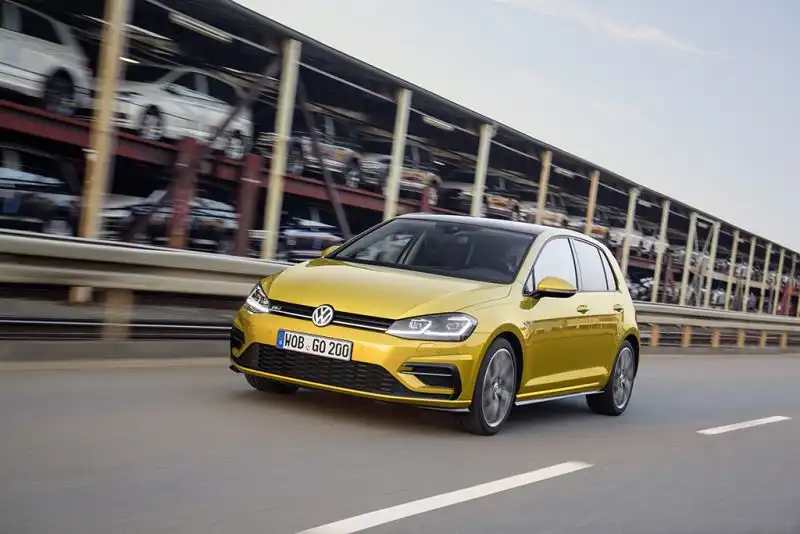
The 2017-2019 Volkswagen Golf VII 1.6 TDI 115 hp DSG is a front-wheel-drive, five-door hatchback that formed a crucial part of Volkswagen’s European lineup. Following the mid-life facelift of the Mk7 Golf, this variant offered a balance between affordability, fuel economy, and practicality. It was positioned as an entry-to-mid-range option, appealing to buyers seeking a comfortable and efficient daily driver. The use of the 1.6-liter diesel engine, coupled with the 7-speed DSG transmission, aimed to provide a smooth and economical driving experience. This model benefitted from the improvements made during the facelift, including updated infotainment systems and revised styling cues.
Powertrain & Engine Architecture
At the heart of this Golf variant lies the 1.6-liter, four-cylinder diesel engine, identified by engine codes DDYA or DGTE. This engine utilizes a common rail direct injection system, delivering fuel directly into the combustion chamber at extremely high pressure. This technology, combined with a turbocharger and intercooler, optimizes combustion for improved power and efficiency. The engine features four valves per cylinder and a timing belt. The 1.6 TDI engine is known for its relatively quiet operation compared to some older diesel designs. The 7-speed DSG (Direct-Shift Gearbox) is a dual-clutch transmission that provides quick and seamless gear changes. It operates similarly to a manual transmission but without the need for a clutch pedal, offering both automatic and manual shifting modes. The DSG’s programming is tuned for fuel efficiency and smooth acceleration.
Driving Characteristics
The 115 hp and 250 Nm (184 lb-ft) of torque produced by the 1.6 TDI engine provide adequate performance for everyday driving. Acceleration from 0-62 mph takes approximately 10.5 seconds, and the top speed is 198 km/h (123 mph). While not a particularly sporty configuration, the DSG transmission helps to maximize the available power, providing responsive acceleration in most situations. Compared to the more powerful Golf variants, such as those equipped with the 2.0 TDI or petrol engines, the 1.6 TDI feels less eager to accelerate, particularly when fully loaded. However, the DSG transmission’s quick shifts help to mitigate this. The gear ratios are optimized for fuel efficiency, with higher gears engaged at lower speeds. The ride quality is generally comfortable, thanks to the Golf’s well-tuned suspension.
Equipment & Trim Levels
The Golf VII 1.6 TDI 115 hp DSG typically came equipped with a reasonable level of standard equipment. This included air conditioning, electric front windows, power-adjustable and heated door mirrors, a touchscreen infotainment system with Bluetooth connectivity, and alloy wheels. Higher trim levels, such as Comfortline and Highline, added features like automatic climate control, parking sensors, rain-sensing wipers, and upgraded upholstery. Optional extras included a panoramic sunroof, navigation system, and adaptive cruise control. Interior upholstery was typically cloth, with leather options available on higher trims. The dashboard layout was clean and functional, with a focus on ergonomics.
Chassis & Braking
The Golf VII 1.6 TDI utilizes a MacPherson strut front suspension and a multi-link rear suspension, providing a good balance between ride comfort and handling. The braking system consists of ventilated discs on the front wheels and solid discs on the rear. Anti-lock Braking System (ABS) is standard, along with Electronic Stability Control (ESC). The suspension is tuned to provide a comfortable ride, but it also offers decent body control in corners. The steering is precise and responsive, providing good feedback to the driver. The weight distribution is well-balanced, contributing to the Golf’s stable handling characteristics.
Market Reception & Comparison
The Golf VII 1.6 TDI DSG was generally well-received by automotive critics. It was praised for its fuel efficiency, comfortable ride, and refined driving experience. However, some critics noted that the engine could feel underpowered, particularly when carrying passengers or luggage. Compared to the 2.0 TDI variants, the 1.6 TDI offered lower running costs but sacrificed some performance. Against petrol-powered Golfs, it provided superior fuel economy but a less engaging driving experience. The DSG transmission was also a point of discussion, with some drivers preferring the simplicity and reliability of a manual gearbox. Fuel economy figures consistently hovered around 3.9-4.0 l/100km, making it a very economical choice for long-distance driving.
Legacy
The 1.6 TDI engine, while generally reliable, has been subject to some scrutiny regarding emissions and potential issues with the diesel particulate filter (DPF). Regular maintenance, including oil changes and DPF regeneration, is crucial for ensuring long-term reliability. The DSG transmission, while offering smooth and quick shifts, can be more expensive to repair than a traditional manual gearbox. In the used car market, the Golf VII 1.6 TDI DSG remains a popular choice, particularly for buyers seeking an affordable and fuel-efficient hatchback. Its reputation for reliability and practicality continues to make it a desirable option, though potential buyers should be aware of the potential maintenance costs associated with the diesel particulate filter and DSG transmission.