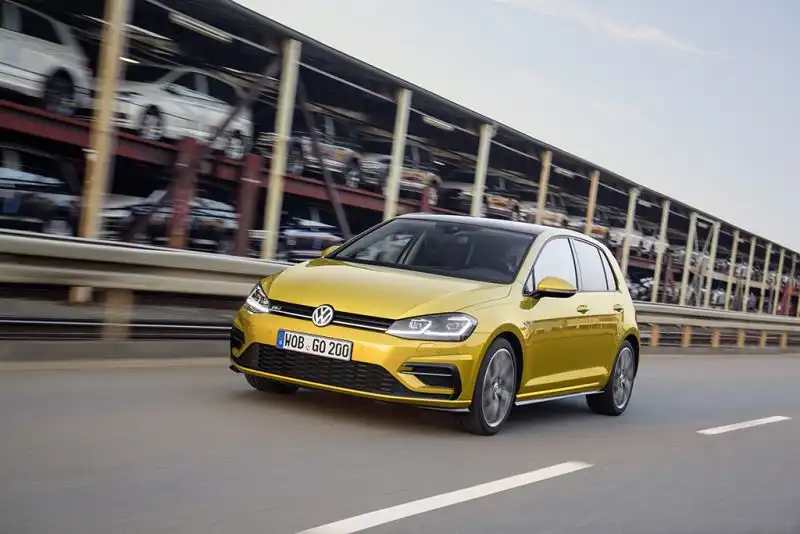
The Volkswagen Golf VII, specifically the 5-door hatchback produced from 2017 to 2019, represented a significant mid-cycle refresh of the seventh-generation Golf. Among the various engine and drivetrain configurations offered, the 2.0 TDI 150 hp model with 4MOTION all-wheel drive occupied a prominent position as a practical and capable all-weather performer. This variant aimed to balance fuel efficiency with respectable performance, appealing to buyers seeking a versatile compact car. It built upon the established Golf platform (PQ25/A7) known for its refinement and build quality.
Technical Specifications
| Brand | Volkswagen |
| Model | Golf |
| Generation | Golf VII (5-door, facelift 2017) |
| Type (Engine) | 2.0 TDI (150 Hp) 4MOTION |
| Start of production | 2017 |
| End of production | 2019 |
| Powertrain Architecture | Internal Combustion engine |
| Body type | Hatchback |
| Seats | 5 |
| Doors | 5 |
| Fuel consumption (urban) | 5.8-5.9 l/100 km (40.6 – 39.9 US mpg, 48.7 – 47.9 UK mpg, 17.2 – 16.9 km/l) |
| Fuel consumption (extra urban) | 4.2-4.3 l/100 km (56 – 54.7 US mpg, 67.3 – 65.7 UK mpg, 23.8 – 23.3 km/l) |
| Fuel consumption (combined) | 4.8-4.9 l/100 km (49 – 48 US mpg, 58.9 – 57.6 UK mpg, 20.8 – 20.4 km/l) |
| CO2 emissions | 127-129 g/km |
| Fuel Type | Diesel |
| Acceleration 0 – 100 km/h | 8.6 sec |
| Acceleration 0 – 62 mph | 8.6 sec |
| Acceleration 0 – 60 mph | 8.2 sec |
| Maximum speed | 211 km/h (131.11 mph) |
| Emission standard | Euro 6 |
| Weight-to-power ratio | 9.3 kg/Hp, 107.5 Hp/tonne |
| Weight-to-torque ratio | 4.1 kg/Nm, 243.7 Nm/tonne |
| Power | 150 Hp @ 3500-4000 rpm |
| Power per litre | 76.2 Hp/l |
| Torque | 340 Nm @ 1750-3000 rpm (250.77 lb.-ft. @ 1750-3000 rpm) |
| Engine layout | Front, Transverse |
| Engine Model/Code | CRLB, DCYA, DEJA, DFGA |
| Engine displacement | 1968 cm3 (120.09 cu. in.) |
| Number of cylinders | 4 |
| Engine configuration | Inline |
| Number of valves per cylinder | 4 |
| Fuel injection system | Diesel Commonrail |
| Engine aspiration | Turbocharger, Intercooler |
| Engine oil capacity | 4.7 l (4.97 US qt | 4.14 UK qt) |
| Kerb Weight | 1395 kg (3075.45 lbs.) |
| Max. weight | 1970 kg (4343.11 lbs.) |
| Max load | 575 kg (1267.66 lbs.) |
| Trunk (boot) space – minimum | 380 l (13.42 cu. ft.) |
| Trunk (boot) space – maximum | 1270 l (44.85 cu. ft.) |
| Fuel tank capacity | 50 l (13.21 US gal | 11 UK gal) |
| Max. roof load | 75 kg (165.35 lbs.) |
| Permitted trailer load with brakes (8%) | 1900 kg (4188.78 lbs.) |
| Permitted trailer load with brakes (12%) | 1700 kg (3747.86 lbs.) |
| Permitted trailer load without brakes | 730 kg (1609.37 lbs.) |
| Permitted towbar download | 80 kg (176.37 lbs.) |
| Length | 4258 mm (167.64 in.) |
| Width | 1799 mm (70.83 in.) |
| Height | 1491 mm (58.7 in.) |
| Wheelbase | 2626 mm (103.39 in.) |
| Front track | 1549 mm (60.98 in.) |
| Rear (Back) track | 1521 mm (59.88 in.) |
| Minimum turning circle | 10.9 m (35.76 ft.) |
| Drive wheel | All wheel drive (4×4) |
| Number of gears and type of gearbox | 6 gears, manual transmission |
| Front brakes | Ventilated discs |
| Rear brakes | Disc |
| Assisting systems | ABS (Anti-lock braking system) |
| Steering type | Steering rack and pinion |
| Power steering | Electric Steering |
| Tires size | 205/55 R16; 205/50 R17; 225/45 R17; |
| Wheel rims size | 6.5 J x 16; 7 J x 17 |
Powertrain & Engine Architecture
The heart of this Golf variant was the 2.0-liter TDI engine, falling under the Volkswagen Group’s engine codes CRLB, DCYA, DEJA, or DFGA depending on the specific production date and market. This engine utilized a common rail direct injection system, delivering fuel at extremely high pressures for optimized combustion. A turbocharger with an intercooler was employed to boost power output and improve efficiency. The engine featured four valves per cylinder and a robust internal architecture designed for longevity. The 4MOTION system, Volkswagen’s all-wheel-drive technology, employed a multi-plate clutch to distribute torque between the front and rear axles as needed, enhancing traction in adverse conditions. The 6-speed manual transmission was standard, providing precise gear changes and a direct connection to the engine.
Driving Characteristics
The 150 hp 2.0 TDI with a manual transmission offered a balanced driving experience. While not overtly sporty, it provided ample power for everyday driving and highway cruising. The 340 Nm (250.77 lb-ft) of torque, available from 1750-3000 rpm, ensured strong acceleration in most situations. The 4MOTION system significantly improved handling and stability, particularly on slippery surfaces. Compared to the lower-powered 1.6 TDI models, this variant offered a noticeable performance upgrade. However, it didn’t match the responsiveness of the higher-output TDI variants or the petrol-powered GTI models. The gear ratios were tuned for a blend of fuel efficiency and usability, with a relatively long sixth gear for relaxed highway driving.
Equipment & Trim Levels
The 2.0 TDI 4MOTION typically came with a reasonably well-equipped specification, often positioned as a mid-range offering within the Golf VII lineup. Standard features included air conditioning, alloy wheels, a touchscreen infotainment system with Bluetooth connectivity, and a suite of safety features like ABS, ESC, and multiple airbags. Higher trim levels added features such as automatic climate control, parking sensors, adaptive cruise control, and upgraded interior upholstery. Optional extras included a panoramic sunroof, navigation system, and premium sound system.
Chassis & Braking
The Golf VII’s chassis was well-regarded for its balance and refinement. The 2.0 TDI 4MOTION variant featured a fully independent suspension setup, with MacPherson struts at the front and a multi-link rear suspension. This configuration provided a comfortable ride and precise handling. The braking system consisted of ventilated discs at the front and solid discs at the rear, providing adequate stopping power for the vehicle’s weight and performance. The 4MOTION system contributed to enhanced braking stability, particularly in challenging conditions.
Market Reception & Comparison
The Golf VII 2.0 TDI 4MOTION was generally well-received by automotive critics. It was praised for its practicality, fuel efficiency, and all-weather capability. Compared to the front-wheel-drive TDI models, the 4MOTION version offered superior traction and handling. However, it came at a price premium and with a slight fuel economy penalty. Against competitors like the Ford Focus, Opel Astra, and Skoda Octavia, the Golf offered a compelling combination of quality, refinement, and technology. The manual transmission was favored by enthusiasts for its engaging driving experience.
Legacy
The 2.0 TDI engine, in its various iterations, proved to be a durable and reliable powerplant. While diesel engines, in general, faced increased scrutiny regarding emissions in later years, the Golf VII 2.0 TDI 4MOTION remains a popular choice in the used car market. Regular maintenance, including timely oil changes and filter replacements, is crucial for ensuring long-term reliability. The 4MOTION system is particularly valued in regions with harsh winters or challenging road conditions. The Golf VII continues to be recognized as a benchmark in the compact hatchback segment, and the 2.0 TDI 4MOTION variant represents a well-rounded and capable option for buyers seeking a practical and versatile vehicle.