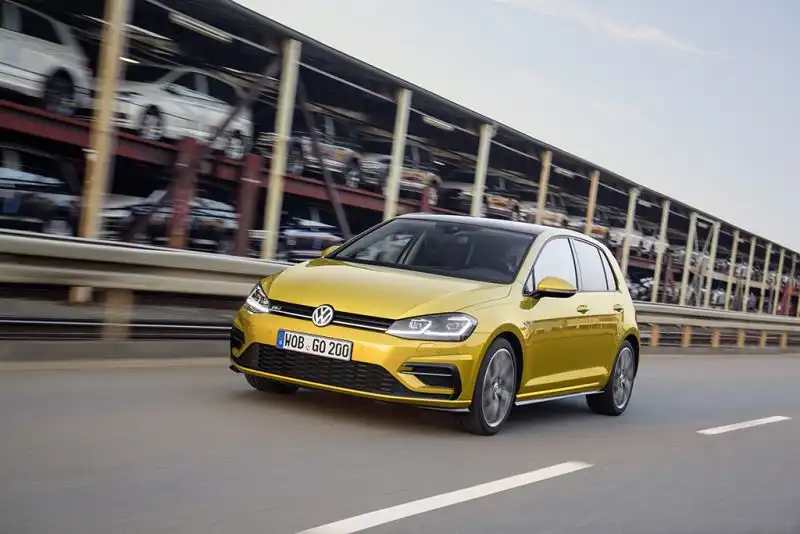
The Volkswagen Golf VII, specifically the 5-door hatchback produced during the 2017 facelift and continuing through 2019, offered a range of engine and transmission options. Among these, the 2.0 TDI SCR variant with 150 horsepower coupled with a 7-speed Dual Clutch Gearbox (DSG) represented a popular choice, particularly in European markets. This configuration balanced fuel efficiency with respectable performance, catering to drivers seeking a practical and refined daily driver. It sat within the mid-range of the Golf VII lineup, offering more power and a more sophisticated transmission than the base models, but falling short of the performance-oriented GTI or the higher-output diesel trims.
Technical Specifications
| Brand | Volkswagen |
| Model | Golf |
| Generation | Golf VII (5-door, facelift 2017) |
| Type (Engine) | 2.0 TDI SCR (150 Hp) DSG |
| Start of production | 2018 |
| End of production | 2019 |
| Powertrain Architecture | Internal Combustion engine |
| Body type | Hatchback |
| Seats | 5 |
| Doors | 5 |
| Fuel consumption (urban) | 5.2-5.3 l/100 km (45.2 – 44.4 US mpg, 54.3 – 53.3 UK mpg, 19.2 – 18.9 km/l) |
| Fuel consumption (extra urban) | 3.9-4.0 l/100 km (60.3 – 58.8 US mpg, 72.4 – 70.6 UK mpg, 25.6 – 25 km/l) |
| Fuel consumption (combined) | 4.4-4.5 l/100 km (53.5 – 52.3 US mpg, 64.2 – 62.8 UK mpg, 22.7 – 22.2 km/l) |
| CO2 emissions | 116-118 g/km |
| Fuel Type | Diesel |
| Acceleration 0 – 100 km/h | 8.7 sec |
| Acceleration 0 – 62 mph | 8.7 sec |
| Acceleration 0 – 60 mph | 8.3 sec |
| Maximum speed | 214 km/h (132.97 mph) |
| Emission standard | Euro 6d-TEMP |
| Weight-to-power ratio | 9.6 kg/Hp, 103.8 Hp/tonne |
| Weight-to-torque ratio | 4.3 kg/Nm, 235.3 Nm/tonne |
| Power | 150 Hp |
| Power per litre | 76.2 Hp/l |
| Torque | 340 Nm @ 1750-3000 rpm (250.77 lb.-ft. @ 1750-3000 rpm) |
| Engine layout | Front, Transverse |
| Engine Model/Code | CRLB, DCYA, DEJA, DFGA |
| Engine displacement | 1968 cm3 (120.09 cu. in.) |
| Number of cylinders | 4 |
| Engine configuration | Inline |
| Number of valves per cylinder | 4 |
| Fuel injection system | Diesel Commonrail |
| Engine aspiration | Turbocharger, Intercooler |
| Engine oil capacity | 4.7 l (4.97 US qt | 4.14 UK qt) |
| Kerb Weight | 1445 kg (3185.68 lbs.) |
| Max. weight | 1960 kg (4321.06 lbs.) |
| Max load | 515 kg (1135.38 lbs.) |
| Trunk (boot) space – minimum | 380 l (13.42 cu. ft.) |
| Trunk (boot) space – maximum | 1270 l (44.85 cu. ft.) |
| Fuel tank capacity | 50 l (13.21 US gal | 11 UK gal) |
| AdBlue tank | 12 l (3.17 US gal | 2.64 UK gal) |
| Max. roof load | 75 kg (165.35 lbs.) |
| Permitted trailer load with brakes (8%) | 1800 kg (3968.32 lbs.) |
| Permitted trailer load with brakes (12%) | 1600 kg (3527.4 lbs.) |
| Permitted trailer load without brakes | 720 kg (1587.33 lbs.) |
| Permitted towbar download | 80 kg (176.37 lbs.) |
| Length | 4258 mm (167.64 in.) |
| Width | 1790-1799 mm (70.47 – 70.83 in.) |
| Width including mirrors | 2027 mm (79.8 in.) |
| Height | 1492 mm (58.74 in.) |
| Wheelbase | 2620 mm (103.15 in.) |
| Front track | 1533-1549 mm (60.35 – 60.98 in.) |
| Rear (Back) track | 1504-1521 mm (59.21 – 59.88 in.) |
| Ride height (ground clearance) | 142 mm (5.59 in.) |
| Minimum turning circle (turning diameter) | 10.9 m (35.76 ft.) |
| Drivetrain Architecture | The Internal combustion engine (ICE) drives the front wheels of the vehicle. |
| Drive wheel | Front wheel drive |
| Number of gears and type of gearbox | 7 gears, automatic transmission DSG |
INTRODUCTION
The Volkswagen Golf VII, launched in 2013, represented a significant evolution of the iconic Golf lineage. The 2017 facelift brought with it revised styling, updated technology, and refined engine options. The 2.0 TDI SCR 150 hp DSG variant, introduced around 2018, was a key component of this update. Built on the MQB (Modular Transverse Matrix) platform – specifically the 1HX0/A3 designation – this Golf aimed to deliver a blend of efficiency, comfort, and practicality. It was primarily targeted at European buyers seeking a diesel-powered hatchback with the convenience of an automatic transmission.
Powertrain & Engine Architecture
At the heart of this Golf variant lies the 2.0-liter four-cylinder diesel engine, identified by engine codes such as CRLB, DCYA, DEJA, and DFGA. This engine utilizes a common rail direct injection system, delivering fuel directly into the combustion chamber at extremely high pressure for optimized combustion. A turbocharger with an intercooler further enhances performance by forcing more air into the engine. The engine also incorporates Selective Catalytic Reduction (SCR) technology, utilizing AdBlue (Diesel Exhaust Fluid) to reduce nitrogen oxide (NOx) emissions, ensuring compliance with stringent Euro 6d-TEMP emission standards. The 7-speed DSG (Dual Clutch Gearbox) provides rapid and smooth gear changes, contributing to both performance and fuel efficiency. This transmission features two separate clutches, allowing for pre-selection of the next gear, minimizing interruption in power delivery.
Driving Characteristics
The 150 hp and 340 Nm (250.77 lb-ft) of torque offered by this engine and transmission combination provided a balanced driving experience. Acceleration from 0 to 100 km/h (0-62 mph) took approximately 8.7 seconds, making it adequately quick for everyday driving. The DSG transmission’s quick shifts and well-chosen gear ratios ensured responsive acceleration. Compared to the lower-powered 1.6 TDI variants, the 2.0 TDI offered noticeably more punch, particularly during overtaking maneuvers. While not as sporty as the Golf GTI, the 2.0 TDI DSG provided a comfortable and refined driving experience, with ample torque available from low engine speeds. The automatic transmission eliminated the need for manual gear changes, making it ideal for urban commuting and long-distance journeys.
Equipment & Trim Levels
The 2.0 TDI SCR 150 hp DSG typically came equipped with a generous level of standard features. These included air conditioning, power windows, central locking, and an infotainment system with a touchscreen display. Higher trim levels offered additional features such as automatic climate control, heated seats, a navigation system, and parking sensors. Interior upholstery was typically cloth, with leather options available as an upgrade. The dashboard layout was clean and functional, with a focus on ergonomics. Optional extras included a panoramic sunroof, adaptive cruise control, and a premium sound system.
Chassis & Braking
The Golf VII’s chassis was designed to provide a comfortable and controlled ride. The front suspension utilized MacPherson struts, while the rear suspension employed a multi-link setup. This configuration offered a good balance between ride comfort and handling precision. Braking systems varied depending on the trim level, with lower trims featuring disc brakes on the front and drum brakes on the rear. Higher trims typically included disc brakes on all four wheels. Anti-lock Braking System (ABS) and Electronic Stability Control (ESC) were standard features, enhancing safety and stability.
Market Reception & Comparison
The 2.0 TDI SCR 150 hp DSG variant was well-received by automotive critics and consumers alike. It was praised for its fuel efficiency, comfortable ride, and refined powertrain. Compared to the 1.6 TDI models, the 2.0 TDI offered a significant performance upgrade, while remaining competitive in terms of fuel economy. The DSG transmission was also a popular feature, providing a smooth and convenient driving experience. However, some critics noted that the 2.0 TDI was not as engaging to drive as the GTI or other performance-oriented hatchbacks. In terms of reliability, the 2.0 TDI engine proved to be generally robust, although some owners reported issues with the DSG transmission, particularly early units.
Legacy
The Volkswagen Golf VII 2.0 TDI SCR 150 hp DSG remains a popular choice in the used car market. Its combination of fuel efficiency, practicality, and reliability has made it a desirable option for buyers seeking a well-rounded hatchback. While the DSG transmission requires regular maintenance, it is generally considered to be a durable unit. The 2.0 TDI engine is also known for its longevity, provided it is properly maintained. As a result, this Golf variant continues to hold its value well and remains a competitive option in its segment.