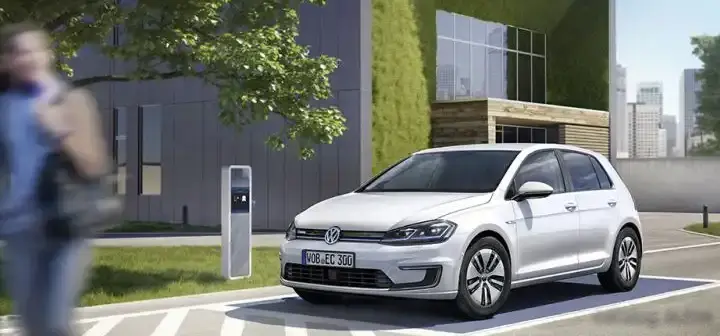
The Volkswagen e-Golf, specifically the 35.8 kWh variant introduced with the facelift of the Golf VII in February 2017 and continuing through December 2020, represented Volkswagen’s initial significant step into mass-market, all-electric vehicles. Positioned as a practical and accessible EV, it aimed to deliver the familiar Golf driving experience with zero tailpipe emissions. This version, producing 136 horsepower and utilizing a single-speed CVT (Continuously Variable Transmission), was a key model within the Golf VII range, serving as a bridge between traditional internal combustion engine (ICE) Golfs and the later, more advanced ID. series of electric vehicles. The e-Golf was primarily marketed in Europe and North America, offering a compelling alternative for environmentally conscious buyers seeking a compact hatchback.
Technical Specifications
| Brand | Volkswagen |
| Model | Golf |
| Generation | Golf VII (5-door, facelift 2017) |
| Type (Engine) | e-Golf 35.8 kWh (136 Hp) CVT |
| Start of production | February, 2017 |
| End of production | December, 2020 |
| Powertrain Architecture | BEV (Electric Vehicle) |
| Body type | Hatchback |
| Seats | 5 |
| Doors | 5 |
| Fuel Type | Electricity |
| Acceleration 0 – 100 km/h | 9.6 sec |
| Acceleration 0 – 62 mph | 9.6 sec |
| Acceleration 0 – 60 mph | 9.1 sec |
| Maximum speed | 150 km/h (93.21 mph) |
| Weight-to-power ratio | 11.3 kg/Hp, 88.3 Hp/tonne |
| Weight-to-torque ratio | 5.3 kg/Nm, 188.3 Nm/tonne |
| Gross battery capacity | 35.8 kWh |
| Net (usable) battery capacity | 32 kWh |
| Battery voltage | 323 V |
| Battery technology | Lithium-ion (Li-Ion) |
| Battery weight | 318 kg (701.07 lbs) |
| Battery location | Below the floor |
| All-electric range | 300 km (186.41 mi) |
| Average Energy consumption | 12.7 kWh/100 km (20.44 kWh/100 mi) |
| MPGe | 165 |
| km/kWh | 7.9 |
| mi/kWh | 4.9 |
| Electric motor power | 136 Hp @ 3000-12000 rpm |
| Electric motor Torque | 290 Nm @ 0-3000 rpm (213.89 lb.-ft. @ 0-3000 rpm) |
| Electric motor location | Front axle, Transverse |
| System power | 136 Hp @ 3000-12000 rpm |
| System torque | 290 Nm @ 0-3000 rpm (213.89 lb.-ft. @ 0-3000 rpm) |
| Kerb Weight | 1540 kg (3395.12 lbs) |
| Max. weight | 2020 kg (4453.34 lbs) |
| Max load | 480 kg (1058.22 lbs) |
| Trunk (boot) space – minimum | 341 l (12.04 cu. ft) |
| Trunk (boot) space – maximum | 1231 l (43.47 cu. ft) |
| Max. roof load | 75 kg (165.35 lbs) |
| Length | 4270 mm (168.11 in) |
| Width | 1799 mm (70.83 in) |
| Width including mirrors | 2027 mm (79.8 in) |
| Height | 1482 mm (58.35 in) |
| Wheelbase | 2629 mm (103.5 in) |
| Front track | 1533-1549 mm (60.35 – 60.98 in) |
| Rear (Back) track | 1503-1521 mm (59.17 – 59.88 in) |
| Ride height (ground clearance) | 143 mm (5.63 in) |
| Minimum turning circle | 10.9 m (35.76 ft) |
| Drivetrain Architecture | One electric motor drives the front wheels |
| Drive wheel | Front wheel drive |
| Number of gears and type of gearbox | 1 gears, automatic transmission |
| Front suspension | Independent type McPherson, Transverse stabilizer |
| Rear suspension | Independent multi-link suspension, Transverse stabilizer |
| Front brakes | Ventilated discs |
| Rear brakes | Disc |
| Assisting systems | ABS (Anti-lock braking system) |
| Steering type | Steering rack and pinion |
| Power steering | Electric Steering |
| Tires size | 205/55 R16 |
| Wheel rims size | 6.5J x 16 |
Powertrain & Engine Architecture
The e-Golf’s powertrain revolves around a permanently magnetized synchronous electric motor generating 136 horsepower and 290 Nm (213.89 lb-ft) of torque. This motor is transversely mounted at the front of the vehicle, powering the front wheels. Power is transmitted through a single-speed CVT, engineered for efficiency and smooth acceleration. The 35.8 kWh lithium-ion battery pack is positioned under the vehicle floor, lowering the center of gravity and enhancing handling. The battery incorporates a liquid cooling system to maintain optimal operating temperatures. The e-Golf features regenerative braking, capturing kinetic energy during deceleration to recharge the battery and extend range. An onboard charger supports both AC and DC fast charging, offering variable charge times based on the power source.
Driving Characteristics
The e-Golf 35.8 kWh delivers a driving experience markedly different from its gasoline-powered counterparts. The electric motor’s instant torque provides brisk acceleration, especially in city driving. While the 0-60 mph time of approximately 9.1 seconds isn’t particularly quick, the readily available torque makes overtaking effortless. The single-speed CVT provides seamless acceleration, eliminating the gear changes of a conventional automatic transmission. Compared to the more potent e-Golf variants (later models featured higher-output motors), this version prioritized efficiency over outright performance. Handling is characteristic of the Golf – composed and predictable – with the low-mounted battery pack contributing to a stable feel. The regenerative braking system requires some acclimation, but its intensity can be adjusted to provide varying levels of deceleration.
Equipment & Trim Levels
The e-Golf 35.8 kWh was generally well-equipped, even in its base configuration. Standard features typically included automatic climate control, a touchscreen infotainment system with Apple CarPlay and Android Auto compatibility, and a suite of safety technologies such as automatic emergency braking and lane departure warning. Higher trim levels added features like a larger touchscreen display, premium upholstery, and advanced driver-assistance systems. Optional extras included a panoramic sunroof, adaptive cruise control, and a premium sound system. Interior upholstery was typically cloth or leatherette, with an emphasis on sustainable materials. The dashboard layout mirrored that of the standard Golf VII, with subtle blue accents to highlight its electric nature.
Chassis & Braking
The e-Golf utilizes the standard Golf VII chassis, with modifications to accommodate the battery pack. The front suspension features an independent McPherson strut setup, while the rear employs an independent multi-link suspension. Both axles are equipped with a transverse stabilizer bar to minimize body roll. The braking system consists of ventilated discs at the front and solid discs at the rear. ABS (Anti-lock Braking System) is standard. The added weight of the battery pack (around 318 kg / 701 lbs) prompted suspension tuning to provide a comfortable ride while maintaining good handling characteristics. The steering is electrically assisted, offering precise and responsive control.
Market Reception & Comparison
The e-Golf received generally positive reviews, with critics praising its practicality, comfortable ride, and smooth acceleration. However, its limited range (around 186 miles) compared to some competitors was a frequent point of criticism. Compared to gasoline-powered Golf models, the e-Golf offered significantly lower running costs due to the elimination of fuel expenses and reduced maintenance needs. Within the e-Golf lineup, the 35.8 kWh variant served as the entry point, providing a more affordable option for buyers new to electric vehicles. It was often compared to other EVs like the Nissan Leaf and BMW i3, offering a more conventional hatchback experience than some of its rivals.
Legacy
The Volkswagen e-Golf played a vital role in establishing Volkswagen as a significant player in the electric vehicle market. While it has been succeeded by the ID. series of EVs, the e-Golf remains a popular choice in the used car market. Its proven reliability and relatively low maintenance costs make it an appealing option for buyers seeking an affordable and practical electric vehicle. The powertrain, while not revolutionary, proved to be durable and dependable. The e-Golf’s success paved the way for Volkswagen’s ambitious electrification strategy, demonstrating the viability of electric vehicles in the mainstream automotive landscape.