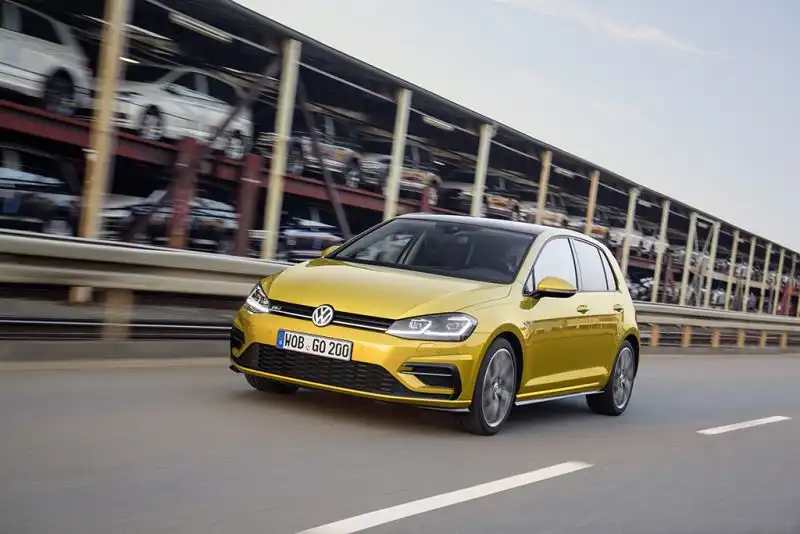
The Volkswagen Golf VII GTE 1.4 TSI, produced from August 2019 to May 2020, represents Volkswagen’s foray into the plug-in hybrid market within the highly successful Golf VII range. Positioned as a performance-oriented, yet fuel-efficient option, the GTE (Gran Turismo Executive) aimed to bridge the gap between the standard Golf models and the more potent GTI. This variant, utilizing a 1.4-liter turbocharged gasoline engine paired with an electric motor and a 6-speed DSG dual-clutch transmission, was primarily sold in the European market, offering a compelling alternative to traditional gasoline or diesel powertrains. It falls within the facelifted Golf VII series (5-door configuration), denoted by the 5G chassis code, and incorporated updated styling and technology compared to earlier VII models.
Technical Specifications
| Brand | Volkswagen |
| Model | Golf |
| Generation | Golf VII (5-door, facelift 2017) |
| Type (Engine) | GTE 1.4 TSI (204 Hp) Plug-in Hybrid DSG OPF |
| Start of production | August, 2019 |
| End of production | May, 2020 |
| Powertrain Architecture | PHEV (Plug-in Hybrid Electric Vehicle) |
| Body type | Hatchback |
| Seats | 5 |
| Doors | 5 |
| Fuel consumption (combined) | 1.9-2.1 l/100 km (123.8 – 112 US mpg, 148.7 – 134.5 UK mpg, 52.6 – 47.6 km/l) |
| CO2 emissions | 43-47 g/km |
| Fuel Type | Petrol / electricity |
| Acceleration 0 – 100 km/h | 7.6 sec |
| Acceleration 0 – 62 mph | 7.6 sec |
| Acceleration 0 – 60 mph | 7.2 sec |
| Maximum speed | 222 km/h (137.94 mph) |
| Emission standard | Euro 6d-ISC |
| Weight-to-power ratio | 7.5 kg/Hp, 132.5 Hp/tonne |
| Weight-to-torque ratio | 4.4 kg/Nm, 227.3 Nm/tonne |
| Gross battery capacity | 8.7 kWh |
| Battery technology | Lithium-ion (Li-Ion) |
| Battery location | Under the rear seats |
| All-electric range | 45-49 km (27.96 – 30.45 mi) |
| Average Energy consumption | 12.1-12.7 kWh/100 km (19.47 – 20.44 kWh/100 mi, 173 – 165 MPGe, 8.3 – 7.9 km/kWh, 5.1 – 4.9 mi/kWh) |
| Electric motor power | 102 Hp @ 2500 rpm |
| Electric motor Torque | 330 Nm (243.4 lb.-ft.) |
| Maximum revolutions of the electric motor | 7000 rpm |
| Electric motor type | Synchronous |
| System power | 204 Hp |
| System torque | 350 Nm (258.15 lb.-ft.) |
| Power | 150 Hp @ 5000-6000 rpm |
| Torque | 250 Nm @ 1550-3500 rpm (184.39 lb.-ft. @ 1550-3500 rpm) |
| Engine layout | Front, Transverse |
| Engine Model/Code | EA211 / DGEA |
| Engine displacement | 1395 cm3 (85.13 cu. in.) |
| Number of cylinders | 4 |
| Engine configuration | Inline |
| Cylinder Bore | 74.5 mm (2.93 in.) |
| Piston Stroke | 80 mm (3.15 in.) |
| Compression ratio | 10:1 |
| Number of valves per cylinder | 4 |
| Fuel injection system | Direct injection |
| Engine aspiration | Turbocharger, Intercooler |
| Valvetrain | DOHC |
| Engine oil capacity | 4 l (4.23 US qt | 3.52 UK qt) |
| Kerb Weight | 1540 kg (3395.12 lbs.) |
| Max. weight | 2040 kg (4497.43 lbs.) |
| Max load | 500 kg (1102.31 lbs.) |
| Trunk (boot) space – minimum | 272 l (9.61 cu. ft.) |
| Trunk (boot) space – maximum | 1162 l (41.04 cu. ft.) |
| Fuel tank capacity | 40 l (10.57 US gal | 8.8 UK gal) |
| Max. roof load | 75 kg (165.35 lbs.) |
| Permitted trailer load with brakes (8%) | 1700 kg (3747.86 lbs.) |
| Permitted trailer load with brakes (12%) | 1500 kg (3306.93 lbs.) |
| Permitted trailer load without brakes | 750 kg (1653.47 lbs.) |
| Permitted towbar download | 80 kg (176.37 lbs.) |
| Length | 4276 mm (168.35 in.) |
| Width | 1799 mm (70.83 in.) |
| Width including mirrors | 2027 mm (79.8 in.) |
| Height | 1484 mm (58.43 in.) |
| Wheelbase | 2630 mm (103.54 in.) |
| Front track | 1533-1549 mm (60.35 – 60.98 in.) |
| Rear (Back) track | 1503-1521 mm (59.17 – 59.88 in.) |
| Ride height (ground clearance) | 140 mm (5.51 in.) |
| Minimum turning circle (turning diameter) | 10.9 m (35.76 ft.) |
| Drivetrain Architecture | The Internal combustion engine (ICE) and electric motor drive the front wheels of the car with the ability to work in full electric or mixed mode. |
| Drive wheel | Front wheel drive |
| Number of gears and type of gearbox | 6 gears, automatic transmission DSG |
| Front suspension | Independent, type McPherson with coil spring and anti-roll bar |
| Rear suspension | Independent multi-link spring suspension with stabilizer |
| Front brakes | Ventilated discs |
| Rear brakes | Disc |
| Assisting systems | ABS (Anti-lock braking system) |
| Steering type | Steering rack and pinion |
| Power steering | Electric Steering |
| Tires size | 205/55 R16; 225/45 R17; 225/40 R18 |
| Wheel rims size | 6.5J x 16; 7.5J x 17; 7.5J x 18 |
Powertrain & Engine Architecture
The Golf VII GTE’s powertrain centers around the EA211 series 1.4-liter turbocharged four-cylinder gasoline engine (code DGEA). This engine produces 150 horsepower and 250 Nm (184 lb-ft) of torque. It utilizes direct fuel injection and an intercooled turbocharger to enhance efficiency and power output. The engine is paired with a 102 horsepower electric motor, capable of generating 330 Nm (243 lb-ft) of torque. The combined system output is 204 horsepower and 350 Nm (258 lb-ft) of torque. The electric motor is strategically positioned between the engine and the DSG transmission. Power is delivered to the front wheels via a 6-speed DSG (Direct-Shift Gearbox) dual-clutch automatic transmission, known for its quick and smooth gear changes. The 8.7 kWh lithium-ion battery pack is located under the rear seats, impacting rear passenger space slightly but optimizing weight distribution. The GTE also incorporates a particulate filter (OPF) to reduce emissions, meeting stringent Euro 6d-ISC standards.
Driving Characteristics
The GTE offers a unique driving experience, blending the responsiveness of a gasoline engine with the instant torque of an electric motor. In ‘E-Mode’, the vehicle operates solely on electric power for up to 45-49 kilometers (28-30 miles) under ideal conditions. ‘Hybrid Auto’ mode intelligently switches between the engine and electric motor, optimizing fuel efficiency. ‘GTE’ mode unlocks the full system power, providing brisk acceleration – 0 to 100 km/h in 7.6 seconds. The DSG transmission contributes to seamless gear changes, enhancing the overall driving experience. Compared to the standard 1.4 TSI Golf, the GTE offers noticeably quicker acceleration. However, the added weight of the battery pack and electric motor does slightly diminish handling agility compared to lighter Golf variants. The GTE’s power delivery is more immediate than the non-hybrid models, particularly at lower speeds, thanks to the electric motor’s instant torque.
Equipment & Trim Levels
The Golf VII GTE typically came well-equipped as standard. Key features included sports seats upholstered in a unique GTE-specific fabric pattern, a leather-wrapped multi-function steering wheel, and stainless steel pedal caps. The infotainment system featured a color touchscreen display with navigation and smartphone integration. Exterior styling cues included distinctive blue accents on the front grille and brake calipers, along with a unique rear diffuser. Optional extras included adaptive chassis control (DCC), a panoramic sunroof, and advanced driver assistance systems such as adaptive cruise control and lane assist.
Chassis & Braking
The GTE utilizes an independent McPherson strut front suspension and an independent multi-link rear suspension, providing a comfortable yet controlled ride. Stabilizer bars are fitted to both axles to reduce body roll during cornering. Braking duties are handled by ventilated discs at the front and solid discs at the rear. ABS (Anti-lock Braking System) is standard. The suspension tuning is slightly firmer than that of standard Golf models to accommodate the increased weight and performance capabilities of the GTE.
Market Reception & Comparison
The Golf VII GTE was generally well-received by automotive critics, praised for its blend of performance, efficiency, and practicality. It offered a compelling alternative to diesel-powered Golfs, particularly in regions with stricter emissions regulations. Compared to the Golf GTI, the GTE prioritized fuel economy and lower emissions over outright performance. The GTI, with its more powerful engine and sport-tuned chassis, offered a more engaging driving experience, while the GTE focused on providing a refined and efficient driving experience. Fuel economy figures of 1.9-2.1 l/100km were achievable under optimal conditions, making it a very economical option for daily commuting.
Legacy
The Golf VII GTE represented a significant step forward for Volkswagen in the realm of plug-in hybrid technology. While early models experienced some minor software glitches, the powertrain proved to be generally reliable. On the used car market, the GTE holds its value relatively well, appealing to buyers seeking a fuel-efficient and technologically advanced hatchback. The EA211 engine, while not without its quirks, is a well-documented and relatively easy-to-maintain unit. The longevity of the battery pack is a key consideration for potential buyers, but with proper care, the battery can provide many years of reliable service. The GTE paved the way for subsequent generations of Golf eHybrid and GTE models, solidifying Volkswagen’s commitment to electrification.