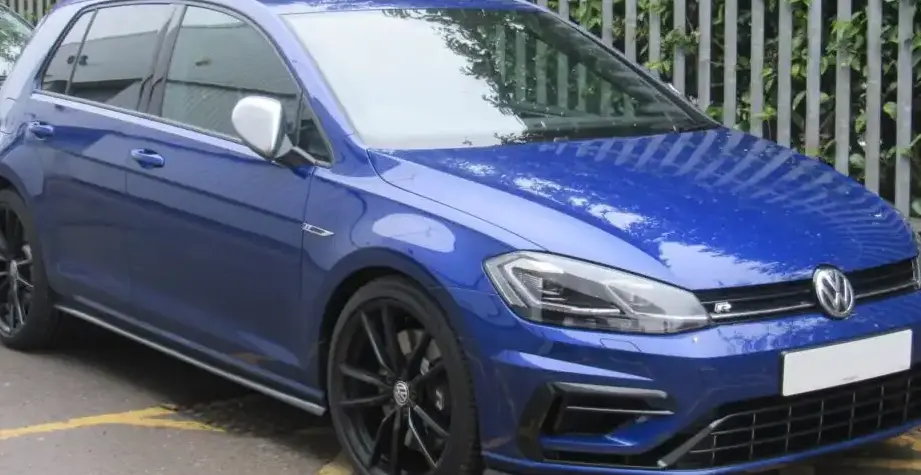
The Volkswagen Golf VII R, specifically the 5-door hatchback produced from 2018 to 2021 following the facelift, represents the high-performance pinnacle of the seventh-generation Golf lineup. Introduced in September 2018, this variant, powered by the 2.0 TSI engine producing 288 horsepower and equipped with Volkswagen’s 4MOTION all-wheel-drive system, aimed to deliver a compelling blend of everyday usability and exhilarating performance. It sat at the top of the Golf VII range, offering a significant step up in power and handling compared to models like the GTI or the standard Golf trims. The Golf VII R was a key model for Volkswagen, demonstrating their capability in creating a genuinely sporty and practical hatchback for the European and increasingly, the North American market.
Technical Specifications
| Brand | Volkswagen |
| Model | Golf |
| Generation | Golf VII (5-door, facelift 2017) |
| Type (Engine) | R 2.0 TSI (288 Hp) 4MOTION |
| Start of production | September, 2018 |
| End of production | 2021 |
| Powertrain Architecture | Internal Combustion engine |
| Body type | Hatchback |
| Seats | 5 |
| Doors | 5 |
| Fuel consumption (economy) – urban (EPA) | 11.2 l/100 km (21 US mpg, 25.2 UK mpg, 8.9 km/l) |
| Fuel consumption (economy) – extra urban (EPA) | 8.1 l/100 km (29 US mpg, 34.9 UK mpg, 12.3 km/l) |
| Fuel consumption (economy) – combined (EPA) | 9.8 l/100 km (24 US mpg, 28.8 UK mpg, 10.2 km/l) |
| Fuel Type | Petrol (Gasoline) |
| Weight-to-power ratio | 5.2 kg/Hp, 192.4 Hp/tonne |
| Weight-to-torque ratio | 3.9 kg/Nm, 253.8 Nm/tonne |
| Power | 288 Hp @ 5400-6200 rpm |
| Power per litre | 145.2 Hp/l |
| Torque | 380 Nm @ 1800-5500 rpm (280.27 lb.-ft. @ 1800-5500 rpm) |
| Engine layout | Front, Transverse |
| Engine Model/Code | EA888 / DLRA |
| Engine displacement | 1984 cm3 (121.07 cu. in.) |
| Number of cylinders | 4 |
| Engine configuration | Inline |
| Cylinder Bore | 82.5 mm (3.25 in.) |
| Piston Stroke | 92.8 mm (3.65 in.) |
| Compression ratio | 9.6:1 |
| Number of valves per cylinder | 4 |
| Fuel injection system | Direct injection |
| Engine aspiration | Turbocharger, Intercooler |
| Valvetrain | DOHC |
| Engine oil capacity | 5.7 l (6.02 US qt | 5.02 UK qt) |
| Coolant | 10 l (10.57 US qt | 8.8 UK qt) |
| Kerb Weight | 1497 kg (3300.32 lbs.) |
| Max. weight | 1980 kg (4365.15 lbs.) |
| Max load | 483 kg (1064.83 lbs.) |
| Trunk (boot) space – minimum | 343 l (12.11 cu. ft.) |
| Trunk (boot) space – maximum | 1233 l (43.54 cu. ft.) |
| Fuel tank capacity | 55 l (14.53 US gal | 12.1 UK gal) |
| Length | 4276 mm (168.35 in.) |
| Width | 1799 mm (70.83 in.) |
| Height | 1436 mm (56.54 in.) |
| Wheelbase | 2630 mm (103.54 in.) |
| Front track | 1541 mm (60.67 in.) |
| Rear (Back) track | 1515 mm (59.65 in.) |
| Ride height (ground clearance) | 122 mm (4.8 in.) |
| Drag coefficient (Cd) | 0.32 |
| Minimum turning circle (turning diameter) | 10.9 m (35.76 ft.) |
| Drivetrain Architecture | All wheel drive (4×4). ICE drives front wheels, rear wheels driven by clutch. |
| Drive wheel | All wheel drive (4×4) |
| Number of gears and type of gearbox | 6 gears, manual transmission |
| Front suspension | Independent, McPherson with coil spring and anti-roll bar |
| Rear suspension | Independent multi-link spring suspension with stabilizer |
| Front brakes | Ventilated discs, 340×30 mm |
| Rear brakes | Disc, 310×23 mm |
| Assisting systems | ABS (Anti-lock braking system) |
| Steering type | Steering rack and pinion |
| Power steering | Electric Steering |
| Tires size | 225/40 R18; 235/35 R19 |
| Wheel rims size | 7.5J x 18; 8J x 19 |
Powertrain & Engine Architecture
The heart of the Golf VII R is the EA888 2.0-liter turbocharged inline-four cylinder engine, specifically the DLRA variant. This engine is a direct-injection gasoline engine, utilizing a sophisticated fuel delivery system for optimal combustion efficiency and power output. The EA888 engine family is known for its robust construction and tuning potential. The R version features a larger turbocharger, upgraded pistons, connecting rods, and a revised cylinder head compared to the standard 2.0 TSI found in lower Golf trims. The engine produces 288 horsepower and 380 Nm (280 lb-ft) of torque. The 6-speed manual transmission was standard, providing a direct connection to the engine and allowing for precise gear changes. The 4MOTION all-wheel-drive system is a Haldex system, which proactively distributes torque between the front and rear axles based on driving conditions, enhancing traction and stability.
Driving Characteristics
The Golf VII R with the manual transmission delivers a genuinely engaging driving experience. The 288 horsepower and 380 Nm of torque provide strong acceleration, with a 0-60 mph time of around 4.6 seconds. The 4MOTION system ensures excellent grip in all weather conditions, making it a capable year-round vehicle. The manual gearbox is well-matched to the engine’s powerband, offering precise shifts and a satisfying mechanical feel. Compared to the Golf GTI, the R offers a more aggressive and focused driving experience, with sharper handling and more powerful acceleration. While the GTI prioritizes a balance between performance and comfort, the R leans more towards outright performance.
Equipment & Trim Levels
The Golf VII R came generously equipped as standard. Key features included sport seats upholstered in cloth and Alcantara, a leather-wrapped steering wheel, stainless steel pedal caps, and unique R-specific exterior styling cues, such as a more aggressive front bumper, rear diffuser, and quad exhaust outlets. Optional extras included adaptive dampers (DCC), a panoramic sunroof, navigation system, and premium sound system. The interior generally featured a dark color scheme with blue stitching accents, further differentiating it from other Golf models.
Chassis & Braking
The Golf VII R benefits from a sport-tuned suspension, featuring stiffer springs and dampers compared to the standard Golf. The front suspension utilizes a McPherson strut design, while the rear employs a multi-link setup. This configuration provides excellent handling and stability. The braking system consists of ventilated discs all around, with larger front discs (340x30mm) compared to the GTI. The ABS (Anti-lock Braking System) is standard, providing enhanced braking performance and control.
Market Reception & Comparison
The Golf VII R was widely praised by automotive critics for its performance, handling, and practicality. It was often compared favorably to rivals such as the Audi S3 and the BMW M140i. Fuel economy was reasonable for a high-performance hatchback, averaging around 24 mpg combined. Reliability was generally good, although some owners reported minor issues with the turbocharger and the Haldex all-wheel-drive system. The R offered a compelling value proposition, providing a near-premium driving experience at a more accessible price point than its direct competitors.
Legacy
The Golf VII R has established itself as a highly desirable used car. The EA888 engine, while requiring regular maintenance, is generally considered robust and reliable. The 4MOTION system, when properly maintained, provides years of dependable all-wheel-drive performance. The Golf VII R remains a popular choice for enthusiasts seeking a practical and engaging high-performance hatchback. Its blend of performance, practicality, and refinement has cemented its place as a modern classic in the hot hatch segment.