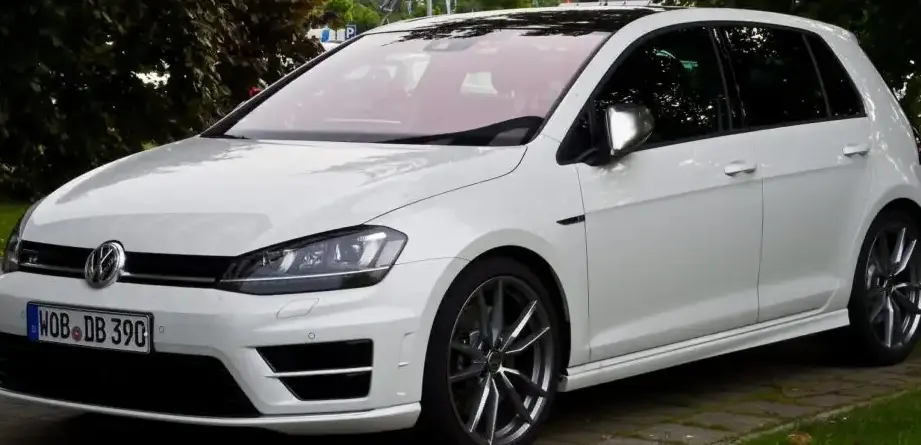
The Volkswagen Golf VII R, produced from 2014 to 2017, represents the high-performance pinnacle of the seventh-generation Golf lineup. Positioned as the flagship model, the R distinguished itself with a potent 2.0-liter turbocharged engine, a sophisticated all-wheel-drive system (4MOTION), and a host of performance-enhancing features. This variant was primarily marketed in Europe and North America as a direct competitor to hot hatches like the Ford Focus RS and the Audi S3, offering a blend of everyday usability and exhilarating performance. The Golf VII R was exclusively offered as a five-door hatchback, catering to buyers seeking both practicality and sporty driving dynamics.
Technical Specifications
| Brand | Volkswagen |
| Model | Golf |
| Generation | Golf VII (5-door) |
| Type (Engine) | R 2.0 TSI (292 Hp) 4MOTION |
| Start of production | 2014 |
| End of production | 2017 |
| Powertrain Architecture | Internal Combustion engine |
| Body type | Hatchback |
| Seats | 5 |
| Doors | 5 |
| Fuel consumption (economy) – urban (EPA) | 10.7 l/100 km (22 US mpg, 26.4 UK mpg, 9.3 km/l) |
| Fuel consumption (economy) – extra urban (EPA) | 7.6 l/100 km (30.9 US mpg, 37.2 UK mpg, 13.2 km/l) |
| Fuel consumption (economy) – combined (EPA) | 9.4 l/100 km (25 US mpg, 30.1 UK mpg, 10.6 km/l) |
| Fuel Type | Petrol (Gasoline) |
| Acceleration 0 – 60 mph | 5.3 sec |
| Maximum speed | 250 km/h (155.34 mph), Electronically limited |
| Weight-to-power ratio | 5.1 kg/Hp, 196.1 Hp/tonne |
| Weight-to-torque ratio | 3.9 kg/Nm, 255.2 Nm/tonne |
| Power | 292 Hp @ 5400 rpm |
| Power per litre | 147.2 Hp/l |
| Torque | 380 Nm @ 1800 rpm (280.27 lb.-ft. @ 1800 rpm) |
| Engine layout | Front, Transverse |
| Engine Model/Code | EA888 / CYFB |
| Engine displacement | 1984 cm3 (121.07 cu. in.) |
| Number of cylinders | 4 |
| Engine configuration | Inline |
| Cylinder Bore | 82.5 mm (3.25 in.) |
| Piston Stroke | 92.8 mm (3.65 in.) |
| Compression ratio | 9.6:1 |
| Number of valves per cylinder | 4 |
| Fuel injection system | Direct injection |
| Engine aspiration | Turbocharger, Intercooler |
| Valvetrain | DOHC |
| Engine oil capacity | 5.7 l (6.02 US qt | 5.02 UK qt) |
| Kerb Weight | 1489-1499 kg (3282.68 – 3304.73 lbs.) |
| Max. weight | 1960-1970 kg (4321.06 – 4343.11 lbs.) |
| Max load | 471 kg (1038.38 lbs.) |
| Trunk (boot) space – minimum | 343 l (12.11 cu. ft.) |
| Trunk (boot) space – maximum | 1233 l (43.54 cu. ft.) |
| Fuel tank capacity | 55 l (14.53 US gal | 12.1 UK gal) |
| Length | 4276 mm (168.35 in.) |
| Width | 1799 mm (70.83 in.) |
| Width including mirrors | 2027 mm (79.8 in.) |
| Height | 1436 mm (56.54 in.) |
| Wheelbase | 2630 mm (103.54 in.) |
| Front track | 1541 mm (60.67 in.) |
| Rear (Back) track | 1515 mm (59.65 in.) |
| Ride height (ground clearance) | 122 mm (4.8 in.) |
| Drag coefficient (Cd) | 0.32 |
| Minimum turning circle (turning diameter) | 10.9 m (35.76 ft.) |
| Drivetrain Architecture | The Internal combustion engine (ICE) drives the front wheels permanently, and the rear wheels are driven through an electrically or mechanically operated clutch if necessary. |
| Drive wheel | All wheel drive (4×4) |
| Number of gears and type of gearbox | 6 gears, manual transmission |
| Front suspension | Independent, type McPherson with coil spring and anti-roll bar |
| Rear suspension | Independent multi-link spring suspension with stabilizer |
| Front brakes | Ventilated discs, 340×30 mm |
| Rear brakes | Ventilated discs, 310×23 mm |
| Assisting systems | ABS (Anti-lock braking system) |
| Steering type | Steering rack and pinion |
| Power steering | Electric Steering |
| Tires size | 225/40 R18; 235/35 R19 |
| Wheel rims size | 7.5J x 18; 8J x 19 |
Powertrain & Engine Architecture
The heart of the Golf VII R is the EA888 2.0-liter turbocharged four-cylinder engine, specifically the CYFB variant. This engine is a direct-injection powerplant featuring a cast iron block and an aluminum cylinder head. The CYFB engine benefits from a twin-scroll turbocharger, which minimizes turbo lag and enhances responsiveness. The direct injection system delivers fuel directly into the combustion chamber, optimizing combustion efficiency and power output. The engine utilizes a double overhead camshaft (DOHC) valvetrain with four valves per cylinder, further contributing to its performance capabilities. The 6-speed manual transmission was standard, providing drivers with precise control over the engine’s power.
Driving Characteristics
The Golf VII R delivers a thrilling driving experience characterized by its potent acceleration and confident handling. The 292 horsepower and 380 Nm (280 lb-ft) of torque provide brisk acceleration, with a 0-60 mph time of just 5.3 seconds. The 4MOTION all-wheel-drive system distributes power between the front and rear axles as needed, ensuring optimal traction in various driving conditions. The manual transmission offers a direct and engaging feel, allowing drivers to fully exploit the engine’s powerband. Compared to lower-trim Golfs, the R’s suspension is significantly firmer and more responsive, providing a more connected feel to the road. While the ride quality is firmer, it remains reasonably comfortable for daily driving.
Equipment & Trim Levels
The Golf VII R came generously equipped as standard. Key features included sport seats upholstered in a unique cloth/Alcantara combination, stainless steel pedal caps, ambient lighting, and a touchscreen infotainment system. Optional extras included leather upholstery, a panoramic sunroof, adaptive dampers (DCC), and a premium sound system. The interior featured a sporty aesthetic with R-specific badging and trim elements. The standard equipment level positioned the R as a premium offering within the Golf range, justifying its higher price point.
Chassis & Braking
The Golf VII R features a sport-tuned chassis with a McPherson strut front suspension and a multi-link rear suspension. The suspension components were specifically calibrated to handle the increased power and performance of the R model. Larger ventilated disc brakes were fitted at all four corners, providing ample stopping power. The front brakes measured 340x30mm, while the rear brakes were 310x23mm. The standard ABS (Anti-lock Braking System) and electronic stability control further enhanced safety and control.
Market Reception & Comparison
The Golf VII R was widely praised by automotive critics for its exceptional performance, handling, and practicality. It was consistently ranked among the best hot hatches on the market. Compared to the standard Golf models, the R offered a significant performance upgrade, but at a higher price. The R’s fuel economy, while not exceptional, was reasonable for a high-performance vehicle, averaging around 25 US mpg in combined driving. Reliability was generally good, although some owners reported minor issues with the turbocharger and fuel injectors.
Legacy
The Golf VII R has established itself as a highly desirable and collectible hot hatch. The EA888 engine, in its CYFB configuration, has proven to be a robust and reliable powerplant when properly maintained. On the used car market, Golf VII Rs command a premium price due to their performance, rarity, and enthusiast following. The Golf VII R set a new benchmark for performance in the compact hatchback segment and paved the way for future generations of high-performance Golf models.