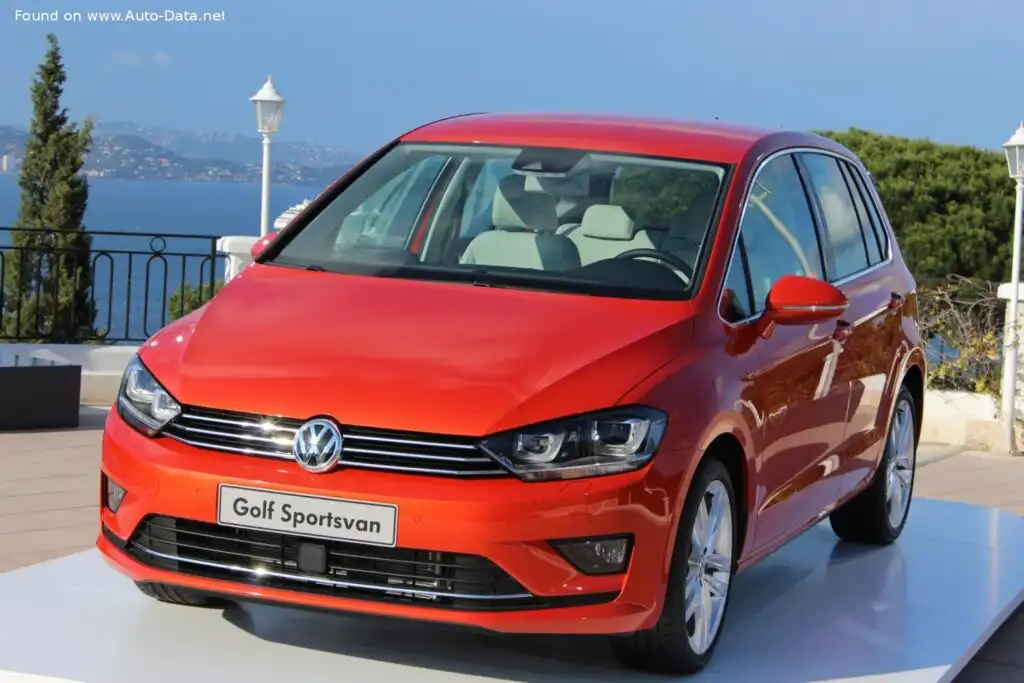
The Volkswagen Golf VII Sportsvan 1.2 TSI (110 hp) was a compact minivan produced between April 2014 and March 2017. Positioned as an entry-level offering within the broader Golf VII Sportsvan range, it aimed to provide a practical and fuel-efficient option for families and individuals seeking a versatile vehicle. The Sportsvan, a derivative of the seventh-generation Golf (Golf VII), offered increased interior space and practicality compared to the standard hatchback, competing with other compact MPVs in the European market. This particular variant, with its 1.2-liter turbocharged engine and six-speed manual transmission, represented a balance between affordability and usability.
Technical Specifications
| Brand | Volkswagen |
| Model | Golf |
| Generation | Golf VII Sportsvan |
| Type (Engine) | 1.2 TSI (110 Hp) |
| Start of production | April, 2014 |
| End of production | March, 2017 |
| Powertrain Architecture | Internal Combustion engine |
| Body type | Minivan |
| Seats | 5 |
| Doors | 5 |
| Fuel consumption (urban) | 6.3-6.4 l/100 km (37.3 – 36.8 US mpg, 44.8 – 44.1 UK mpg, 15.9 – 15.6 km/l) |
| Fuel consumption (extra urban) | 4.4-4.6 l/100 km (53.5 – 51.1 US mpg, 64.2 – 61.4 UK mpg, 22.7 – 21.7 km/l) |
| Fuel consumption (combined) | 5.1-5.3 l/100 km (46.1 – 44.4 US mpg, 55.4 – 53.3 UK mpg, 19.6 – 18.9 km/l) |
| CO2 emissions | 117-122 g/km |
| Fuel Type | Petrol (Gasoline) |
| Acceleration 0 – 100 km/h | 10.7 sec |
| Acceleration 0 – 62 mph | 10.7 sec |
| Acceleration 0 – 60 mph | 10.2 sec |
| Maximum speed | 192 km/h (119.3 mph) |
| Weight-to-power ratio | 12 kg/Hp, 83.1 Hp/tonne |
| Weight-to-torque ratio | 7.6 kg/Nm, 132.2 Nm/tonne |
| Power | 110 Hp @ 4600-5600 rpm |
| Power per litre | 91.9 Hp/l |
| Torque | 175 Nm @ 1400-4000 rpm (129.07 lb.-ft. @ 1400-4000 rpm) |
| Engine layout | Front, Transverse |
| Engine Model/Code | CYVB |
| Engine displacement | 1197 cm3 (73.05 cu. in.) |
| Number of cylinders | 4 |
| Engine configuration | Inline |
| Fuel injection system | Direct injection |
| Engine aspiration | Turbocharger, Intercooler |
| Valvetrain | DOHC |
| Engine oil capacity | 4 l (4.23 US qt | 3.52 UK qt) |
| Kerb Weight | 1324 kg (2918.92 lbs.) |
| Max. weight | 1850 kg (4078.55 lbs.) |
| Max load | 526 kg (1159.63 lbs.) |
| Trunk (boot) space – minimum | 500 l (17.66 cu. ft.) |
| Trunk (boot) space – maximum | 1520 l (53.68 cu. ft.) |
| Fuel tank capacity | 50 l (13.21 US gal | 11 UK gal) |
| Length | 4338 mm (170.79 in.) |
| Width | 1807 mm (71.14 in.) |
| Height | 1578 mm (62.13 in.) |
| Wheelbase | 2685 mm (105.71 in.) |
| Front track | 1543 mm (60.75 in.) |
| Rear (Back) track | 1514 mm (59.61 in.) |
| Minimum turning circle | 11.1 m (36.42 ft.) |
| Drivetrain Architecture | The Internal combustion engine (ICE) drives the front wheels of the vehicle. |
| Drive wheel | Front wheel drive |
| Number of gears and type of gearbox | 6 gears, manual transmission |
| Assisting systems | ABS (Anti-lock braking system) |
| Steering type | Steering rack and pinion |
Powertrain & Engine Architecture
The heart of the Golf VII Sportsvan 1.2 TSI was the CYVB engine code, a 1.2-liter inline-four cylinder gasoline engine. This engine was part of Volkswagen’s EA111 engine family, known for its compact size and efficiency. It featured direct fuel injection (FSI) and a turbocharger with an intercooler, allowing it to produce 110 horsepower and 175 Nm (129 lb-ft) of torque. The direct injection system precisely meters fuel into the combustion chamber, improving combustion efficiency and reducing emissions. The turbocharger spools up to provide increased power and torque, particularly at lower engine speeds. The six-speed manual transmission was the standard offering, providing drivers with full control over gear selection. The engine’s valvetrain utilized a dual overhead camshaft (DOHC) design, optimizing valve timing for improved performance and efficiency.
Driving Characteristics
The 1.2 TSI engine, paired with the six-speed manual transmission, provided adequate performance for everyday driving. Acceleration from 0-60 mph took approximately 10.2 seconds, and top speed was rated at 119.3 mph. While not a particularly sporty setup, the engine delivered a usable amount of torque from low RPMs, making it suitable for urban and highway driving. The manual transmission allowed for precise gear changes, and the relatively light weight of the Sportsvan contributed to its nimble handling. Compared to higher-output versions of the Golf VII Sportsvan, such as those equipped with the 1.4 TSI or 2.0 TDI engines, this variant offered a more economical driving experience but lacked the same level of outright performance. The gear ratios were tuned for fuel efficiency, meaning that frequent downshifts were often required when overtaking or climbing hills.
Equipment & Trim Levels
The 1.2 TSI variant of the Golf VII Sportsvan typically came with a reasonable level of standard equipment. This included air conditioning, power windows, power mirrors, a basic audio system with USB connectivity, and ABS brakes. Interior upholstery was typically cloth, and the dashboard featured a functional but relatively simple design. Optional extras included alloy wheels, a touchscreen infotainment system with navigation, parking sensors, and cruise control. Trim levels varied depending on the market, but generally, the 1.2 TSI represented the entry point into the Sportsvan range, with higher trims offering more luxurious features and equipment.
Chassis & Braking
The Golf VII Sportsvan utilized a MacPherson strut front suspension and a multi-link rear suspension, providing a comfortable and controlled ride. The suspension was tuned to prioritize comfort over outright sportiness. Braking systems varied depending on the specific configuration, but typically included disc brakes on the front wheels and drum brakes on the rear wheels. ABS (Anti-lock Braking System) was standard, enhancing braking performance and safety. Stabilizer bars were fitted to both the front and rear axles to reduce body roll during cornering.
Market Reception & Comparison
The Golf VII Sportsvan 1.2 TSI was generally well-received by critics as a practical and fuel-efficient family vehicle. Its compact size and versatile interior made it well-suited for urban environments. Fuel economy was a key selling point, with combined fuel consumption figures ranging from 5.1 to 5.3 liters per 100 kilometers (46.1 to 44.4 US mpg). Compared to the diesel-powered variants, the 1.2 TSI offered lower CO2 emissions but slightly higher running costs due to the higher price of gasoline. Compared to the more powerful engine options, the 1.2 TSI was considered a more affordable and economical choice, but it lacked the same level of performance and refinement.
Legacy
The 1.2 TSI engine, while generally reliable, has been known to exhibit some issues related to carbon buildup on the intake valves, particularly in vehicles that primarily undertake short journeys. Regular servicing and the use of high-quality fuel can help mitigate this issue. The Golf VII Sportsvan 1.2 TSI remains a popular choice in the used car market, offering a practical and affordable option for buyers seeking a compact MPV. Its fuel efficiency and relatively low maintenance costs make it an attractive proposition for those looking for a reliable and economical family vehicle. The Sportsvan, in general, helped Volkswagen expand its presence in the compact MPV segment, offering a compelling alternative to traditional hatchback models.