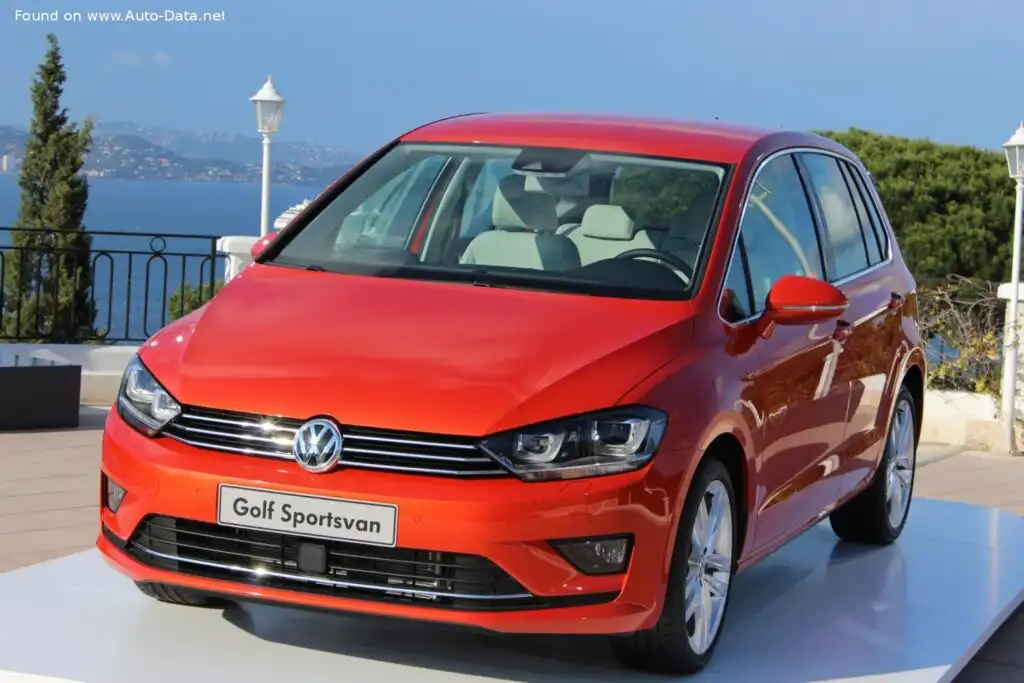
The Volkswagen Golf VII Sportsvan 1.2 TSI, producing 85 horsepower, was a front-wheel-drive compact minivan produced from August 2012 to March 2017. Positioned as an entry-level offering within the broader Golf Sportsvan (also known as the Golf Variant in some markets) lineup, it aimed to provide a practical and fuel-efficient option for families and individuals seeking a versatile vehicle. This variant occupied the lower end of the performance spectrum for the seventh-generation Golf Sportsvan, slotting below the more powerful 1.4 TSI and diesel options. It was primarily marketed in Europe, where compact MPVs were a popular segment, offering a blend of Golf practicality with increased interior space.
Technical Specifications
| Brand | Volkswagen |
| Model | Golf |
| Generation | Golf VII Sportsvan |
| Type (Engine) | 1.2 TSI (85 Hp) |
| Start of production | August, 2012 |
| End of production | March, 2017 |
| Powertrain Architecture | Internal Combustion engine |
| Body type | Minivan |
| Seats | 5 |
| Doors | 5 |
| Fuel consumption (urban) | 6.4-6.1 l/100 km (36.8 – 38.6 US mpg, 44.1 – 46.3 UK mpg, 15.6 – 16.4 km/l) |
| Fuel consumption (extra urban) | 4.5-4.2 l/100 km (52.3 – 56 US mpg, 62.8 – 67.3 UK mpg, 22.2 – 23.8 km/l) |
| Fuel consumption (combined) | 5.2-4.9 l/100 km (45.2 – 48 US mpg, 54.3 – 57.6 UK mpg, 19.2 – 20.4 km/l) |
| CO2 emissions | 119-114 g/km |
| Fuel Type | Petrol (Gasoline) |
| Acceleration 0 – 100 km/h | 13.2 sec |
| Acceleration 0 – 62 mph | 13.2 sec |
| Acceleration 0 – 60 mph | 12.5 sec |
| Maximum speed | 177 km/h (109.98 mph) |
| Emission standard | Euro 6 |
| Weight-to-power ratio | 14.6 kg/Hp, 68.3 Hp/tonne |
| Weight-to-torque ratio | 7.8 kg/Nm, 128.5 Nm/tonne |
| Power | 85 Hp @ 4300-5300 rpm |
| Power per litre | 71 Hp/l |
| Torque | 160 Nm @ 1400-3500 rpm (118.01 lb.-ft. @ 1400-3500 rpm) |
| Engine layout | Front, Transverse |
| Engine Model/Code | CYVA |
| Engine displacement | 1197 cm3 (73.05 cu. in.) |
| Number of cylinders | 4 |
| Engine configuration | Inline |
| Number of valves per cylinder | 4 |
| Fuel injection system | Direct injection |
| Engine aspiration | Turbocharger, Intercooler |
| Engine oil capacity | 4 l (4.23 US qt | 3.52 UK qt) |
| Kerb Weight | 1245 kg (2744.76 lbs.) |
| Max. weight | 1840 kg (4056.51 lbs.) |
| Max load | 595 kg (1311.75 lbs.) |
| Trunk (boot) space – minimum | 590 l (20.84 cu. ft.) |
| Trunk (boot) space – maximum | 1520 l (53.68 cu. ft.) |
| Fuel tank capacity | 50 l (13.21 US gal | 11 UK gal) |
| Max. roof load | 75 kg (165.35 lbs.) |
| Permitted trailer load with brakes (8%) | 1300 kg (2866.01 lbs.) |
| Permitted trailer load with brakes (12%) | 1100 kg (2425.08 lbs.) |
| Permitted trailer load without brakes | 660 kg (1455.05 lbs.) |
| Permitted towbar download | 80 kg (176.37 lbs.) |
| Length | 4338 mm (170.79 in.) |
| Width | 1807 mm (71.14 in.) |
| Width including mirrors | 2050 mm (80.71 in.) |
| Height | 1578 mm (62.13 in.) |
| Wheelbase | 2685 mm (105.71 in.) |
| Front track | 1543 mm (60.75 in.) |
| Rear (Back) track | 1514 mm (59.61 in.) |
| Ride height (ground clearance) | 144 mm (5.67 in.) |
| Minimum turning circle (turning diameter) | 11.1 m (36.42 ft.) |
| Drivetrain Architecture | The Internal combustion engine (ICE) drives the front wheels of the vehicle. |
| Drive wheel | Front wheel drive |
| Number of gears and type of gearbox | 5 gears, manual transmission |
| Front brakes | Ventilated discs |
| Rear brakes | Disc |
| Assisting systems | ABS (Anti-lock braking system) |
| Steering type | Steering rack and pinion |
| Power steering | Electric Steering |
| Tires size | 205/55 R16 |
| Wheel rims size | 6.5J x 16 |
Powertrain & Engine Architecture
The heart of the Golf VII Sportsvan 1.2 TSI (85 Hp) is the CYVA engine code, a 1.2-liter turbocharged inline-four cylinder petrol engine. This engine is part of Volkswagen’s EA111 family, known for its compact size and efficiency. It utilizes direct fuel injection (FSI) and a single turbocharger with an intercooler to boost power output. The engine’s valvetrain features four valves per cylinder, contributing to improved breathing and efficiency. The 85 horsepower output is achieved between 4300 and 5300 rpm, while peak torque of 160 Nm (118 lb-ft) is available from 1400 to 3500 rpm. The engine is transversely mounted at the front of the vehicle. The transmission is a five-speed manual gearbox, chosen for its cost-effectiveness and contribution to fuel economy. While a seven-speed DSG dual-clutch transmission was available on higher-spec Golf Sportsvans, it wasn’t offered with this particular engine and power output.
Driving Characteristics
The 1.2 TSI 85 hp engine, paired with the five-speed manual transmission, delivers modest performance. Acceleration from 0 to 100 km/h (0-62 mph) takes approximately 13.2 seconds, and top speed is rated at 177 km/h (109.98 mph). In real-world driving, the engine feels adequate for everyday commuting and urban driving, but can feel strained when fully loaded or during overtaking maneuvers. The turbocharger provides a noticeable boost in power, but the engine lacks the punch of the larger 1.4 TSI variants. The gear ratios are tuned for fuel efficiency rather than outright performance. The five-speed gearbox is smooth and precise, but the relatively wide gear spacing can require frequent shifting to maintain optimal engine speed. Compared to the more powerful Golf Sportsvan models, this variant prioritizes fuel economy and affordability over dynamic driving experience.
Equipment & Trim Levels
The 1.2 TSI 85 hp Sportsvan typically came with a base level of equipment, focusing on practicality and essential features. Standard equipment generally included air conditioning, electric front windows, a basic audio system with USB connectivity, and stability control (ESC). Interior upholstery was typically cloth, and the dashboard featured a functional but relatively simple design. Optional extras included alloy wheels, parking sensors, a touchscreen infotainment system, and cruise control. Trim levels varied slightly depending on the market, but generally followed a progressive structure, with higher trims adding more comfort and convenience features. This variant was often seen as a ‘fleet’ or ‘business’ specification, appealing to company car drivers and those prioritizing low running costs.
Chassis & Braking
The Golf VII Sportsvan 1.2 TSI utilizes a MacPherson strut front suspension and a multi-link rear suspension, providing a comfortable and controlled ride. The suspension setup is tuned for everyday driving, prioritizing comfort over sporty handling. The front brakes are ventilated discs, while the rear brakes are solid discs. Anti-lock Braking System (ABS) is standard. The chassis is reinforced to accommodate the increased size and weight of the Sportsvan compared to the standard Golf hatchback. Stabilizer bars are fitted to both the front and rear axles to reduce body roll during cornering. The steering is electrically assisted, providing light and precise steering feel.
Market Reception & Comparison
The Golf VII Sportsvan 1.2 TSI (85 Hp) received mixed reviews. Critics praised its fuel efficiency and practicality, but noted its lack of outright performance. Compared to the 1.4 TSI and diesel variants, it was considered less refined and less engaging to drive. However, its lower price point and competitive fuel economy made it an attractive option for budget-conscious buyers. Fuel economy figures of 5.2-4.9 l/100 km (45.2 – 48 US mpg) were a key selling point. Reliability was generally good, with the 1.2 TSI engine proving to be relatively robust. However, some owners reported issues with the turbocharger and fuel injectors.
Legacy
The Volkswagen Golf VII Sportsvan 1.2 TSI (85 Hp) remains a relatively common sight on European roads. While not a performance icon, it has proven to be a reliable and practical family vehicle. In the used car market, it represents an affordable entry point into Golf ownership. The 1.2 TSI engine, while not as powerful as some of its counterparts, has demonstrated reasonable long-term reliability, provided it has been properly maintained. Its fuel efficiency and spacious interior continue to appeal to buyers seeking a versatile and economical vehicle.