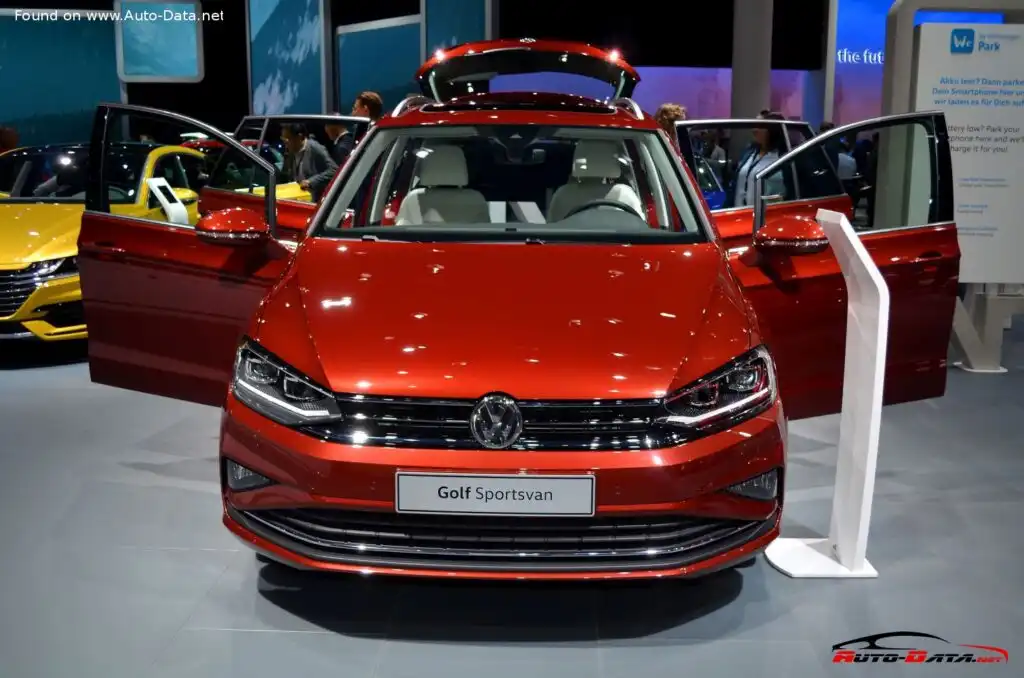
The Volkswagen Golf VII Sportsvan 1.0 TSI (116 hp) DSG, produced from 2018 to 2019, represents a specific configuration within the broader Golf VII Sportsvan (facelifted in 2017) range. Positioned as an entry-to-mid-level trim, this variant aimed to provide a balance of fuel efficiency, practicality, and modern technology within the compact minivan segment. It was primarily marketed in Europe, where the Sportsvan – a taller, more spacious alternative to the standard Golf hatchback – found a significant audience among families and those requiring versatile cargo space. This model utilized the A3 platform, shared with several other Volkswagen Group vehicles.
Technical Specifications
| Brand | Volkswagen |
| Model | Golf |
| Generation | Golf VII Sportsvan (facelift 2017) |
| Type (Engine) | 1.0 TSI (116 Hp) DSG |
| Start of production | 2018 |
| End of production | 2019 |
| Powertrain Architecture | Internal Combustion engine |
| Body type | Minivan |
| Seats | 5 |
| Doors | 5 |
| Fuel consumption (urban) | 5.5-5.7 l/100 km (42.8 – 41.3 US mpg, 51.4 – 49.6 UK mpg, 18.2 – 17.5 km/l) |
| Fuel consumption (extra urban) | 4.7 l/100 km (50 US mpg, 60.1 UK mpg, 21.3 km/l) |
| Fuel consumption (combined) | 5.0-5.1 l/100 km (47 – 46.1 US mpg, 56.5 – 55.4 UK mpg, 20 – 19.6 km/l) |
| CO2 emissions | 113-116 g/km |
| Fuel Type | Petrol (Gasoline) |
| Acceleration 0 – 100 km/h | 10.5 sec |
| Acceleration 0 – 62 mph | 10.5 sec |
| Acceleration 0 – 60 mph | 10 sec |
| Maximum speed | 192 km/h (119.3 mph) |
| Emission standard | Euro 6d-TEMP |
| Weight-to-power ratio | 11.7 kg/Hp, 85.6 Hp/tonne |
| Weight-to-torque ratio | 6.8 kg/Nm, 147.6 Nm/tonne |
| Power | 116 Hp |
| Power per litre | 116.1 Hp/l |
| Torque | 200 Nm @ 2000-3500 rpm (147.51 lb.-ft. @ 2000-3500 rpm) |
| Engine layout | Front, Transverse |
| Engine Model/Code | DKRA, DKRF |
| Engine displacement | 999 cm3 (60.96 cu. in.) |
| Number of cylinders | 3 |
| Engine configuration | Inline |
| Number of valves per cylinder | 4 |
| Fuel injection system | Direct injection |
| Engine aspiration | Turbocharger, Intercooler |
| Engine oil capacity | 4 l (4.23 US qt | 3.52 UK qt) |
| Kerb Weight | 1355 kg (2987.26 lbs.) |
| Max. weight | 1880 kg (4144.69 lbs.) |
| Max load | 525 kg (1157.43 lbs.) |
| Trunk (boot) space – minimum | 590 l (20.84 cu. ft.) |
| Trunk (boot) space – maximum | 1520 l (53.68 cu. ft.) |
| Fuel tank capacity | 50 l (13.21 US gal | 11 UK gal) |
| Max. roof load | 75 kg (165.35 lbs.) |
| Permitted trailer load with brakes (8%) | 1500 kg (3306.93 lbs.) |
| Permitted trailer load with brakes (12%) | 1300 kg (2866.01 lbs.) |
| Permitted trailer load without brakes | 670 kg (1477.1 lbs.) |
| Permitted towbar download | 80 kg (176.37 lbs.) |
| Length | 4351 mm (171.3 in.) |
| Width | 1807 mm (71.14 in.) |
| Width including mirrors | 2050 mm (80.71 in.) |
| Height | 1613 mm (63.5 in.) |
| Wheelbase | 2670 mm (105.12 in.) |
| Front track | 1533-1549 mm (60.35 – 60.98 in.) |
| Rear (Back) track | 1504-1520 mm (59.21 – 59.84 in.) |
| Minimum turning circle | 11.1 m (36.42 ft.) |
| Drive wheel | Front wheel drive |
| Number of gears and type of gearbox | 7 gears, automatic transmission DSG |
| Assisting systems | ABS (Anti-lock braking system) |
| Steering type | Steering rack and pinion |
| Power steering | Electric Steering |
| Tires size | 205/55 R16; 205/50 R17 |
| Wheel rims size | 6.5J x 16; 6J x 17 |
Powertrain & Engine Architecture
The heart of this Sportsvan variant is the 1.0 TSI engine, specifically the DKRA or DKRF engine code. This is a three-cylinder, turbocharged gasoline engine with direct fuel injection. The engine utilizes a Miller cycle for improved efficiency, and features an exhaust manifold integrated into the cylinder head for faster warm-up times and reduced emissions. The turbocharger is a single-scroll unit, providing boost across a broad rev range. The 1.0 TSI engine produces 116 horsepower and 200 Nm (147.51 lb-ft) of torque between 2000 and 3500 rpm. This power is delivered to the front wheels via a seven-speed dual-clutch transmission (DSG). The DSG transmission offers quick and smooth gear changes, contributing to both performance and fuel economy. The transmission’s gear ratios are tuned for a balance of acceleration and cruising efficiency.
Driving Characteristics
The 1.0 TSI DSG Sportsvan delivers adequate performance for everyday driving. Acceleration from 0-62 mph takes approximately 10.5 seconds, and the top speed is 119.3 mph. While not particularly sporty, the engine provides sufficient power for overtaking and merging onto highways. The DSG transmission helps to keep the engine in its optimal power band, resulting in a responsive driving experience. Compared to higher-output Golf Sportsvan variants, such as those with the 1.4 TSI engine, this 1.0 TSI model feels less powerful, especially when fully loaded with passengers and cargo. However, it offers a noticeable improvement in fuel economy. The steering is light and precise, making it easy to maneuver in urban environments. The suspension is tuned for comfort, providing a smooth ride over most road surfaces.
Equipment & Trim Levels
The 1.0 TSI DSG Sportsvan typically came equipped with a reasonable level of standard features. These included air conditioning, a touchscreen infotainment system with Bluetooth connectivity, alloy wheels, and a suite of safety features such as ABS, electronic stability control, and multiple airbags. Higher trim levels offered additional features such as automatic climate control, parking sensors, a rearview camera, and upgraded upholstery. Optional extras included a panoramic sunroof, adaptive cruise control, and a navigation system. Interior upholstery was typically cloth, with the option of leather upgrades on higher trims. The dashboard layout was typical of the Golf VII, with a clean and functional design.
Chassis & Braking
The Golf Sportsvan’s chassis is based on the MQB platform, providing a solid and stable foundation. The front suspension utilizes MacPherson struts, while the rear suspension employs a multi-link setup. This configuration provides a good balance of ride comfort and handling. Braking systems varied slightly depending on the specific trim level and options selected. Most models featured disc brakes on the front wheels and drum brakes on the rear. Higher-spec models often included disc brakes on all four wheels. The Sportsvan typically included a stabilizer bar on both the front and rear axles to reduce body roll during cornering.
Market Reception & Comparison
The Golf Sportsvan 1.0 TSI DSG was generally well-received by automotive critics. It was praised for its fuel efficiency, practicality, and comfortable ride. However, some reviewers noted that the 1.0 TSI engine could feel underpowered, especially when the vehicle was fully loaded. Compared to other trims in the Golf Sportsvan lineup, the 1.0 TSI offered the most affordable entry point, making it an attractive option for budget-conscious buyers. The 1.4 TSI variants offered more performance but came at a higher price. The 1.6 TDI diesel models provided excellent fuel economy but were subject to stricter emissions regulations in some markets.
Legacy
The 1.0 TSI engine has proven to be a relatively reliable powertrain, although some owners have reported issues with the timing chain. Regular maintenance, including oil changes and timing chain inspections, is crucial for ensuring long-term reliability. On the used car market, the Golf Sportsvan 1.0 TSI DSG represents a good value proposition, offering a practical and fuel-efficient vehicle at an affordable price. Its compact size, spacious interior, and modern features make it a popular choice among families and those seeking a versatile vehicle for everyday use. The DSG transmission, while generally reliable, requires periodic servicing to maintain optimal performance.