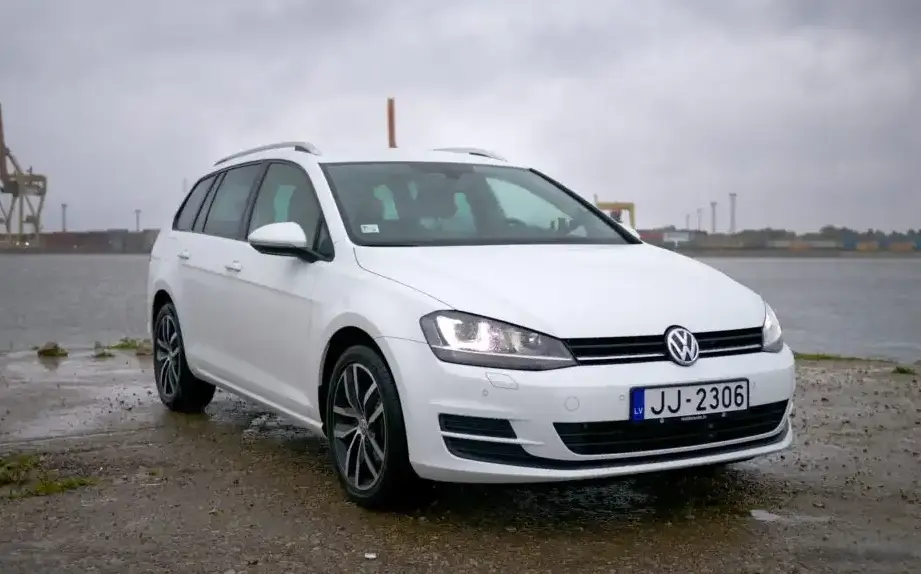
The Volkswagen Golf VII Variant 1.0 TSI (115 hp) BlueMotion DSG represents a significant entry point into the seventh-generation Golf Variant (estate) lineup, produced between April 2015 and December 2016. Positioned as a fuel-efficient and practical option, this variant combined a downsized turbocharged engine with a dual-clutch transmission, catering to buyers prioritizing economy and usability over outright performance. It was part of the broader Golf VII series, built on the versatile MQB (Modular Transverse Matrix) platform – designated 1HX0 for the hatchback and 1K80 for the Variant – which underpinned numerous models across the Volkswagen Group.
Technical Specifications
| Brand | Volkswagen |
| Model | Golf |
| Generation | Golf VII Variant |
| Type (Engine) | 1.0 TSI (115 Hp) BlueMotion DSG |
| Start of production | April, 2015 |
| End of production | December, 2016 |
| Powertrain Architecture | Internal Combustion engine |
| Body type | Station wagon (estate) |
| Seats | 5 |
| Doors | 5 |
| Fuel consumption (urban) | 5.4 l/100 km (43.6 US mpg, 52.3 UK mpg, 18.5 km/l) |
| Fuel consumption (extra urban) | 4 l/100 km (58.8 US mpg, 70.6 UK mpg, 25 km/l) |
| Fuel consumption (combined) | 4.5 l/100 km (52.3 US mpg, 62.8 UK mpg, 22.2 km/l) |
| CO2 emissions | 103 g/km |
| Fuel Type | Petrol (Gasoline) |
| Acceleration 0 – 100 km/h | 10.1 sec |
| Acceleration 0 – 62 mph | 10.1 sec |
| Acceleration 0 – 60 mph | 9.6 sec |
| Maximum speed | 204 km/h (126.76 mph) |
| Emission standard | Euro 6 |
| Weight-to-power ratio | 10.7 kg/Hp, 93.1 Hp/tonne |
| Weight-to-torque ratio | 6.2 kg/Nm, 161.9 Nm/tonne |
| Power | 115 Hp @ 5000-5500 rpm |
| Power per litre | 115.1 Hp/l |
| Torque | 200 Nm @ 2000-3500 rpm (147.51 lb.-ft. @ 2000-3500 rpm) |
| Engine layout | Front, Transverse |
| Engine Model/Code | CHZD |
| Engine displacement | 999 cm3 (60.96 cu. in.) |
| Number of cylinders | 3 |
| Engine configuration | Inline |
| Number of valves per cylinder | 4 |
| Fuel injection system | Direct injection |
| Engine aspiration | Turbocharger, Intercooler |
| Engine oil capacity | 4 l (4.23 US qt | 3.52 UK qt) |
| Kerb Weight | 1235 kg (2722.71 lbs) |
| Max. weight | 1810 kg (3990.37 lbs) |
| Max load | 575 kg (1267.66 lbs) |
| Trunk (boot) space – minimum | 605 l (21.37 cu. ft.) |
| Trunk (boot) space – maximum | 1620 l (57.21 cu. ft.) |
| Fuel tank capacity | 50 l (13.21 US gal | 11 UK gal) |
| Max. roof load | 75 kg (165.35 lbs) |
| Permitted trailer load with brakes (8%) | 1300 kg (2866.01 lbs) |
| Permitted trailer load with brakes (12%) | 1100 kg (2425.08 lbs) |
| Permitted trailer load without brakes | 650 kg (1433 lbs) |
| Permitted towbar download | 80 kg (176.37 lbs) |
| Length | 4562 mm (179.61 in) |
| Width | 1799 mm (70.83 in) |
| Width including mirrors | 2027 mm (79.8 in) |
| Height | 1481 mm (58.31 in) |
| Wheelbase | 2635 mm (103.74 in) |
| Front track | 1549 mm (60.98 in) |
| Rear (Back) track | 1520 mm (59.84 in) |
| Ride height (ground clearance) | 140 mm (5.51 in) |
| Minimum turning circle (turning diameter) | 10.9 m (35.76 ft) |
| Drivetrain Architecture | The Internal combustion engine (ICE) drives the front wheels of the vehicle. |
| Drive wheel | Front wheel drive |
| Number of gears and type of gearbox | 7 gears, automatic transmission DSG |
| Front brakes | Ventilated discs |
| Rear brakes | Disc |
| Assisting systems | ABS (Anti-lock braking system) |
| Steering type | Steering rack and pinion |
| Power steering | Electric Steering |
| Tires size | 195/65 R15; 205/55 R16 |
| Wheel rims size | 6J x 15; 6.5J x 16 |
Powertrain & Engine Architecture
The heart of this Golf Variant is the CHZD engine, a 999cc inline-three cylinder petrol engine. This engine is part of Volkswagen’s EA211 family, known for its compact design and efficiency. The CHZD utilizes direct fuel injection and a single turbocharger with an intercooler to deliver 115 horsepower and 200 Nm (147.51 lb-ft) of torque. The turbocharger provides a noticeable boost in power, particularly at lower engine speeds, helping to overcome the limitations of the small displacement. The engine’s valvetrain features four valves per cylinder, contributing to improved breathing and efficiency. Paired with this engine is a 7-speed dual-clutch transmission (DSG), offering quick and smooth gear changes. The DSG transmission is programmed for fuel efficiency, with taller gear ratios in the higher gears to reduce engine speed at cruising speeds.
Driving Characteristics
The 1.0 TSI with the DSG transmission delivers a surprisingly refined driving experience. While not a performance-oriented setup, it provides adequate power for everyday driving situations. Acceleration from 0-60 mph takes around 9.6 seconds, and top speed is rated at 126.76 mph. The DSG transmission contributes to smooth acceleration and minimizes the need for frequent gear changes. However, compared to higher-output Golf variants like the 1.8 TSI or the diesel-powered models, this version feels less responsive, especially when overtaking or climbing hills. The gear ratios are optimized for fuel economy, which can sometimes result in the engine feeling slightly strained at higher speeds. The steering is light and precise, making it easy to maneuver in urban environments.
Equipment & Trim Levels
The 1.0 TSI BlueMotion DSG typically came with a reasonable level of standard equipment. This included air conditioning, alloy wheels (typically 16-inch), a touchscreen infotainment system with Bluetooth connectivity, and a suite of safety features such as ABS, ESC (Electronic Stability Control), and multiple airbags. Higher trim levels, such as Comfortline or Highline, added features like automatic climate control, parking sensors, cruise control, and upgraded interior upholstery. Optional extras included a panoramic sunroof, navigation system, and adaptive dampers.
Chassis & Braking
The Golf VII Variant’s chassis features independent suspension at the front (MacPherson strut) and a multi-link rear suspension. This setup provides a comfortable ride and good handling characteristics. The 1.0 TSI variant typically used ventilated front discs and solid rear discs for braking. ABS (Anti-lock Braking System) and ESC (Electronic Stability Control) were standard features, enhancing safety and stability. The suspension tuning was generally geared towards comfort, with a focus on absorbing bumps and providing a smooth ride. Stabilizer bars were fitted to both the front and rear axles to reduce body roll during cornering.
Market Reception & Comparison
The Golf VII Variant 1.0 TSI BlueMotion DSG was generally well-received by critics for its fuel efficiency and practicality. It offered a compelling alternative to diesel-powered models, particularly for buyers concerned about emissions regulations. However, some reviewers noted that the engine could feel underpowered in certain situations, especially when fully loaded or driving uphill. Compared to the 1.4 TSI, the 1.0 TSI offered similar fuel economy but with slightly less power. The 1.8 TSI provided significantly more performance but at the cost of increased fuel consumption. The diesel variants (like the 1.6 TDI or 2.0 TDI) offered even better fuel economy and torque, but were often more expensive to purchase.
Legacy
The 1.0 TSI engine has proven to be a relatively reliable unit, although some owners have reported issues with the turbocharger and direct injection system. Regular maintenance, including oil changes and spark plug replacements, is crucial for ensuring long-term reliability. In the used car market, the Golf VII Variant 1.0 TSI BlueMotion DSG represents a good value proposition for buyers seeking a practical, fuel-efficient, and well-equipped estate car. Its compact engine and DSG transmission make it a suitable choice for urban driving and long-distance journeys alike. However, potential buyers should be aware of the potential for turbocharger and direct injection issues and ensure that the vehicle has been properly maintained.