Technical Specifications
| Brand | Volkswagen |
| Model | Golf |
| Generation | Golf VII Variant |
| Type (Engine) | 1.6 TDI (105 Hp) |
| Start of production | May, 2013 |
| End of production | April, 2014 |
| Powertrain Architecture | Internal Combustion engine |
| Body type | Station wagon (estate) |
| Seats | 5 |
| Doors | 5 |
| Fuel consumption (urban) | 4.9 l/100 km (48 US mpg, 57.6 UK mpg, 20.4 km/l) |
| Fuel consumption (extra urban) | 3.3 l/100 km (71.3 US mpg, 85.6 UK mpg, 30.3 km/l) |
| Fuel consumption (combined) | 3.9 l/100 km (60.3 US mpg, 72.4 UK mpg, 25.6 km/l) |
| Fuel Type | Diesel |
| Acceleration 0 – 100 km/h | 11.2 sec |
| Acceleration 0 – 62 mph | 11.2 sec |
| Acceleration 0 – 60 mph | 10.6 sec |
| Maximum speed | 193 km/h (119.92 mph) |
| Weight-to-power ratio | 13.3 kg/Hp, 75.3 Hp/tonne |
| Weight-to-torque ratio | 5.6 kg/Nm, 179.2 Nm/tonne |
| Power | 105 Hp @ 3000-4000 rpm |
| Power per litre | 65.7 Hp/l |
| Torque | 250 Nm @ 1500-2750 rpm (184.39 lb.-ft. @ 1500-2750 rpm) |
| Engine layout | Front, Transverse |
| Engine Model/Code | CLHA |
| Engine displacement | 1598 cm3 (97.52 cu. in.) |
| Number of cylinders | 4 |
| Engine configuration | Inline |
| Fuel injection system | Diesel Commonrail |
| Engine aspiration | Turbocharger, Intercooler |
| Engine oil capacity | 4.7 l (4.97 US qt | 4.14 UK qt) |
| Kerb Weight | 1395 kg (3075.45 lbs.) |
| Max. weight | 1920 kg (4232.88 lbs.) |
| Max load | 525 kg (1157.43 lbs.) |
| Trunk (boot) space – minimum | 605 l (21.37 cu. ft.) |
| Trunk (boot) space – maximum | 1620 l (57.21 cu. ft.) |
| Fuel tank capacity | 50 l (13.21 US gal | 11 UK gal) |
| Length | 4562 mm (179.61 in.) |
| Width | 1799 mm (70.83 in.) |
| Height | 1481 mm (58.31 in.) |
| Wheelbase | 2635 mm (103.74 in.) |
| Front track | 1549 mm (60.98 in.) |
| Rear (Back) track | 1520 mm (59.84 in.) |
| Minimum turning circle | 10.9 m (35.76 ft.) |
| Drivetrain Architecture | The Internal combustion engine (ICE) drives the front wheels of the vehicle. |
| Drive wheel | Front wheel drive |
| Number of gears and type of gearbox | 5 gears, manual transmission |
| Assisting systems | ABS (Anti-lock braking system) |
| Steering type | Steering rack and pinion |
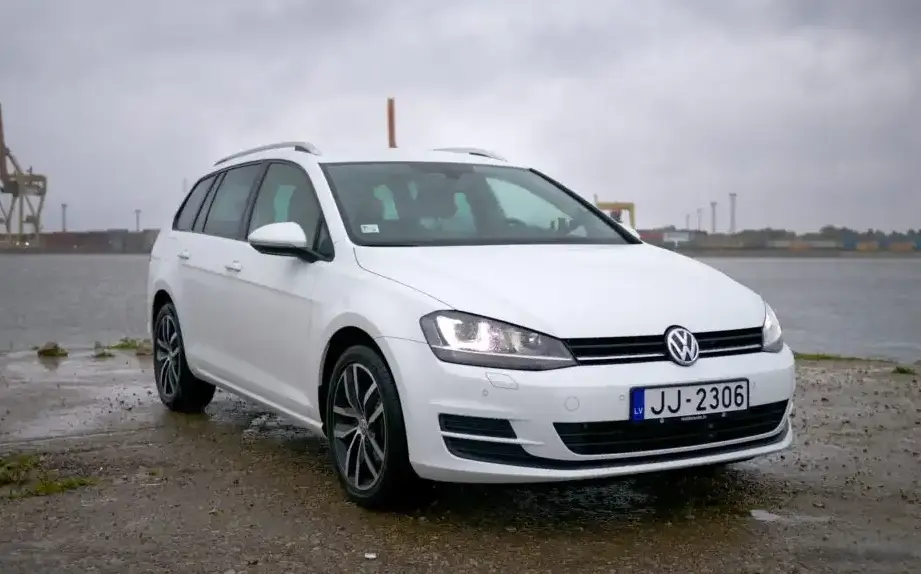
The Volkswagen Golf VII Variant 1.6 TDI (105 hp) was a station wagon, or estate as it’s known in Europe, produced between May 2013 and April 2014. Positioned as an entry-level offering within the Golf VII Variant range, it aimed to provide fuel efficiency and practicality for families and individuals seeking a versatile vehicle. This variant was part of the seventh generation of the Golf, known internally as the A7 platform, and represented Volkswagen’s continued commitment to offering a comprehensive lineup of Golf models to suit diverse consumer needs. It primarily served the European market, where the station wagon body style remains popular, though limited numbers were also available in other regions. The Golf VII Variant, in general, offered increased cargo capacity compared to the standard Golf hatchback, making it a popular choice for those needing more space.
Powertrain & Engine Architecture
The Golf VII Variant 1.6 TDI (105 hp) was powered by the CLHA engine code, a 1.6-liter inline-four cylinder diesel engine. This engine utilized a common rail direct injection system, delivering fuel directly into the combustion chamber at extremely high pressure for improved efficiency and reduced emissions. A turbocharger with an intercooler was employed to boost power output and enhance torque across a wider rev range. The engine featured four valves per cylinder and a single overhead camshaft. The 1.6 TDI engine was known for its relatively simple design, contributing to its reliability and lower maintenance costs compared to more complex engines. The five-speed manual transmission was the standard offering, chosen for its cost-effectiveness and suitability for the engine’s torque characteristics. The transmission’s gear ratios were optimized for fuel economy, with a relatively long final drive. While an automatic transmission was available on other Golf VII variants, it wasn’t offered with this specific 1.6 TDI engine and power output.
Driving Characteristics
The 1.6 TDI 105 hp variant offered a practical and economical driving experience. Acceleration was adequate for everyday driving, with a 0-60 mph time of around 10.6 seconds. However, it wasn’t designed for spirited performance. The engine produced a respectable 250 Nm (184 lb-ft) of torque, available from 1500-2750 rpm, providing sufficient pulling power for highway cruising and overtaking. Compared to the more powerful Golf VII Variant models, such as those equipped with the 2.0 TDI or petrol engines, the 1.6 TDI felt noticeably slower. The manual transmission, while precise, required frequent shifting to maintain momentum, especially when climbing hills or carrying a full load. The focus was clearly on fuel efficiency rather than outright performance. The long gearing contributed to the fuel economy but also meant the engine could feel strained when accelerating quickly. The suspension provided a comfortable ride, absorbing bumps and imperfections in the road well.
Equipment & Trim Levels
The 1.6 TDI (105 hp) typically served as the entry point to the Golf VII Variant range. Standard equipment generally included air conditioning, power windows, central locking, a basic audio system with USB connectivity, and alloy wheels. Safety features such as ABS, electronic stability control, and multiple airbags were also standard. Higher trim levels, such as Trendline and Comfortline, added features like cruise control, a multi-function steering wheel, upgraded audio systems, and parking sensors. Optional extras included a panoramic sunroof, navigation system, and leather upholstery. Interior upholstery was typically cloth, with a functional and durable design. The dashboard layout was consistent across the Golf VII range, featuring a clean and modern aesthetic. The base trim level prioritized essential features, keeping the price point accessible to a wider range of buyers.
Chassis & Braking
The Golf VII Variant 1.6 TDI utilized a MacPherson strut front suspension and a multi-link rear suspension, providing a comfortable and controlled ride. The suspension was tuned for everyday driving, prioritizing comfort over sporty handling. Braking systems varied depending on the specific trim level, but generally consisted of disc brakes on the front wheels and drum brakes on the rear wheels. ABS (Anti-lock Braking System) was standard. Stabilizer bars were fitted to both the front and rear axles to reduce body roll during cornering. The chassis was designed to balance ride comfort with handling stability, making it suitable for a wide range of driving conditions. The relatively lightweight engine contributed to balanced handling characteristics.
Market Reception & Comparison
The Golf VII Variant 1.6 TDI (105 hp) was well-received in the European market as a practical and fuel-efficient option. Critics praised its low running costs and spacious interior. However, some reviewers noted its lack of outright performance compared to higher-powered variants. Compared to the 2.0 TDI models, the 1.6 TDI offered significantly better fuel economy but at the expense of acceleration and overall refinement. The 1.9 TDI, while older technology, offered a similar level of performance with potentially lower maintenance costs. The 1.6 TDI appealed to buyers who prioritized fuel efficiency and practicality over driving excitement. It was often chosen by families and individuals who primarily used the vehicle for commuting and everyday errands.
Legacy
The 1.6 TDI engine, particularly the CLHA variant, proved to be a relatively reliable powertrain. While diesel engines, in general, can be susceptible to issues with the diesel particulate filter (DPF) and turbocharger, the 1.6 TDI was generally considered robust, especially when properly maintained. In the used car market, the Golf VII Variant 1.6 TDI (105 hp) remains a popular choice for buyers seeking an affordable and economical station wagon. Its fuel efficiency and practicality continue to be key selling points. However, potential buyers should be aware of the potential for DPF issues and ensure that the vehicle has been properly maintained with regular oil changes and DPF regeneration cycles. The Golf VII Variant 1.6 TDI represents a solid and dependable option for those seeking a versatile and economical family vehicle, offering a good balance of practicality, fuel efficiency, and reliability.