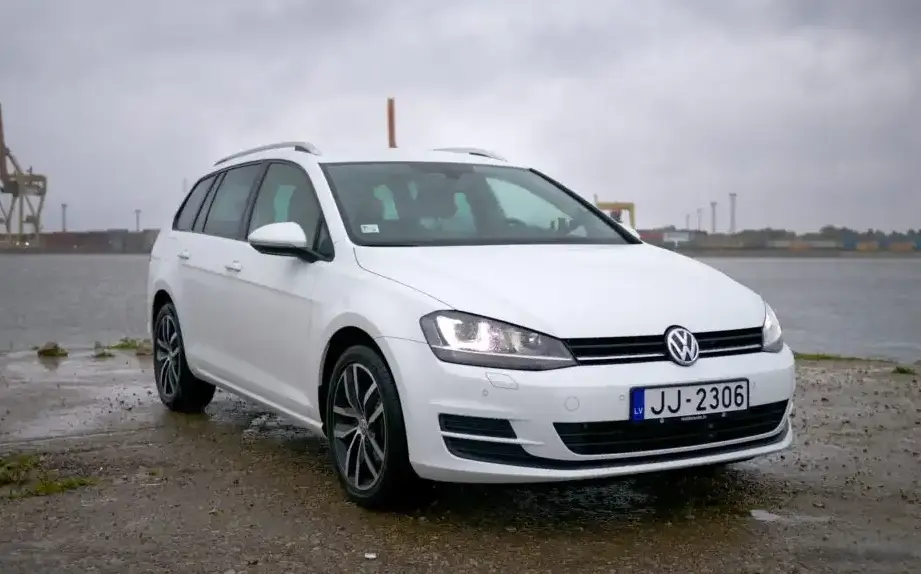
The Volkswagen Golf VII Variant 1.6 TDI 4MOTION, produced from May 2013 to April 2014, represents a practical and efficient offering within the seventh generation Golf lineup. Positioned as a mid-range option, this variant combined the versatility of the Golf Variant (estate/wagon) body style with Volkswagen’s 1.6-liter turbocharged diesel engine and their 4MOTION all-wheel-drive system. It catered to buyers seeking enhanced traction and practicality without the higher costs associated with more powerful engine options. This model was primarily sold in European markets, where diesel engines and station wagons remained highly popular, offering a balance between fuel economy, space, and all-weather capability.
Technical Specifications
| Brand | Volkswagen |
| Model | Golf |
| Generation | Golf VII Variant |
| Type (Engine) | 1.6 TDI (105 Hp) 4MOTION |
| Start of production | May, 2013 |
| End of production | April, 2014 |
| Powertrain Architecture | Internal Combustion engine |
| Body type | Station wagon (estate) |
| Seats | 5 |
| Doors | 5 |
| Fuel consumption (urban) | 5.5 l/100 km (42.8 US mpg, 51.4 UK mpg, 18.2 km/l) |
| Fuel consumption (extra urban) | 4 l/100 km (58.8 US mpg, 70.6 UK mpg, 25 km/l) |
| Fuel consumption (combined) | 4.5 l/100 km (52.3 US mpg, 62.8 UK mpg, 22.2 km/l) |
| Fuel Type | Diesel |
| Acceleration 0 – 100 km/h | 11.9 sec |
| Acceleration 0 – 62 mph | 11.9 sec |
| Acceleration 0 – 60 mph | 11.3 sec |
| Maximum speed | 189 km/h (117.44 mph) |
| Weight-to-power ratio | 14.2 kg/Hp, 70.3 Hp/tonne |
| Weight-to-torque ratio | 6 kg/Nm, 167.3 Nm/tonne |
| Power | 105 Hp @ 3000-4000 rpm |
| Power per litre | 65.7 Hp/l |
| Torque | 250 Nm @ 1500-2750 rpm (184.39 lb.-ft. @ 1500-2750 rpm) |
| Engine layout | Front, Transverse |
| Engine Model/Code | CLHA |
| Engine displacement | 1598 cm3 (97.52 cu. in.) |
| Number of cylinders | 4 |
| Engine configuration | Inline |
| Fuel injection system | Diesel Commonrail |
| Engine aspiration | Turbocharger, Intercooler |
| Engine oil capacity | 4.7 l (4.97 US qt | 4.14 UK qt) |
| Kerb Weight | 1494 kg (3293.71 lbs) |
| Max. weight | 1980 kg (4365.15 lbs) |
| Max load | 486 kg (1071.45 lbs) |
| Trunk (boot) space – minimum | 605 l (21.37 cu. ft) |
| Trunk (boot) space – maximum | 1620 l (57.21 cu. ft) |
| Fuel tank capacity | 50 l (13.21 US gal | 11 UK gal) |
| Length | 4562 mm (179.61 in) |
| Width | 1799 mm (70.83 in) |
| Height | 1481 mm (58.31 in) |
| Wheelbase | 2635 mm (103.74 in) |
| Front track | 1549 mm (60.98 in) |
| Rear (Back) track | 1520 mm (59.84 in) |
| Minimum turning circle | 10.9 m (35.76 ft) |
| Drive wheel | All wheel drive (4×4) |
| Number of gears | 6 gears, manual transmission |
| Assisting systems | ABS (Anti-lock braking system) |
| Steering type | Steering rack and pinion |
Powertrain & Engine Architecture
The heart of the Golf VII Variant 1.6 TDI 4MOTION is the CLHA engine code, a 1.6-liter inline-four cylinder diesel engine. This engine utilizes a common rail direct injection system, delivering fuel directly into the combustion chamber at extremely high pressure for improved efficiency and reduced emissions. A turbocharger with an intercooler is employed to boost power output, providing 105 horsepower at 3000-4000 rpm and a respectable 250 Nm (184 lb-ft) of torque between 1500-2750 rpm. The engine’s design prioritizes fuel economy and low-end torque, making it well-suited for everyday driving. The 4MOTION all-wheel-drive system is a Haldex system, a multi-plate clutch system that proactively distributes torque between the front and rear axles as needed, enhancing traction in slippery conditions. The standard transmission for this variant was a six-speed manual gearbox, chosen for its efficiency and driver engagement.
Driving Characteristics
The 1.6 TDI 4MOTION variant offered a composed and comfortable driving experience. While not a performance-oriented model, the engine provided sufficient power for typical commuting and highway driving. The 4MOTION system noticeably improved grip, particularly on wet or loose surfaces, inspiring confidence in challenging conditions. The six-speed manual transmission allowed for precise gear selection, although the gear ratios were tuned for fuel efficiency rather than outright acceleration. Compared to the more powerful 2.0 TDI variants, the 1.6 TDI felt less responsive, especially during overtaking maneuvers. However, it offered a significant advantage in fuel economy, making it an attractive option for drivers prioritizing efficiency.
Equipment & Trim Levels
The Golf VII Variant 1.6 TDI 4MOTION typically came equipped with a reasonable level of standard features. These included air conditioning, power windows, central locking, and an audio system with USB connectivity. Safety features such as ABS, electronic stability control, and multiple airbags were also standard. Interior upholstery was typically cloth, with options for upgraded materials available. Higher trim levels offered additional features such as alloy wheels, a touchscreen infotainment system, and parking sensors. The specific trim levels varied slightly depending on the market, but generally followed a progression from base “Trendline” to mid-range “Comfortline” and higher-spec “Highline” models.
Chassis & Braking
The Golf VII Variant’s chassis was designed to provide a balance between comfort and handling. The front suspension utilized MacPherson struts, while the rear suspension employed a multi-link setup. This configuration delivered a comfortable ride quality while maintaining good control and stability. The braking system consisted of disc brakes on all four wheels, providing adequate stopping power for the vehicle’s weight and performance. The 4MOTION system added to the vehicle’s stability during braking, particularly on slippery surfaces. Stabilizer bars were fitted to both the front and rear axles to reduce body roll during cornering.
Market Reception & Comparison
The Golf VII Variant 1.6 TDI 4MOTION was generally well-received by automotive critics as a practical and efficient estate car. It was praised for its fuel economy, spacious interior, and all-weather capability. However, some critics noted that the engine lacked the punch of the more powerful diesel options. Compared to the 2.0 TDI variants, the 1.6 TDI offered lower running costs but compromised on performance. Against competitors such as the Ford Focus Estate and Skoda Octavia Estate, the Golf VII Variant 1.6 TDI 4MOTION held its own, offering a refined driving experience and a strong brand reputation.
Legacy
The 1.6 TDI engine, while generally reliable, has been subject to some scrutiny regarding diesel emissions standards. However, the CLHA engine code is considered relatively robust when properly maintained. In the used car market, the Golf VII Variant 1.6 TDI 4MOTION represents a sensible and affordable option for buyers seeking a practical and fuel-efficient estate car. Its all-wheel-drive system adds a layer of security and versatility, making it a suitable choice for drivers in regions with inclement weather. Regular maintenance, including oil changes and filter replacements, is crucial to ensure the long-term reliability of this powertrain.