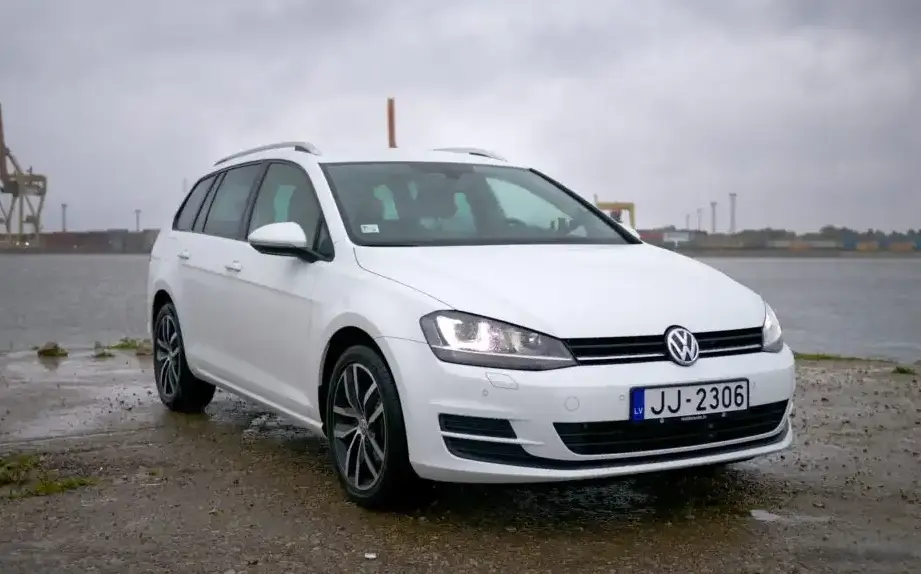
The Volkswagen Golf VII Variant 1.8 TSI (170 hp) was a popular configuration of Volkswagen’s seventh-generation Golf estate, produced between 2014 and 2017. Positioned as a mid-range offering within the Golf VII Variant lineup, it blended respectable performance with good fuel economy, making it a practical choice for families and individuals needing a versatile vehicle. This variant was primarily sold in the European market, where station wagons (known as ‘Variants’ or ‘Estates’) held a significant share of the automotive landscape. It represented a step up in power and refinement from the base 1.2 TSI models, while remaining more accessible than the performance-oriented GTI or diesel-powered GTD versions.
Technical Specifications
| Brand | Volkswagen |
| Model | Golf |
| Generation | Golf VII Variant |
| Type (Engine) | 1.8 TSI (170 Hp) |
| Start of production | 2014 |
| End of production | 2017 |
| Powertrain Architecture | Internal Combustion engine |
| Body type | Station wagon (estate) |
| Seats | 5 |
| Doors | 5 |
| Fuel consumption (economy) – urban (EPA) | 9.4 l/100 km (25 US mpg, 30.1 UK mpg, 10.6 km/l) |
| Fuel consumption (economy) – extra urban (EPA) | 6.5-6.7 l/100 km (36.2 – 35.1 US mpg, 43.5 – 42.2 UK mpg, 15.4 – 14.9 km/l) |
| Fuel consumption (economy) – combined (EPA) | 8.1-8.4 l/100 km (29 – 28 US mpg, 34.9 – 33.6 UK mpg, 12.3 – 11.9 km/l) |
| Fuel Type | Petrol (Gasoline) |
| Weight-to-power ratio | 8.2 kg/Hp, 122.4 Hp/tonne |
| Weight-to-torque ratio | 5.6 kg/Nm, 180 Nm/tonne |
| Power | 170 Hp @ 4500 rpm |
| Power per litre | 94.5 Hp/l |
| Torque | 250 Nm @ 1600 rpm (184.39 lb.-ft. @ 1600 rpm) |
| Engine layout | Front, Transverse |
| Engine Model/Code | EA888 / CXBA, CNSA |
| Engine displacement | 1798 cm3 (109.72 cu. in.) |
| Number of cylinders | 4 |
| Engine configuration | Inline |
| Cylinder Bore | 82.5 mm (3.25 in.) |
| Piston Stroke | 84.1 mm (3.31 in.) |
| Compression ratio | 9.6:1 |
| Number of valves per cylinder | 4 |
| Fuel injection system | Direct injection |
| Engine aspiration | Turbocharger, Intercooler |
| Valvetrain | DOHC |
| Engine oil capacity | 5.7 l (6.02 US qt | 5.02 UK qt) |
| Kerb Weight | 1389 kg (3062.22 lbs.) |
| Max. weight | 1911 kg (4213.03 lbs.) |
| Max load | 522 kg (1150.81 lbs.) |
| Trunk (boot) space – minimum | 605 l (21.37 cu. ft.) |
| Trunk (boot) space – maximum | 1620 l (57.21 cu. ft.) |
| Fuel tank capacity | 50 l (13.21 US gal | 11 UK gal) |
| Length | 4562 mm (179.61 in.) |
| Width | 1799 mm (70.83 in.) |
| Width including mirrors | 2027 mm (79.8 in.) |
| Height | 1481 mm (58.31 in.) |
| Wheelbase | 2630 mm (103.54 in.) |
| Front track | 1549 mm (60.98 in.) |
| Rear (Back) track | 1520 mm (59.84 in.) |
| Ride height (ground clearance) | 140 mm (5.51 in.) |
| Drag coefficient (Cd) | 0.31 |
| Minimum turning circle (turning diameter) | 10.9 m (35.76 ft.) |
| Drivetrain Architecture | The Internal combustion engine (ICE) drives the front wheels of the vehicle. |
| Drive wheel | Front wheel drive |
| Number of gears and type of gearbox | 5 gears, manual transmission |
| Front suspension | Independent, type McPherson with coil spring and anti-roll bar |
| Rear suspension | Independent multi-link spring suspension with stabilizer |
| Front brakes | Ventilated discs, 287×25 mm |
| Rear brakes | Disc, 272×10 mm |
| Assisting systems | ABS (Anti-lock braking system) |
| Steering type | Steering rack and pinion |
| Power steering | Electric Steering |
| Tires size | 195/65 R15; 225/45 R17; 225/40 R18 |
| Wheel rims size | 6J x 15; 7J x 17; 7.5J x 18 |
INTRODUCTION
The Golf VII Variant, launched in 2013, represented Volkswagen’s seventh generation of the iconic Golf, but in a more practical estate body style. The 1.8 TSI (170 hp) variant, introduced in 2014, quickly became a popular choice, offering a balance between performance, fuel efficiency, and practicality. Built on the MQB (Modular Transverse Matrix) platform – specifically the 1HX0/A3 designation – the Golf VII Variant aimed to provide a more spacious and versatile alternative to the standard hatchback, without sacrificing the Golf’s renowned driving dynamics. This model year saw significant updates to the Golf range, including improved engine technology and enhanced safety features.
Powertrain & Engine Architecture
At the heart of the Golf VII Variant 1.8 TSI was the EA888 engine, specifically the CXBA or CNSA code depending on the market and year of production. This 1.8-liter, inline-four cylinder engine utilized direct fuel injection and a single turbocharger with an intercooler. The direct injection system, a key feature of the TSI (Turbocharged Stratified Injection) technology, allowed for precise fuel delivery and improved combustion efficiency. The engine featured a dual overhead camshaft (DOHC) valvetrain with four valves per cylinder, optimizing airflow for increased power output. The turbocharger provided a significant boost in power and torque, delivering 170 horsepower at 4500 rpm and 250 Nm (184 lb-ft) of torque from as low as 1600 rpm. The engine was typically paired with a 6-speed manual transmission, though a 7-speed DSG (Dual Clutch Gearbox) was also available as an option. The DSG offered quicker and smoother gear changes, enhancing the driving experience, but at a higher cost.
Driving Characteristics
The 1.8 TSI engine provided a responsive and enjoyable driving experience in the Golf VII Variant. While not as overtly sporty as the GTI, the 170 hp output was sufficient for confident overtaking and comfortable cruising. The turbocharger provided a noticeable surge of power in the mid-range, making it easy to maintain speed on highways and navigate winding roads. Compared to the lower-powered 1.2 TSI variants, the 1.8 TSI offered a significant improvement in acceleration and overall performance. The manual transmission provided a direct connection to the engine, allowing for precise control, while the optional DSG offered seamless gear changes and enhanced efficiency. The estate body style did add some weight compared to the hatchback, but the engine’s torque compensated for this, providing ample pulling power. The suspension, tuned for comfort and stability, provided a balanced ride, absorbing bumps and imperfections in the road while maintaining good body control.
Equipment & Trim Levels
The Golf VII Variant 1.8 TSI typically came equipped with a generous amount of standard features. These included air conditioning, power windows, power mirrors, a touchscreen infotainment system with Bluetooth connectivity, and alloy wheels. Higher trim levels, such as ‘Comfortline’ and ‘Highline’, added features like automatic climate control, parking sensors, a multi-function steering wheel, and upgraded upholstery. Optional extras included a panoramic sunroof, navigation system, adaptive cruise control, and a premium sound system. Interior upholstery was typically cloth on base models, with leather options available on higher trims. The dashboard layout was clean and modern, with a focus on ergonomics and ease of use.
Chassis & Braking
The Golf VII Variant featured an independent suspension system on both the front and rear axles. The front suspension utilized a McPherson strut design with coil springs and an anti-roll bar, while the rear suspension employed a multi-link setup, also with a stabilizer bar. This configuration provided a good balance between ride comfort and handling precision. Braking duties were handled by ventilated discs on the front wheels and solid discs on the rear. Anti-lock Braking System (ABS) was standard, enhancing safety and control during emergency braking situations. The steering system was a rack and pinion type with electric power assistance, providing precise and responsive steering feel.
Market Reception & Comparison
The Golf VII Variant 1.8 TSI was generally well-received by automotive critics. It was praised for its blend of performance, fuel efficiency, and practicality. Compared to the 1.2 TSI models, the 1.8 TSI offered a noticeable improvement in performance, making it a more enjoyable and versatile vehicle. However, it was more expensive to purchase and maintain than the base models. Compared to the diesel-powered Golf Variants, the 1.8 TSI offered a more refined and responsive driving experience, but typically achieved lower fuel economy. The 1.8 TSI was often seen as a sweet spot in the Golf VII Variant lineup, offering a good balance of features and performance at a reasonable price point.
Legacy
The EA888 1.8 TSI engine, in general, has proven to be a relatively reliable powertrain, although it is not without its potential issues. Common concerns include carbon buildup on the intake valves, which can reduce performance over time, and occasional oil consumption. However, with regular maintenance and proper servicing, these engines can provide many years of reliable service. In the used car market, the Golf VII Variant 1.8 TSI remains a popular choice, offering a practical and well-rounded package. Its reputation for reliability, combined with its comfortable ride and spacious interior, makes it a compelling option for buyers seeking a versatile and affordable estate car.