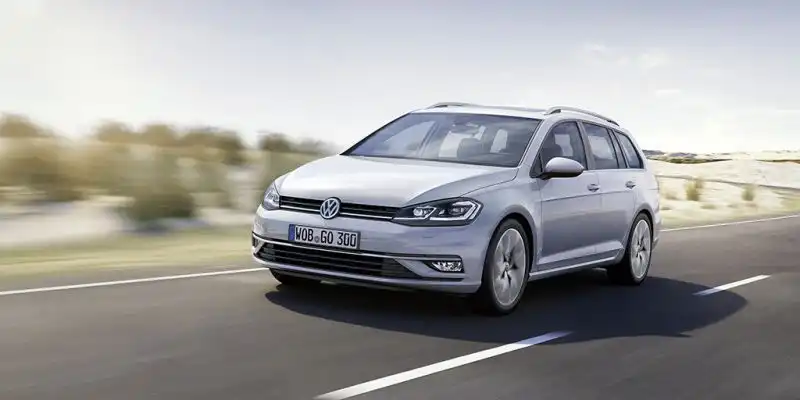
The Volkswagen Golf VII Variant 1.0 TSI (116 hp) DSG, produced from 2018 to 2019, represents a key iteration within the facelifted seventh generation of Volkswagen’s iconic Golf model line. This variant, a practical station wagon (estate) body style, was positioned as an efficient and accessible entry point into the Golf Variant range, appealing to buyers prioritizing fuel economy and everyday usability. It falls within the broader Golf VII (A7) platform, specifically the facelifted version introduced in 2017, which brought styling updates and technological enhancements to the already successful model. The 1.0 TSI with the dual-clutch DSG transmission aimed to provide a balance between performance and running costs, making it a popular choice in European markets.
Technical Specifications
| Brand | Volkswagen |
| Model | Golf |
| Generation | Golf VII Variant (facelift 2017) |
| Type (Engine) | 1.0 TSI (116 Hp) DSG |
| Start of production | 2018 |
| End of production | 2019 |
| Powertrain Architecture | Internal Combustion engine |
| Body type | Station wagon (estate) |
| Seats | 5 |
| Doors | 5 |
| Fuel consumption (urban) | 5.5-5.7 l/100 km (42.8 – 41.3 US mpg, 51.4 – 49.6 UK mpg, 18.2 – 17.5 km/l) |
| Fuel consumption (extra urban) | 4.6-4.7 l/100 km (51.1 – 50 US mpg, 61.4 – 60.1 UK mpg, 21.7 – 21.3 km/l) |
| Fuel consumption (combined) | 4.9-5.0 l/100 km (48 – 47 US mpg, 57.6 – 56.5 UK mpg, 20.4 – 20 km/l) |
| CO2 emissions | 112-114 g/km |
| Fuel Type | Petrol (Gasoline) |
| Acceleration 0 – 100 km/h | 10.2 sec |
| Acceleration 0 – 62 mph | 10.2 sec |
| Acceleration 0 – 60 mph | 9.7 sec |
| Maximum speed | 200 km/h (124.27 mph) |
| Emission standard | Euro 6d-TEMP |
| Weight-to-power ratio | 11.5 kg/Hp, 87.2 Hp/tonne |
| Weight-to-torque ratio | 6.7 kg/Nm, 150.4 Nm/tonne |
| Power | 116 Hp |
| Power per litre | 116.1 Hp/l |
| Torque | 200 Nm @ 2000-3500 rpm (147.51 lb.-ft. @ 2000-3500 rpm) |
| Engine layout | Front, Transverse |
| Engine Model/Code | DKRA, DKRF |
| Engine displacement | 999 cm3 (60.96 cu. in.) |
| Number of cylinders | 3 |
| Engine configuration | Inline |
| Number of valves per cylinder | 4 |
| Fuel injection system | Direct injection |
| Engine aspiration | Turbocharger, Intercooler |
| Engine oil capacity | 4 l (4.23 US qt | 3.52 UK qt) |
| Kerb Weight | 1330 kg (2932.15 lbs.) |
| Max. weight | 1880 kg (4144.69 lbs.) |
| Max load | 550 kg (1212.54 lbs.) |
| Trunk (boot) space – minimum | 605 l (21.37 cu. ft.) |
| Trunk (boot) space – maximum | 1620 l (57.21 cu. ft.) |
| Fuel tank capacity | 50 l (13.21 US gal | 11 UK gal) |
| Max. roof load | 75 kg (165.35 lbs.) |
| Permitted trailer load with brakes (8%) | 1500 kg (3306.93 lbs.) |
| Permitted trailer load with brakes (12%) | 1300 kg (2866.01 lbs.) |
| Permitted trailer load without brakes | 660 kg (1455.05 lbs.) |
| Permitted towbar download | 80 kg (176.37 lbs.) |
| Length | 4567 mm (179.8 in.) |
| Width | 1799 mm (70.83 in.) |
| Width including mirrors | 2027 mm (79.8 in.) |
| Height | 1515 mm (59.65 in.) |
| Wheelbase | 2620 mm (103.15 in.) |
| Front track | 1533-1549 mm (60.35 – 60.98 in.) |
| Rear (Back) track | 1504-1520 mm (59.21 – 59.84 in.) |
| Ride height (ground clearance) | 140 mm (5.51 in.) |
| Minimum turning circle (turning diameter) | 10.9 m (35.76 ft.) |
| Drive wheel | Front wheel drive |
| Number of gears and type of gearbox | 7 gears, automatic transmission DSG |
| Assisting systems | ABS (Anti-lock braking system) |
| Steering type | Steering rack and pinion |
| Power steering | Electric Steering |
| Tires size | 205/55 R16 |
| Wheel rims size | 6.5J x 16 |
Powertrain & Engine Architecture
The heart of this Golf Variant is the 1.0 TSI engine, specifically the DKRA or DKRF engine codes. This is a three-cylinder, 999cc turbocharged gasoline engine featuring direct fuel injection and four valves per cylinder. The direct injection system, coupled with the turbocharger and intercooler, allows for a surprisingly punchy output for its size. The engine utilizes a timing chain for durability. The dual-clutch, seven-speed DSG (Direct-Shift Gearbox) transmission is a crucial component, offering quick and smooth gear changes. This transmission is known for its efficiency and responsiveness, contributing to the vehicle’s overall fuel economy. The DSG unit is electronically controlled, adapting shift points based on driving style and conditions.
Driving Characteristics
The 116 hp output, combined with the DSG transmission, provides adequate performance for everyday driving. Acceleration from 0-60 mph takes around 9.7 seconds, and top speed is rated at 124 mph. While not a sports car, the engine delivers a usable amount of torque (200 Nm or 147.51 lb-ft) between 2000 and 3500 rpm, making overtaking and merging onto highways relatively effortless. Compared to higher-output Golf variants like the 1.8 TSI or the diesel models, this 1.0 TSI feels less powerful, particularly when fully loaded. However, the DSG transmission helps to mitigate this by keeping the engine in its optimal power band. The gear ratios are tuned for fuel efficiency, prioritizing smooth cruising over outright acceleration. The driving experience is generally comfortable and refined, typical of the Golf lineage.
Equipment & Trim Levels
The 1.0 TSI DSG variant typically came with a reasonable level of standard equipment. This included air conditioning, a touchscreen infotainment system with Bluetooth connectivity, alloy wheels, and a suite of safety features like ABS, ESC (Electronic Stability Control), and multiple airbags. Higher trim levels, such as Comfortline or Highline, added features like automatic climate control, parking sensors, adaptive cruise control, and upgraded interior upholstery. Optional extras included a panoramic sunroof, navigation system, and premium sound system. Interior materials were generally of good quality, reflecting Volkswagen’s reputation for build quality.
Chassis & Braking
The Golf VII Variant’s chassis is based on the MQB (Modular Transverse Matrix) platform, providing a good balance between ride comfort and handling. The front suspension utilizes MacPherson struts, while the rear suspension employs a multi-link setup. This configuration contributes to stable and predictable handling. Braking systems varied depending on the trim level, with lower trims often featuring rear drum brakes and higher trims offering rear disc brakes. All variants included ABS and ESC as standard. The steering is electrically assisted, providing a light and precise feel.
Market Reception & Comparison
The Golf VII Variant 1.0 TSI DSG was generally well-received by critics for its fuel efficiency and practicality. It offered a compelling alternative to larger, less economical vehicles. Compared to the 1.6 TDI diesel variant, the 1.0 TSI offered a slightly less refined driving experience but avoided the potential issues associated with diesel particulate filters. Against the more powerful 1.8 TSI, it offered lower running costs but lacked the same level of performance. Fuel economy figures of around 48-47 US mpg combined made it an attractive option for budget-conscious buyers. Reliability was generally good, although some owners reported minor issues with the DSG transmission.
Legacy
The 1.0 TSI engine has become a mainstay in Volkswagen’s lineup, demonstrating its reliability and efficiency. The Golf VII Variant 1.0 TSI DSG remains a popular choice in the used car market, offering a practical and economical option for families and individuals. While not the most exciting Golf variant, it represents a well-rounded package that delivers on its promise of fuel efficiency and everyday usability. The DSG transmission, while requiring occasional maintenance, has proven to be a durable and efficient component. Overall, this variant holds a solid reputation for reliability and value.