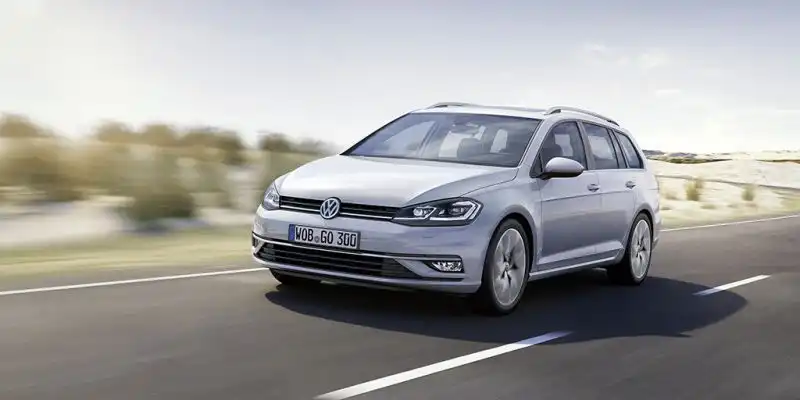
The Volkswagen Golf VII Variant 1.4 TSI (125 hp) DSG, produced from 2017 to March 2018, represents a compelling blend of practicality and efficiency within the seventh generation Golf lineup. This variant, part of the post-facelift models (introduced in 2017), offered a station wagon (estate) body style aimed at buyers seeking increased cargo capacity without sacrificing the Golf’s renowned driving dynamics. Positioned as a mid-range offering, it slotted between the entry-level petrol and diesel models and the more powerful TSI variants, appealing to families and individuals prioritizing fuel economy and comfortable cruising. It was primarily sold in the European market, where the station wagon body style remains highly popular.
Technical Specifications
| Brand | Volkswagen |
| Model | Golf |
| Generation | Golf VII Variant (facelift 2017) |
| Type (Engine) | 1.4 TSI (125 Hp) DSG |
| Start of production | 2017 |
| End of production | March, 2018 |
| Powertrain Architecture | Internal Combustion engine |
| Body type | Station wagon (estate) |
| Seats | 5 |
| Doors | 5 |
| Fuel consumption (urban) | 6.2-6.3 l/100 km (37.9 – 37.3 US mpg, 45.6 – 44.8 UK mpg, 16.1 – 15.9 km/l) |
| Fuel consumption (extra urban) | 4.4-4.5 l/100 km (53.5 – 52.3 US mpg, 64.2 – 62.8 UK mpg, 22.7 – 22.2 km/l) |
| Fuel consumption (combined) | 5.1-5.2 l/100 km (46.1 – 45.2 US mpg, 55.4 – 54.3 UK mpg, 19.6 – 19.2 km/l) |
| CO2 emissions | 118-120 g/km |
| Fuel Type | Petrol (Gasoline) |
| Acceleration 0 – 100 km/h | 9.5 sec |
| Acceleration 0 – 62 mph | 9.5 sec |
| Acceleration 0 – 60 mph | 9 sec (Calculated) |
| Maximum speed | 205 km/h (127.38 mph) |
| Emission standard | Euro 6 |
| Weight-to-power ratio | 10.1 kg/Hp, 99 Hp/tonne |
| Weight-to-torque ratio | 6.3 kg/Nm, 158.4 Nm/tonne |
| Power | 125 Hp @ 5000-6000 rpm |
| Power per litre | 89.6 Hp/l |
| Torque | 200 Nm @ 1400-4000 rpm (147.51 lb.-ft. @ 1400-4000 rpm) |
| Engine layout | Front, Transverse |
| Engine Model/Code | CZCA |
| Engine displacement | 1395 cm3 (85.13 cu. in.) |
| Number of cylinders | 4 |
| Engine configuration | Inline |
| Number of valves per cylinder | 4 |
| Fuel injection system | Direct injection |
| Engine aspiration | Turbocharger, Intercooler |
| Engine oil capacity | 4 l (4.23 US qt | 3.52 UK qt) |
| Kerb Weight | 1263 kg (2784.44 lbs.) |
| Max. weight | 1880 kg (4144.69 lbs.) |
| Max load | 617 kg (1360.25 lbs.) |
| Trunk (boot) space – minimum | 605 l (21.37 cu. ft.) |
| Trunk (boot) space – maximum | 1620 l (57.21 cu. ft.) |
| Fuel tank capacity | 50 l (13.21 US gal | 11 UK gal) |
| Max. roof load | 75 kg (165.35 lbs.) |
| Permitted trailer load with brakes (8%) | 1700 kg (3747.86 lbs.) |
| Permitted trailer load with brakes (12%) | 1400 kg (3086.47 lbs.) |
| Permitted trailer load without brakes | 690 kg (1521.19 lbs.) |
| Permitted towbar download | 80 kg (176.37 lbs.) |
| Length | 4567 mm (179.8 in.) |
| Width | 1799 mm (70.83 in.) |
| Width including mirrors | 2027 mm (79.8 in.) |
| Height | 1515 mm (59.65 in.) |
| Wheelbase | 2620 mm (103.15 in.) |
| Front track | 1549 mm (60.98 in.) |
| Rear (Back) track | 1520 mm (59.84 in.) |
| Ride height (ground clearance) | 140 mm (5.51 in.) |
| Minimum turning circle | 10.9 m (35.76 ft.) |
| Drivetrain Architecture | Front wheel drive |
| Number of gears and type of gearbox | 7 gears, automatic transmission DSG |
| Front brakes | Ventilated discs |
| Rear brakes | Disc |
| Tires size | 205/55 R16 |
| Wheel rims size | 6.5 J x 16 |
INTRODUCTION
The Golf VII Variant 1.4 TSI (125 hp) DSG, introduced as part of the 2017 facelift, builds upon the success of the Golf VII series, which debuted in 2012. The facelift brought subtle styling updates, improved technology, and refined engine options. This particular variant utilizes the MQB (Modular Transverse Matrix) platform, shared with numerous other Volkswagen Group vehicles, allowing for economies of scale and a flexible architecture. The ‘Variant’ designation signifies the station wagon body style, offering a practical alternative to the standard hatchback, with a significantly larger cargo area. This model aimed to provide a balance between affordability, fuel efficiency, and usability for everyday drivers.
Powertrain & Engine Architecture
At the heart of the Golf VII Variant 1.4 TSI (125 hp) DSG lies the CZCA engine code, a 1.4-liter turbocharged four-cylinder petrol engine. This engine is a member of Volkswagen’s EA211 engine family, known for its compact design and efficiency. It features direct fuel injection, delivering fuel directly into the combustion chamber for improved combustion and reduced emissions. The engine utilizes a single turbocharger with an intercooler to boost power output. The 125 hp output is achieved between 5000 and 6000 rpm, while peak torque of 200 Nm (147.51 lb.-ft.) is available from 1400 to 4000 rpm. This broad torque curve contributes to good drivability in various conditions. The engine is paired with a 7-speed dual-clutch transmission (DSG), which provides quick and smooth gear changes. The DSG transmission is electronically controlled and offers both automatic and manual shift modes.
Driving Characteristics
The 1.4 TSI (125 hp) DSG variant delivers a comfortable and refined driving experience. While not overtly sporty, the engine provides adequate power for everyday driving situations, including highway cruising and overtaking. The DSG transmission contributes to seamless acceleration, and the broad torque band minimizes the need for frequent downshifts. Compared to the more powerful 1.8 TSI or 2.0 TSI variants, this engine offers less outright performance, with a 0-100 km/h (0-62 mph) time of 9.5 seconds. However, it excels in fuel efficiency, achieving combined fuel consumption figures of 5.1-5.2 l/100 km (46.1 – 45.2 US mpg). The suspension is tuned for comfort, providing a smooth ride over most road surfaces. The steering is precise and responsive, offering a good level of feedback.
Equipment & Trim Levels
The Golf VII Variant 1.4 TSI (125 hp) DSG typically came equipped with a respectable level of standard features. These included air conditioning, power windows, power mirrors, a touchscreen infotainment system with Bluetooth connectivity, and alloy wheels. Safety features such as ABS, ESP (Electronic Stability Program), and multiple airbags were also standard. Higher trim levels offered additional features such as automatic climate control, a larger touchscreen display, navigation system, parking sensors, and adaptive cruise control. Interior upholstery was typically cloth, with optional leather upholstery available. The dashboard layout was clean and functional, with a focus on ergonomics.
Chassis & Braking
The Golf VII Variant features a MacPherson strut front suspension and a multi-link rear suspension, providing a good balance of ride comfort and handling. The chassis is relatively lightweight, contributing to the car’s agility. The braking system consists of ventilated discs on the front wheels and solid discs on the rear wheels. ABS (Anti-lock Braking System) and ESP (Electronic Stability Program) are standard features, enhancing safety and stability. The steering system is an electric power steering system, providing precise and responsive steering feel.
Market Reception & Comparison
The Golf VII Variant 1.4 TSI (125 hp) DSG was generally well-received by automotive critics. It was praised for its fuel efficiency, comfortable ride, and practical interior space. However, some critics noted that the engine could feel underpowered when fully loaded or when driving uphill. Compared to the 1.6 TDI diesel variant, the 1.4 TSI offered slightly less fuel economy but provided a smoother and quieter driving experience. Compared to the more powerful TSI variants, it was more affordable but lacked the same level of performance. The combination of the 1.4 TSI engine and the DSG transmission proved to be a popular choice for buyers seeking a balance between efficiency and convenience.
Legacy
The CZCA engine, while generally reliable, has been known to exhibit occasional issues with the turbocharger and fuel injectors. Regular maintenance, including oil changes and timely replacement of wear items, is crucial for ensuring long-term reliability. The DSG transmission also requires regular servicing, including fluid changes, to prevent potential problems. In the used car market, the Golf VII Variant 1.4 TSI (125 hp) DSG remains a popular choice due to its practicality, fuel efficiency, and relatively affordable price. It represents a well-rounded and versatile vehicle that continues to offer good value for money.