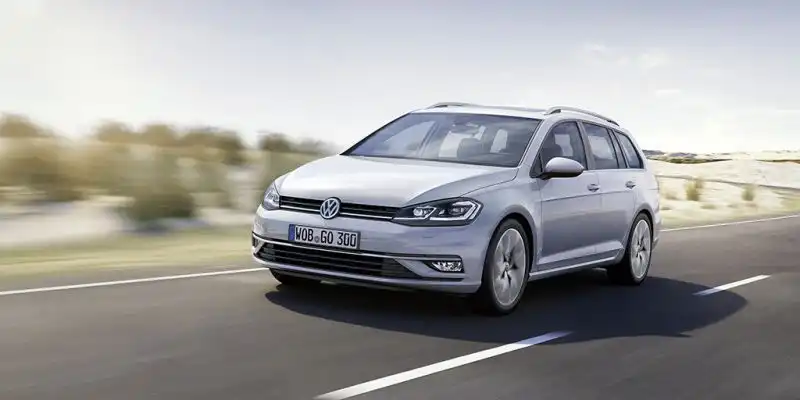
The Volkswagen Golf VII Variant 1.4 TSI (147 hp) represents a compelling blend of practicality and efficiency within the seventh generation Golf lineup. Produced from 2017 to 2020 as part of the facelifted Golf VII series (internally designated as the A7), this variant occupied a mid-range position, offering a balance between performance and fuel economy for buyers seeking a versatile family vehicle. The Golf VII Variant, a station wagon (estate) body style, aimed to provide increased cargo capacity compared to the standard hatchback while retaining the Golf’s renowned driving dynamics and build quality. This specific 1.4 TSI engine and transmission combination was particularly popular in European markets, where fuel efficiency and lower running costs are highly valued.
Technical Specifications
| Brand | Volkswagen |
| Model | Golf |
| Generation | Golf VII Variant (facelift 2017) |
| Type (Engine) | 1.4 TSI (147 Hp) |
| Start of production | 2017 |
| End of production | 2020 |
| Powertrain Architecture | Internal Combustion engine |
| Body type | Station wagon (estate) |
| Seats | 5 |
| Doors | 5 |
| Fuel consumption (urban) | 8.2 l/100 km (28.7 US mpg, 34.4 UK mpg, 12.2 km/l) |
| Fuel consumption (extra urban) | 6.3 l/100 km (37.3 US mpg, 44.8 UK mpg, 15.9 km/l) |
| Fuel consumption (combined) | 7.4 l/100 km (31.8 US mpg, 38.2 UK mpg, 13.5 km/l) |
| Fuel Type | Petrol (Gasoline) |
| Weight-to-power ratio | 9.4 kg/Hp, 105.8 Hp/tonne |
| Weight-to-torque ratio | 5.6 kg/Nm, 180 Nm/tonne |
| Power | 147 Hp @ 5000 rpm |
| Power per litre | 105.4 Hp/l |
| Torque | 250 Nm @ 1500 rpm (184.39 lb.-ft. @ 1500 rpm) |
| Engine layout | Front, Transverse |
| Engine Model/Code | DGXA |
| Engine displacement | 1395 cm3 (85.13 cu. in.) |
| Number of cylinders | 4 |
| Engine configuration | Inline |
| Cylinder Bore | 74.5 mm (2.93 in.) |
| Piston Stroke | 80 mm (3.15 in.) |
| Compression ratio | 10:1 |
| Number of valves per cylinder | 4 |
| Fuel injection system | Direct injection |
| Engine aspiration | Turbocharger, Intercooler |
| Valvetrain | DOHC |
| Engine oil capacity | 4 l (4.23 US qt | 3.52 UK qt) |
| Coolant capacity | 10 l (10.57 US qt | 8.8 UK qt) |
| Kerb Weight | 1389 kg (3062.22 lbs.) |
| Max. weight | 1910 kg (4210.83 lbs.) |
| Max load | 521 kg (1148.61 lbs.) |
| Trunk (boot) space – minimum | 861 l (30.41 cu. ft.) |
| Trunk (boot) space – maximum | 1883 l (66.5 cu. ft.) |
| Fuel tank capacity | 50 l (13.21 US gal | 11 UK gal) |
| Length | 4562 mm (179.61 in.) |
| Width | 1799 mm (70.83 in.) |
| Height | 1481 mm (58.31 in.) |
| Wheelbase | 2629 mm (103.5 in.) |
| Front track | 1549 mm (60.98 in.) |
| Rear track | 1520 mm (59.84 in.) |
| Drag coefficient (Cd) | 0.31 |
| Minimum turning circle | 10.9 m (35.76 ft.) |
| Drivetrain Architecture | Front wheel drive |
| Number of gears | 6 |
| Gearbox type | Manual transmission |
| Front suspension | Independent type McPherson |
| Rear suspension | Independent multi-link suspension |
| Front brakes | Disc |
| Rear brakes | Disc |
| Assisting systems | ABS (Anti-lock braking system) |
| Steering type | Steering rack and pinion |
| Power steering | Electric Steering |
| Tires size | 205/55 R16 |
| Wheel rims size | 16 |
Powertrain & Engine Architecture
The heart of the Golf VII Variant 1.4 TSI is the DGXA engine code, a 1.4-liter turbocharged inline-four cylinder gasoline engine. This engine utilizes direct fuel injection (FSI) and an exhaust gas turbocharger with an intercooler to deliver a balance of power and efficiency. The engine’s design incorporates a variable valve timing system on both the intake and exhaust sides (DOHC – Dual Overhead Camshaft) to optimize performance across the rev range. The 1.4 TSI engine is known for its relatively smooth operation and responsiveness. The 6-speed manual transmission was a common pairing, offering precise shifts and driver engagement. The transmission’s gear ratios were tuned to maximize fuel economy while still providing adequate acceleration.
Driving Characteristics
The 147 hp output, coupled with the 250 Nm (184 lb-ft) of torque available from 1500 rpm, provided adequate performance for everyday driving. While not a sports-oriented variant, the Golf VII Variant 1.4 TSI offered sufficient power for highway cruising and overtaking maneuvers. Compared to the more powerful 1.8 TSI or the diesel-powered TDI models, this version felt less urgent in its acceleration. However, the lower power output also contributed to improved fuel economy. The manual transmission allowed for greater driver control, but the gear ratios were optimized for efficiency rather than outright speed. The suspension setup provided a comfortable ride, absorbing bumps and imperfections in the road effectively.
Equipment & Trim Levels
The Golf VII Variant 1.4 TSI typically came equipped with a respectable level of standard features. These included air conditioning, power windows, power mirrors, a touchscreen infotainment system with Bluetooth connectivity, and a suite of safety features such as ABS, ESP (Electronic Stability Program), and multiple airbags. Higher trim levels offered additional features such as automatic climate control, upgraded upholstery, alloy wheels, parking sensors, and a more advanced infotainment system with navigation. Optional extras included a panoramic sunroof, adaptive cruise control, and a premium sound system.
Chassis & Braking
The Golf VII Variant featured an independent McPherson strut suspension at the front and an independent multi-link suspension at the rear, providing a good balance of ride comfort and handling. The braking system consisted of disc brakes on all four wheels, offering adequate stopping power. ABS (Anti-lock Braking System) was standard, enhancing safety during emergency braking situations. The chassis was designed to minimize weight while maximizing rigidity, contributing to the car’s overall stability and handling characteristics.
Market Reception & Comparison
The Golf VII Variant 1.4 TSI was generally well-received by automotive critics. It was praised for its practicality, fuel efficiency, and comfortable ride. However, some reviewers noted that the 1.4 TSI engine could feel underpowered when the car was fully loaded or traveling uphill. Compared to the 1.8 TSI variant, the 1.4 TSI offered better fuel economy but less performance. The 1.6 TDI diesel model provided even better fuel economy but with a different driving experience. The 1.4 TSI struck a balance between these two extremes, appealing to buyers who prioritized efficiency and affordability.
Legacy
The DGXA 1.4 TSI engine, while generally reliable, has been known to exhibit some issues related to carbon buildup on the intake valves over time, particularly with infrequent oil changes or predominantly short-trip driving. Regular maintenance, including the use of quality engine oil and occasional intake valve cleaning, can help mitigate these issues. The Golf VII Variant 1.4 TSI remains a popular choice in the used car market, offering a practical and efficient option for families and individuals seeking a versatile station wagon. Its reputation for reliability and relatively low running costs continues to make it an attractive proposition.