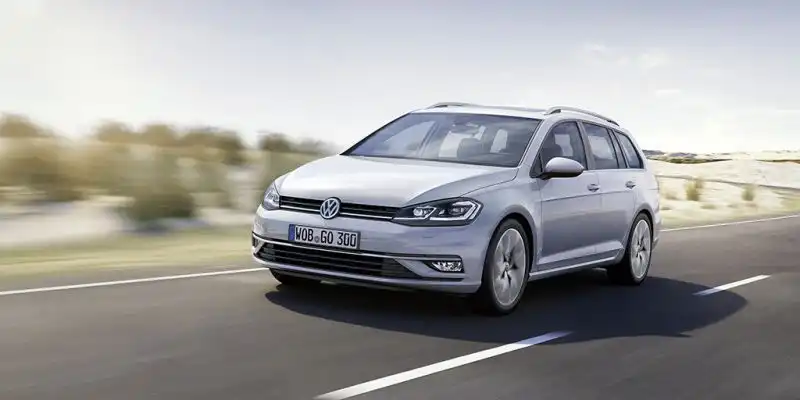
The Volkswagen Golf VII Variant, specifically the 1.8 TSI 4MOTION DSG model produced from 2017 to 2018, represents a compelling blend of practicality, performance, and all-weather capability within the seventh generation Golf lineup. This variant, a facelift of the Golf VII, offered a more refined and technologically advanced package compared to earlier iterations. Positioned as a mid-range offering, it catered to buyers seeking a versatile wagon with enhanced grip and a responsive turbocharged engine. It was a key model for Volkswagen in the European market, where station wagons (known as ‘Variants’ or ‘Estates’) remain popular, offering a premium alternative to more basic family vehicles.
Technical Specifications
| Brand | Volkswagen |
| Model | Golf |
| Generation | Golf VII Variant (facelift 2017) |
| Type (Engine) | 1.8 TSI (168 Hp) 4MOTION DSG |
| Start of production | 2017 |
| End of production | 2018 |
| Powertrain Architecture | Internal Combustion engine |
| Body type | Station wagon (estate) |
| Seats | 5 |
| Doors | 5 |
| Fuel consumption (urban) | 10.8 l/100 km (21.8 US mpg, 26.2 UK mpg, 9.3 km/l) |
| Fuel consumption (extra urban) | 8.1 l/100 km (29 US mpg, 34.9 UK mpg, 12.3 km/l) |
| Fuel consumption (combined) | 9.6 l/100 km (24.5 US mpg, 29.4 UK mpg, 10.4 km/l) |
| Fuel Type | Petrol (Gasoline) |
| Weight-to-power ratio | 9.2 kg/Hp, 108.5 Hp/tonne |
| Weight-to-torque ratio | 5.7 kg/Nm, 174.3 Nm/tonne |
| Power | 168 Hp @ 4500 rpm |
| Power per litre | 93.2 Hp/l |
| Torque | 270 Nm @ 1600 rpm (199.14 lb.-ft. @ 1600 rpm) |
| Engine layout | Front, Transverse |
| Engine Model/Code | CXBA, CXBB |
| Engine displacement | 1803 cm3 (110.03 cu. in.) |
| Number of cylinders | 4 |
| Engine configuration | Inline |
| Cylinder Bore | 82.6 mm (3.25 in.) |
| Piston Stroke | 84.1 mm (3.31 in.) |
| Compression ratio | 9.6:1 |
| Number of valves per cylinder | 4 |
| Fuel injection system | Direct injection |
| Engine aspiration | Turbocharger, Intercooler |
| Engine oil capacity | 5.7 l (6.02 US qt | 5.02 UK qt) |
| Kerb Weight | 1549 kg (3414.96 lbs.) |
| Max. weight | 2000 kg (4409.25 lbs.) |
| Max load | 451 kg (994.28 lbs.) |
| Trunk (boot) space – minimum | 861 l (30.41 cu. ft.) |
| Trunk (boot) space – maximum | 1883 l (66.5 cu. ft.) |
| Fuel tank capacity | 55 l (14.53 US gal | 12.1 UK gal) |
| Length | 4562 mm (179.61 in.) |
| Width | 1799 mm (70.83 in.) |
| Height | 1481 mm (58.31 in.) |
| Wheelbase | 2629 mm (103.5 in.) |
| Front track | 1549 mm (60.98 in.) |
| Rear (Back) track | 1520 mm (59.84 in.) |
| Drag coefficient (Cd) | 0.31 |
| Minimum turning circle | 10.9 m (35.76 ft.) |
| Drivetrain Architecture | All wheel drive (4×4). ICE drives all four wheels. |
| Number of gears | 6 |
| Gearbox type | Automatic transmission DSG |
| Front suspension | Independent type McPherson |
| Rear suspension | Independent multi-link suspension |
| Front brakes | Disc |
| Rear brakes | Disc |
| Assisting systems | ABS (Anti-lock braking system) |
| Steering type | Steering rack and pinion |
| Power steering | Electric Steering |
| Tires size | 205/55 R16 |
| Wheel rims size | 16 |
Powertrain & Engine Architecture
At the heart of the Golf VII Variant 1.8 TSI 4MOTION DSG lies the EA888 1.8-liter turbocharged four-cylinder engine, specifically the CXBA or CXBB engine code depending on minor regional variations. This engine is a direct-injection gasoline engine, utilizing a sophisticated fuel injection system that delivers fuel directly into the combustion chamber, optimizing combustion efficiency and power output. The engine features a single-scroll turbocharger with an intercooler, providing a broad torque curve and responsive acceleration. The valvetrain employs four valves per cylinder, contributing to improved breathing and overall engine performance. The dual-clutch seven-speed DSG (Direct-Shift Gearbox) transmission is integral to the driving experience, offering quick and seamless gear changes. This transmission is known for its efficiency and ability to adapt to various driving styles.
Driving Characteristics
The 168 horsepower and 199 lb-ft of torque delivered by the 1.8 TSI engine, coupled with the all-wheel-drive 4MOTION system and DSG transmission, resulted in a well-balanced driving experience. Acceleration from 0 to 62 mph (0-100 km/h) was typically around 8.0-8.5 seconds. While not as overtly sporty as the Golf GTI or R models, the 1.8 TSI offered ample power for everyday driving and comfortable highway cruising. The 4MOTION system provided enhanced traction, particularly in inclement weather conditions, making it a practical choice for regions experiencing rain, snow, or ice. The DSG transmission’s gear ratios were tuned for a balance of fuel efficiency and responsiveness, with quick downshifts available for overtaking maneuvers. Compared to the base 1.0 TSI engine, the 1.8 TSI provided a noticeable performance upgrade, while remaining more economical than the higher-output 2.0 TSI found in the GTI.
Equipment & Trim Levels
The Golf VII Variant 1.8 TSI 4MOTION DSG typically came equipped with a generous array of standard features. These included air conditioning, power windows and mirrors, a touchscreen infotainment system with Bluetooth connectivity, and a multi-function steering wheel. Safety features such as ABS, electronic stability control, and multiple airbags were standard. Interior upholstery was typically cloth, with optional upgrades to leather available. Higher trim levels offered features like automatic climate control, heated seats, a larger infotainment screen with navigation, and parking sensors. Optional extras included a panoramic sunroof, adaptive cruise control, and a premium sound system.
Chassis & Braking
The Golf VII Variant’s chassis was designed to provide a comfortable yet engaging driving experience. The front suspension utilized an independent McPherson strut setup, while the rear featured an independent multi-link suspension. This configuration contributed to good ride quality and handling characteristics. The 1.8 TSI 4MOTION models typically featured disc brakes on all four wheels, providing ample stopping power. The electronic stability control system worked in conjunction with the ABS to enhance braking performance and maintain vehicle control. Stabilizer bars were fitted to both the front and rear axles to reduce body roll during cornering.
Market Reception & Comparison
The Golf VII Variant 1.8 TSI 4MOTION DSG was generally well-received by automotive critics. It was praised for its blend of practicality, performance, and all-weather capability. Fuel economy was considered reasonable for a vehicle of its class, averaging around 24.5 US mpg in combined driving. Reliability was generally good, although some owners reported minor issues with the DSG transmission. Compared to other trims in the Golf VII Variant lineup, the 1.8 TSI 4MOTION offered a compelling alternative to the base models, providing a significant performance upgrade without the higher price tag of the GTI or R variants. It competed with other compact wagons such as the Ford Focus Estate, Skoda Octavia Combi, and Opel Astra Sports Tourer.
Legacy
The 1.8 TSI engine, in various iterations, proved to be a reliable and durable powerplant. The DSG transmission, while occasionally requiring maintenance, generally offered smooth and efficient operation. Today, used Golf VII Variant 1.8 TSI 4MOTION models represent a good value proposition for buyers seeking a practical and capable wagon. Regular maintenance, including timely DSG fluid changes, is crucial to ensure long-term reliability. The combination of a spacious interior, responsive engine, and all-wheel-drive capability continues to make this variant a popular choice in the used car market.