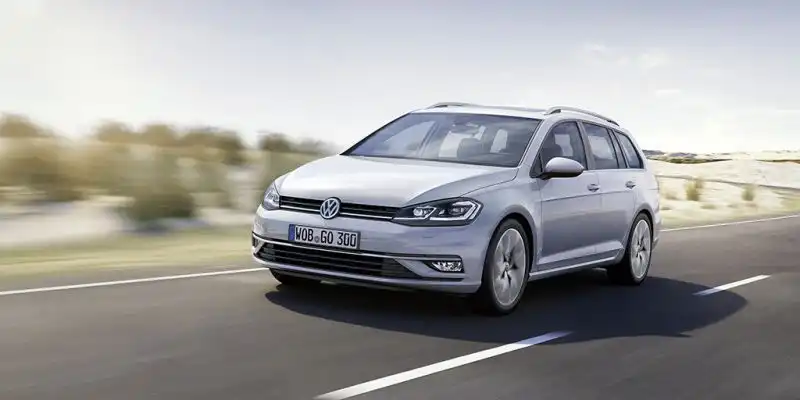
The Volkswagen Golf VII Variant, specifically the 2.0 TDI variant producing 150 horsepower, represents a significant iteration within the highly successful seventh generation of the Golf family. Introduced with the 2017 facelift, this model combined the practicality of a station wagon (estate) body style with the efficiency and refinement of a modern diesel engine. Production ran from 2017 to 2019, positioning it as a key offering in the European market where wagons remain a popular choice. This variant aimed to balance fuel economy, performance, and cargo capacity for families and individuals seeking a versatile vehicle.
Technical Specifications
| Brand | Volkswagen |
| Model | Golf |
| Generation | Golf VII Variant (facelift 2017) |
| Type (Engine) | 2.0 TDI (150 Hp) |
| Start of production | 2017 |
| End of production | 2019 |
| Powertrain Architecture | Internal Combustion engine |
| Body type | Station wagon (estate) |
| Seats | 5 |
| Doors | 5 |
| Fuel consumption (urban) | 5.2-5.3 l/100 km (45.2 – 44.4 US mpg, 54.3 – 53.3 UK mpg, 19.2 – 18.9 km/l) |
| Fuel consumption (extra urban) | 3.8-3.9 l/100 km (61.9 – 60.3 US mpg, 74.3 – 72.4 UK mpg, 26.3 – 25.6 km/l) |
| Fuel consumption (combined) | 4.3-4.4 l/100 km (54.7 – 53.5 US mpg, 65.7 – 64.2 UK mpg, 23.3 – 22.7 km/l) |
| CO2 emissions | 111-113 g/km |
| Fuel Type | Diesel |
| Acceleration 0 – 100 km/h | 8.9 sec |
| Acceleration 0 – 62 mph | 8.9 sec |
| Acceleration 0 – 60 mph | 8.5 sec |
| Maximum speed | 218 km/h (135.46 mph) |
| Emission standard | Euro 6 |
| Weight-to-power ratio | 9.1 kg/Hp, 110.1 Hp/tonne |
| Weight-to-torque ratio | 4 kg/Nm, 249.4 Nm/tonne |
| Power | 150 Hp @ 3500-4000 rpm |
| Power per litre | 76.2 Hp/l |
| Torque | 340 Nm @ 1750-3000 rpm (250.77 lb.-ft. @ 1750-3000 rpm) |
| Engine layout | Front, Transverse |
| Engine Model/Code | CRLB, DCYA, DEJA, DFGA |
| Engine displacement | 1968 cm3 (120.09 cu. in.) |
| Number of cylinders | 4 |
| Engine configuration | Inline |
| Number of valves per cylinder | 4 |
| Fuel injection system | Diesel Commonrail |
| Engine aspiration | Turbocharger, Intercooler |
| Engine oil capacity | 4.7 l (4.97 US qt | 4.14 UK qt) |
| Kerb Weight | 1363 kg (3004.9 lbs.) |
| Max. weight | 1970 kg (4343.11 lbs.) |
| Max load | 607 kg (1338.21 lbs.) |
| Trunk (boot) space – minimum | 605 l (21.37 cu. ft.) |
| Trunk (boot) space – maximum | 1620 l (57.21 cu. ft.) |
| Fuel tank capacity | 50 l (13.21 US gal | 11 UK gal) |
| Max. roof load | 75 kg (165.35 lbs.) |
| Permitted trailer load with brakes (8%) | 1800 kg (3968.32 lbs.) |
| Permitted trailer load with brakes (12%) | 1600 kg (3527.4 lbs.) |
| Permitted trailer load without brakes | 710 kg (1565.28 lbs.) |
| Permitted towbar download | 80 kg (176.37 lbs.) |
| Length | 4567 mm (179.8 in.) |
| Width | 1799 mm (70.83 in.) |
| Width including mirrors | 2027 mm (79.8 in.) |
| Height | 1515 mm (59.65 in.) |
| Wheelbase | 2620 mm (103.15 in.) |
| Front track | 1549 mm (60.98 in.) |
| Rear (Back) track | 1520 mm (59.84 in.) |
| Ride height (ground clearance) | 140 mm (5.51 in.) |
| Minimum turning circle (turning diameter) | 10.9 m (35.76 ft.) |
| Drive wheel | Front wheel drive |
| Number of gears and type of gearbox | 6 gears, manual transmission |
| Front brakes | Ventilated discs |
| Rear brakes | Disc |
| Assisting systems | ABS (Anti-lock braking system) |
| Steering type | Steering rack and pinion |
| Power steering | Electric Steering |
| Tires size | 205/55 R16 |
| Wheel rims size | 6.5 J x 16 |
INTRODUCTION
The Golf VII Variant 2.0 TDI (150 hp) was a key component of Volkswagen’s strategy to offer a diverse range of options within the seventh-generation Golf lineup. Introduced during the 2017 facelift, this variant built upon the success of the Golf VII, which debuted in 2012, and addressed the growing demand for practical, fuel-efficient vehicles. The “Variant” designation signifies the station wagon body style, offering increased cargo capacity compared to the standard hatchback. This model sat within the Golf VII range, positioned as a mid-range offering, appealing to buyers who prioritized fuel economy and practicality over outright performance. It was primarily sold in Europe, where the station wagon segment remains strong, and to a lesser extent in other markets where VW offered the Variant.
Powertrain & Engine Architecture
At the heart of the Golf VII Variant 2.0 TDI (150 hp) lies the Volkswagen Group’s 2.0-liter four-cylinder diesel engine. Engine codes for this specific output included CRLB, DCYA, DEJA, and DFGA, depending on the specific year and market. This engine is a turbocharged common rail direct injection diesel, known for its balance of power and efficiency. The common rail system delivers fuel at extremely high pressure, ensuring fine atomization for cleaner combustion and improved power delivery. The engine utilizes a single overhead camshaft (SOHC) design with four valves per cylinder. The turbocharger, typically a variable geometry turbo (VGT), provides increased power output by forcing more air into the engine. An intercooler further enhances performance by cooling the compressed air. The 150 hp version of this engine was tuned for a balance between performance and fuel economy, offering a noticeable step up in power compared to the lower-output 1.6 TDI variants. The engine was typically paired with a 6-speed manual transmission, although a 7-speed dual-clutch transmission (DSG) was often available as an option.
Driving Characteristics
The 2.0 TDI (150 hp) Golf VII Variant offered a composed and refined driving experience. While not a sports car, the engine provided ample torque – 340 Nm (250.77 lb.-ft.) – available from a low 1750 rpm, making it easy to accelerate and maintain speed in various driving conditions. The 6-speed manual transmission offered precise shifts, and the gear ratios were well-matched to the engine’s powerband. Compared to the lower-powered 1.6 TDI models, the 2.0 TDI felt noticeably more responsive, particularly when overtaking or climbing hills. However, it didn’t possess the outright acceleration of the higher-performance gasoline variants like the GTI. The suspension, tuned for comfort, provided a smooth ride, absorbing bumps and imperfections in the road effectively. The steering was accurate and well-weighted, providing a confident feel behind the wheel. The wagon body style did introduce a slight increase in weight compared to the hatchback, but the extra power of the 2.0 TDI mitigated this effect.
Equipment & Trim Levels
The Golf VII Variant 2.0 TDI (150 hp) typically came equipped with a solid range of standard features. These included air conditioning, power windows, power mirrors, a touchscreen infotainment system with Bluetooth connectivity, and alloy wheels. Higher trim levels, such as Comfortline and Highline, added features like automatic climate control, rain-sensing wipers, front fog lights, parking sensors, and upgraded upholstery. Optional extras included a panoramic sunroof, navigation system, adaptive cruise control, and a premium sound system. Interior upholstery typically consisted of cloth seats, with leather options available on higher trims. The dashboard layout was clean and functional, with a focus on ergonomics and ease of use.
Chassis & Braking
The Golf VII Variant utilized a MacPherson strut front suspension and a multi-link rear suspension, providing a good balance of ride comfort and handling. The chassis was reinforced to accommodate the increased weight and length of the wagon body style. Braking systems varied depending on the trim level, but typically included ventilated front discs and solid rear discs. ABS (Anti-lock Braking System) was standard, along with electronic stability control (ESC). The suspension was tuned to provide a comfortable ride without sacrificing handling, and the steering was precise and responsive. Stabilizer bars were fitted to both the front and rear axles to reduce body roll during cornering.
Market Reception & Comparison
The Golf VII Variant 2.0 TDI (150 hp) was generally well-received by automotive critics. It was praised for its fuel efficiency, practicality, and refined driving experience. Compared to the lower-powered 1.6 TDI variants, the 2.0 TDI offered a significant improvement in performance, making it a more enjoyable car to drive. However, it was more expensive to purchase and maintain. Compared to gasoline-powered Golf variants, the 2.0 TDI offered superior fuel economy, but it was also subject to stricter emissions regulations and potential issues with diesel particulate filters (DPF). The 2.0 TDI was often compared to other diesel station wagons in its class, such as the Ford Focus Estate and the Skoda Octavia Combi, and generally held its own in terms of performance, fuel economy, and overall value.
Legacy
The 2.0 TDI engine, in various iterations, has proven to be a reliable and durable powertrain. However, like many modern diesel engines, it has been subject to scrutiny regarding emissions and potential issues with the DPF. Proper maintenance, including regular oil changes and DPF regeneration, is crucial for ensuring long-term reliability. In the used car market, the Golf VII Variant 2.0 TDI (150 hp) remains a popular choice, offering a good balance of practicality, fuel economy, and affordability. Its reputation for reliability and durability, combined with the Golf’s overall strong brand image, continues to make it a desirable vehicle for buyers seeking a versatile and efficient station wagon.