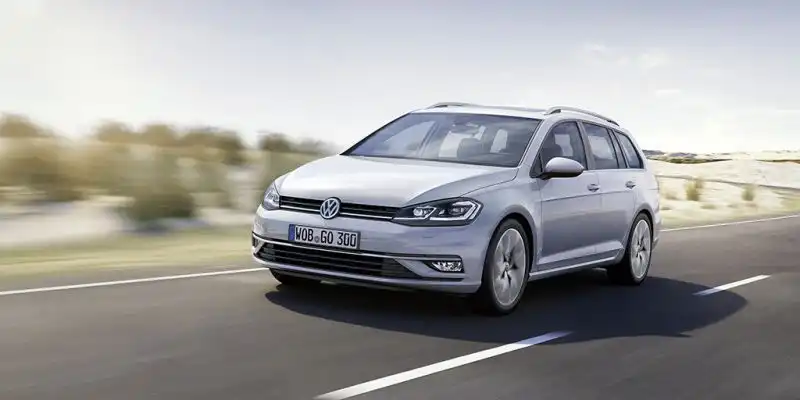
The Volkswagen Golf VII Variant, specifically the 2.0 TDI SCR (150 hp) 4MOTION DSG model produced from 2018 to 2019, represents a compelling blend of practicality, efficiency, and all-weather capability within the seventh generation Golf lineup. This variant, a facelift of the Golf VII, offered a station wagon (estate) body style, appealing to buyers needing increased cargo space without sacrificing the Golf’s renowned driving dynamics. Positioned as a mid-to-upper trim level, it catered to those seeking a more refined and capable vehicle than the base models, while remaining a more accessible option than the performance-oriented GTI or R variants. It was primarily marketed in Europe, where the station wagon body style remains highly popular, offering a versatile family vehicle.
Technical Specifications
| Brand | Volkswagen |
| Model | Golf |
| Generation | Golf VII Variant (facelift 2017) |
| Type (Engine) | 2.0 TDI SCR (150 Hp) 4MOTION DSG |
| Start of production | 2018 |
| End of production | 2019 |
| Powertrain Architecture | Internal Combustion engine |
| Body type | Station wagon (estate) |
| Seats | 5 |
| Doors | 5 |
| Fuel consumption (urban) | 5.6-5.8 l/100 km (42 – 40.6 US mpg) |
| Fuel consumption (extra urban) | 4.5-4.7 l/100 km (52.3 – 50 US mpg) |
| Fuel consumption (combined) | 4.9-5.1 l/100 km (48 – 46.1 US mpg) |
| CO2 emissions | 128-134 g/km |
| Fuel Type | Diesel |
| Acceleration 0 – 100 km/h | 9 sec |
| Acceleration 0 – 62 mph | 9 sec |
| Acceleration 0 – 60 mph | 8.6 sec |
| Maximum speed | 214 km/h (132.97 mph) |
| Emission standard | Euro 6d-TEMP |
| Weight-to-power ratio | 10.5 kg/Hp |
| Weight-to-torque ratio | 4.6 kg/Nm |
| Power | 150 Hp |
| Torque | 340 Nm @ 1750-3000 rpm (250.77 lb.-ft. @ 1750-3000 rpm) |
| Engine layout | Front, Transverse |
| Engine Model/Code | CRLB, DCYA, DEJA, DFGA |
| Engine displacement | 1968 cm3 (120.09 cu. in.) |
| Number of cylinders | 4 |
| Engine configuration | Inline |
| Number of valves per cylinder | 4 |
| Fuel injection system | Diesel Commonrail |
| Engine aspiration | Turbocharger, Intercooler |
| Engine oil capacity | 4.7 l (4.97 US qt | 4.14 UK qt) |
| Kerb Weight | 1580-1595 kg (3483.3 – 3516.37 lbs.) |
| Max. weight | 2110 kg (4651.75 lbs.) |
| Max load | 515-530 kg (1135.38 – 1168.45 lbs.) |
| Trunk (boot) space – minimum | 605 l (21.37 cu. ft.) |
| Trunk (boot) space – maximum | 1620 l (57.21 cu. ft.) |
| Fuel tank capacity | 55 l (14.53 US gal | 12.1 UK gal) |
| AdBlue tank | 12 l (3.17 US gal | 2.64 UK gal) |
| Max. roof load | 75 kg (165.35 lbs.) |
| Permitted trailer load with brakes (12%) | 2000 kg (4409.25 lbs.) |
| Permitted trailer load without brakes | 750 kg (1653.47 lbs.) |
| Permitted towbar download | 80 kg (176.37 lbs.) |
| Length | 4567 mm (179.8 in.) |
| Width | 1799 mm (70.83 in.) |
| Width including mirrors | 2027 mm (79.8 in.) |
| Height | 1515 mm (59.65 in.) |
| Wheelbase | 2620 mm (103.15 in.) |
| Front track | 1533-1549 mm (60.35 – 60.98 in.) |
| Rear (Back) track | 1504-1520 mm (59.21 – 59.84 in.) |
| Ride height (ground clearance) | 140 mm (5.51 in.) |
| Minimum turning circle (turning diameter) | 10.9 m (35.76 ft.) |
| Drive wheel | All wheel drive (4×4) |
| Number of gears and type of gearbox | 7 gears, automatic transmission DSG |
| Assisting systems | ABS (Anti-lock braking system) |
| Steering type | Steering rack and pinion |
| Power steering | Electric Steering |
| Tires size | 205/50 R17; 225/45 R17; 225/45 R18 |
| Wheel rims size | 6J x 17; 7J x 17; 7.5J x 18 |
INTRODUCTION
The Golf VII Variant facelift, introduced in 2017 and continuing through 2019, built upon the success of the seventh-generation Golf, offering a refreshed design and updated technology. The 2.0 TDI SCR 4MOTION DSG variant specifically combined a potent diesel engine with Volkswagen’s all-wheel-drive system and a dual-clutch transmission. This configuration aimed to deliver a balance of fuel efficiency, performance, and all-weather traction, making it a practical choice for drivers in regions with varied climates or those frequently undertaking long journeys. It sat within the Golf VII range, above the 1.6 TDI models and below the more powerful and sporty GTI and R versions.
Powertrain & Engine Architecture
At the heart of this Golf Variant lies the 2.0-liter four-cylinder diesel engine, identified by engine codes CRLB, DCYA, DEJA, or DFGA. This engine utilizes a common rail direct injection system, delivering fuel directly into the combustion chamber at extremely high pressure for optimized combustion. A turbocharger with an intercooler further enhances performance by forcing more air into the engine. The engine also incorporates Selective Catalytic Reduction (SCR) technology, utilizing AdBlue (Diesel Exhaust Fluid) to reduce nitrogen oxide (NOx) emissions, ensuring compliance with stringent Euro 6d-TEMP emission standards. The engine produces 150 horsepower and 340 Nm (250.77 lb-ft) of torque between 1750 and 3000 rpm. The engine is transversely mounted in the front of the vehicle. The seven-speed DSG (Direct-Shift Gearbox) automatic transmission provides quick and smooth gear changes, contributing to both performance and fuel efficiency. The 4MOTION all-wheel-drive system utilizes a Haldex multi-plate clutch to distribute torque between the front and rear axles as needed, enhancing traction in slippery conditions.
Driving Characteristics
The 2.0 TDI SCR 4MOTION DSG Golf Variant offers a composed and refined driving experience. While not overtly sporty, the 150 hp engine provides ample power for everyday driving and overtaking maneuvers. The DSG transmission shifts quickly and efficiently, and the 4MOTION system provides excellent grip, particularly on wet or loose surfaces. Acceleration from 0 to 62 mph takes approximately 9 seconds. The engine’s torque curve is relatively flat, providing strong pulling power across a wide range of engine speeds. Compared to the lower-powered 1.6 TDI variants, the 2.0 TDI offers noticeably more performance, while remaining more economical than the petrol-powered GTI. The automatic transmission, while convenient, may not offer the same level of driver engagement as a manual gearbox.
Equipment & Trim Levels
The Golf VII Variant 2.0 TDI SCR 4MOTION DSG typically came well-equipped, reflecting its mid-range positioning. Standard features often included air conditioning, a touchscreen infotainment system with Bluetooth connectivity, alloy wheels, and a suite of safety features such as ABS, ESP (Electronic Stability Program), and multiple airbags. Higher trim levels offered options such as leather upholstery, a panoramic sunroof, adaptive cruise control, and a more advanced infotainment system with navigation. Interior upholstery was typically cloth on base models, with leather options available. Dashboard configuration was consistent across the range, featuring a clean and functional design.
Chassis & Braking
The Golf VII Variant utilizes an independent suspension setup, with MacPherson struts at the front and a multi-link suspension at the rear. This configuration provides a comfortable ride and good handling characteristics. The 4MOTION variants often featured slightly stiffer suspension components to accommodate the added weight and complexity of the all-wheel-drive system. Braking systems varied depending on the trim level, with lower trims typically equipped with disc brakes at the front and drum brakes at the rear, while higher trims featured disc brakes all around. Stabilizer bars were fitted to both the front and rear axles to reduce body roll during cornering.
Market Reception & Comparison
The Golf VII Variant 2.0 TDI SCR 4MOTION DSG was generally well-received by automotive critics. It was praised for its practicality, fuel efficiency, and all-weather capability. The combination of the diesel engine, DSG transmission, and 4MOTION system was seen as a compelling package for those seeking a versatile and refined family vehicle. Compared to other trims in the Golf lineup, the 2.0 TDI offered a significant performance upgrade over the 1.6 TDI models, while remaining more economical than the petrol-powered GTI. Fuel economy figures of around 4.9-5.1 l/100 km (48-46.1 US mpg) were considered competitive for a vehicle of its size and capability.
Legacy
The 2.0 TDI SCR engine, in various iterations, proved to be a reliable and durable powertrain. However, like many modern diesel engines, it was subject to scrutiny regarding emissions and potential issues with the diesel particulate filter (DPF) and SCR system, particularly if not maintained properly with quality fuel and regular AdBlue refills. In the used car market, these Golf Variants hold their value reasonably well, particularly those with a full service history and low mileage. They remain a popular choice for buyers seeking a practical, efficient, and capable estate car.