Technical Specifications
| Brand | Volkswagen |
| Model | Golf |
| Generation | Golf VII Variant (facelift 2017) |
| Type (Engine) | 2.0 TDI SCR (150 Hp) DSG |
| Start of production | 2018 |
| End of production | 2019 |
| Powertrain Architecture | Internal Combustion engine |
| Body type | Station wagon (estate) |
| Seats | 5 |
| Doors | 5 |
| Fuel consumption (urban) | 5.2-5.3 l/100 km (45.2 – 44.4 US mpg, 54.3 – 53.3 UK mpg, 19.2 – 18.9 km/l) |
| Fuel consumption (extra urban) | 3.9-4.0 l/100 km (60.3 – 58.8 US mpg, 72.4 – 70.6 UK mpg, 25.6 – 25 km/l) |
| Fuel consumption (combined) | 4.4-4.5 l/100 km (53.5 – 52.3 US mpg, 64.2 – 62.8 UK mpg, 22.7 – 22.2 km/l) |
| CO2 emissions | 115-117 g/km |
| Fuel Type | Diesel |
| Acceleration 0 – 100 km/h | 9 sec |
| Acceleration 0 – 62 mph | 9 sec |
| Acceleration 0 – 60 mph | 8.6 sec |
| Maximum speed | 216 km/h (134.22 mph) |
| Emission standard | Euro 6d-TEMP |
| Weight-to-power ratio | 9.9 kg/Hp, 101 Hp/tonne |
| Weight-to-torque ratio | 4.4 kg/Nm, 229 Nm/tonne |
| Power | 150 Hp |
| Power per litre | 76.2 Hp/l |
| Torque | 340 Nm @ 1750-3000 rpm (250.77 lb.-ft. @ 1750-3000 rpm) |
| Engine layout | Front, Transverse |
| Engine Model/Code | CRLB, DCYA, DEJA, DFGA |
| Engine displacement | 1968 cm3 (120.09 cu. in.) |
| Number of cylinders | 4 |
| Engine configuration | Inline |
| Number of valves per cylinder | 4 |
| Fuel injection system | Diesel Commonrail |
| Engine aspiration | Turbocharger, Intercooler |
| Engine oil capacity | 4.7 l (4.97 US qt | 4.14 UK qt) |
| Kerb Weight | 1485 kg (3273.86 lbs.) |
| Max. weight | 2020 kg (4453.34 lbs.) |
| Max load | 535 kg (1179.47 lbs.) |
| Trunk (boot) space – minimum | 605 l (21.37 cu. ft.) |
| Trunk (boot) space – maximum | 1620 l (57.21 cu. ft.) |
| Fuel tank capacity | 50 l (13.21 US gal | 11 UK gal) |
| AdBlue tank | 12 l (3.17 US gal | 2.64 UK gal) |
| Max. roof load | 75 kg (165.35 lbs.) |
| Permitted trailer load with brakes (8%) | 1800 kg (3968.32 lbs.) |
| Permitted trailer load with brakes (12%) | 1600 kg (3527.4 lbs.) |
| Permitted trailer load without brakes | 740 kg (1631.42 lbs.) |
| Permitted towbar download | 80 kg (176.37 lbs.) |
| Length | 4567 mm (179.8 in.) |
| Width | 1799 mm (70.83 in.) |
| Width including mirrors | 2027 mm (79.8 in.) |
| Height | 1515 mm (59.65 in.) |
| Wheelbase | 2620 mm (103.15 in.) |
| Drive wheel | Front wheel drive |
| Number of gears and type of gearbox | 7 gears, automatic transmission DSG |
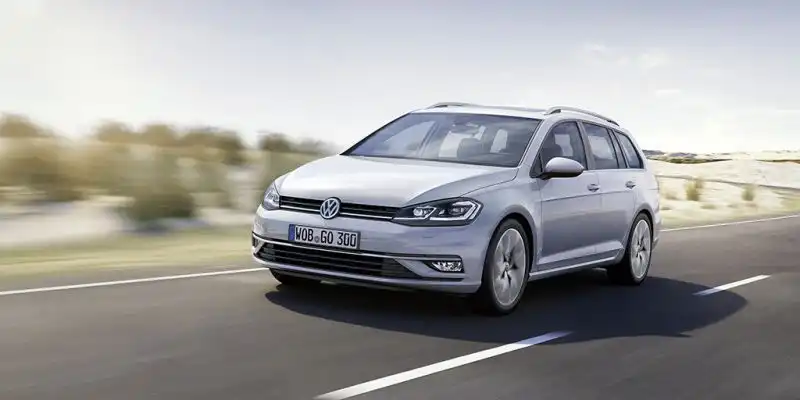
The Volkswagen Golf VII Variant (facelift, introduced in 2017) 2.0 TDI SCR with 150 horsepower and a dual-clutch gearbox (DSG) represents a significant iteration within the seventh generation of Volkswagen’s iconic Golf model line. Production of this specific configuration ran from 2018 to 2019. Positioned as a mid-range offering within the Variant (estate/wagon) body style, it aimed to balance fuel efficiency, practicality, and performance for European drivers. This model capitalized on Volkswagen’s advancements in diesel technology, specifically Selective Catalytic Reduction (SCR), to meet stringent Euro 6d-TEMP emissions standards. The Golf VII Variant, in general, offered increased cargo capacity compared to the hatchback, making it a popular choice for families and those requiring versatile transportation.
Powertrain & Engine Architecture
At the heart of the Golf VII Variant 2.0 TDI SCR lies the Volkswagen Group’s EA288 series diesel engine. Specifically, engine codes CRLB, DCYA, DEJA, and DFGA were utilized, representing minor variations within the same fundamental design. This 1968cc inline-four cylinder engine features a common rail direct injection system, delivering fuel at pressures up to 2,000 bar for optimized combustion. A turbocharger with an intercooler is employed to boost power and torque. The engine incorporates four valves per cylinder and utilizes a timing belt for valve actuation. Crucially, this engine is equipped with a Selective Catalytic Reduction (SCR) system, utilizing AdBlue (Diesel Exhaust Fluid) to reduce nitrogen oxide (NOx) emissions, enabling compliance with Euro 6d-TEMP standards. The 7-speed DSG (Direct-Shift Gearbox) is a dual-clutch transmission known for its quick and smooth gear changes. It offers both fully automatic operation and the ability for the driver to manually select gears via paddle shifters or the gear lever.
Driving Characteristics
The 150 horsepower and 340 Nm (250.77 lb-ft) of torque produced by this engine configuration provide a respectable level of performance for a family-oriented estate car. Acceleration from 0-100 km/h (0-62 mph) takes approximately 9 seconds. While not overtly sporty, the engine delivers strong pulling power from low RPMs, making it well-suited for everyday driving and overtaking maneuvers. The DSG transmission contributes to a refined driving experience, offering seamless gear changes and contributing to good fuel economy. Compared to the more powerful 2.0 TDI variants (typically 184 or 200 hp), this version prioritizes efficiency over outright speed. The manual transmission options offered in other Golf VII variants provided a more engaging driving experience, but at the cost of some convenience. The DSG’s programming is tuned for efficiency, sometimes resulting in slightly hesitant responses in Sport mode compared to more aggressively tuned DSGs.
Equipment & Trim Levels
The 2.0 TDI SCR 150 hp DSG variant typically fell into the mid-range of the Golf VII Variant lineup. Standard equipment generally included air conditioning, a touchscreen infotainment system with Bluetooth connectivity, alloy wheels, and a suite of safety features such as ABS, ESP (Electronic Stability Program), and multiple airbags. Higher trim levels, such as ‘Highline’ or ‘R-Line’, added features like automatic climate control, larger alloy wheels, sports seats, and advanced driver assistance systems like adaptive cruise control and lane assist. Interior upholstery was typically cloth, with leather options available as an upgrade. Optional extras included a panoramic sunroof, navigation system, and parking sensors.
Chassis & Braking
The Golf VII Variant utilizes an independent suspension setup at the front (MacPherson strut) and a multi-link suspension at the rear. The suspension tuning is geared towards comfort and stability, providing a compliant ride quality. The braking system typically consists of ventilated disc brakes at the front and either disc or drum brakes at the rear, depending on the specific trim level and options selected. The steering is electrically assisted, providing a light and precise feel. Stabilizer bars are fitted to both the front and rear axles to reduce body roll during cornering.
Market Reception & Comparison
The Golf VII Variant 2.0 TDI SCR 150 hp DSG was generally well-received by automotive critics. It was praised for its fuel efficiency, practicality, and comfortable ride. The combination of the diesel engine and DSG transmission was considered a good balance between performance and economy. Compared to the higher-output TDI variants, this version offered lower running costs and a more accessible price point. However, some critics noted that the engine could be somewhat noisy under heavy acceleration. Fuel economy figures of 4.4-4.5 l/100 km (53.5-52.3 US mpg) were competitive within its class.
Legacy
The EA288 diesel engine, in its various iterations, has proven to be a relatively reliable powertrain. However, like all modern diesel engines, it is susceptible to issues related to the diesel particulate filter (DPF) and SCR system if not properly maintained. Regular servicing, including the use of high-quality oil and AdBlue, is crucial for long-term reliability. In the used car market, the Golf VII Variant 2.0 TDI SCR 150 hp DSG remains a popular choice due to its practicality, fuel efficiency, and relatively affordable price. Models with a well-documented service history and lower mileage tend to command higher prices.