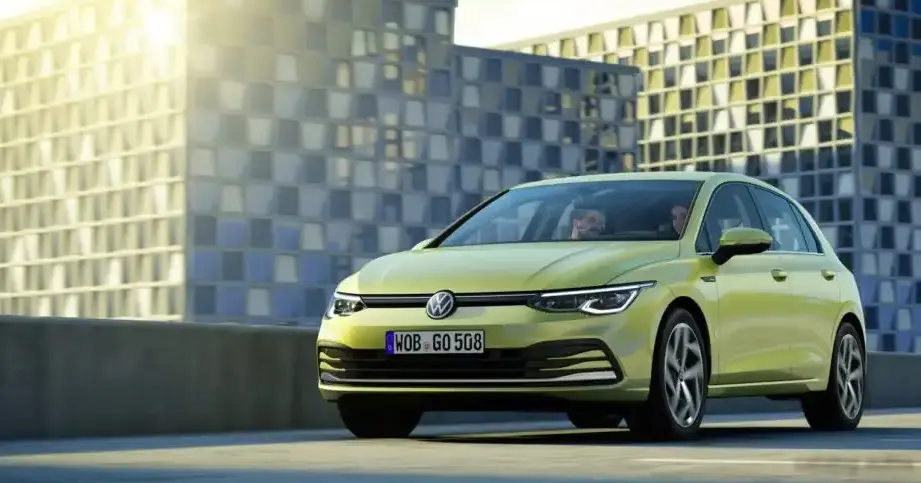
The Volkswagen Golf VIII 1.4 TSI eHybrid DSG, produced from 2020 to 2024, represents Volkswagen’s entry into the plug-in hybrid market within the highly successful eighth-generation Golf lineup (designated the 8HX). Positioned as a fuel-efficient and technologically advanced option, this variant aimed to appeal to buyers seeking lower running costs and reduced emissions without sacrificing the Golf’s renowned practicality and driving experience. It slots into the Golf VIII range between the standard petrol and diesel models and the more performance-oriented GTI and R variants. The eHybrid utilizes a combined petrol and electric powertrain, offering both all-electric driving capability and the extended range of a traditional internal combustion engine.
Technical Specifications
| Brand | Volkswagen |
| Model | Golf |
| Generation | Golf VIII |
| Type (Engine) | 1.4 TSI (204 Hp) eHybrid DSG |
| Start of production | 2020 |
| End of production | 2024 |
| Powertrain Architecture | PHEV (Plug-in Hybrid Electric Vehicle) |
| Body type | Hatchback |
| Seats | 5 |
| Doors | 5 |
| Combined fuel consumption (WLTP) | 0.9 l/100 km (261.3 US mpg, 313.9 UK mpg, 111.1 km/l) |
| CO2 emissions (WLTP) | 21 g/km |
| Fuel consumption (NEDC) – combined | 1.4 l/100 km (168 US mpg, 201.8 UK mpg, 71.4 km/l) |
| CO2 emissions (NEDC) | 33 g/km |
| Fuel Type | Petrol / electricity |
| Acceleration 0 – 100 km/h | 7.4 sec |
| Acceleration 0 – 62 mph | 7.4 sec |
| Acceleration 0 – 60 mph | 7 sec |
| Maximum speed | 220 km/h (136.7 mph) |
| Emission standard | EURO 6d-ISC-FCM |
| Weight-to-power ratio | 7.4 kg/Hp, 134.7 Hp/tonne |
| Weight-to-torque ratio | 4.3 kg/Nm, 231 Nm/tonne |
| Gross battery capacity | 13 kWh |
| Net (usable) battery capacity | 10.4 kWh |
| Battery technology | Lithium-ion (Li-Ion) |
| Battery weight | 130 kg (286.6 lbs) |
| Battery location | Below the floor, under the rear seats |
| All-electric range (NEDC) | 79 km (49.09 mi) |
| Average Energy consumption (NEDC) | 10.1 kWh/100 km (16.25 kWh/100 mi, 207 MPGe, 9.9 km/kWh, 6.2 mi/kWh) |
| Max speed (electric) | 130 km/h (80.78 mph) |
| Electric motor power | 110 Hp |
| Electric motor Torque | 330 Nm (243.4 lb.-ft.) |
| Electric motor location | Between the combustion engine and the transmission |
| System power | 204 Hp |
| System torque | 350 Nm (258.15 lb.-ft.) |
| Power | 150 Hp @ 5000-6000 rpm |
| Torque | 250 Nm @ 1550-3500 rpm (184.39 lb.-ft. @ 1550-3500 rpm) |
| Engine layout | Front, Transverse |
| Engine Model/Code | DGEA |
| Engine displacement | 1395 cm3 (85.13 cu. in.) |
| Number of cylinders | 4 |
| Engine configuration | Inline |
| Cylinder Bore | 74.5 mm (2.93 in.) |
| Piston Stroke | 80 mm (3.15 in.) |
| Compression ratio | 10:1 |
| Number of valves per cylinder | 4 |
| Fuel injection system | Direct injection |
| Engine aspiration | Turbocharger, Intercooler |
| Valvetrain | DOHC |
| Engine oil capacity | 4 l (4.23 US qt | 3.52 UK qt) |
| Kerb Weight | 1515 kg (3340 lbs) |
| Max. weight | 2020 kg (4453.34 lbs) |
| Max load | 505 kg (1113.33 lbs) |
| Trunk (boot) space – minimum | 273 l (9.64 cu. ft.) |
| Trunk (boot) space – maximum | 1129 l (39.87 cu. ft.) |
| Fuel tank capacity | 39.5 l (10.43 US gal | 8.69 UK gal) |
| Max. roof load | 75 kg (165.35 lbs) |
| Permitted trailer load with brakes (8%) | 1700 kg (3747.86 lbs) |
| Permitted trailer load with brakes (12%) | 1500 kg (3306.93 lbs) |
| Permitted trailer load without brakes | 750 kg (1653.47 lbs) |
| Permitted towbar download | 80 kg (176.37 lbs) |
| Length | 4284 mm (168.66 in.) |
| Width | 1789 mm (70.43 in.) |
| Width including mirrors | 2073 mm (81.61 in.) |
| Height | 1482 mm (58.35 in.) |
| Wheelbase | 2629 mm (103.5 in.) |
| Front track | 1533-1543 mm (60.35 – 60.75 in.) |
| Rear (Back) track | 1506-1516 mm (59.29 – 59.69 in.) |
| Minimum turning circle (turning diameter) | 10.9 m (35.76 ft.) |
| Drivetrain Architecture | The Internal combustion engine (ICE) and electric motor drive the front wheels of the car with the ability to work in full electric or mixed mode. |
| Drive wheel | Front wheel drive |
| Number of gears and type of gearbox | 6 gears, automatic transmission DSG |
| Front suspension | Independent type McPherson, Transverse stabilizer |
| Rear suspension | Independent multi-link suspension, Transverse stabilizer |
| Front brakes | Ventilated discs |
| Rear brakes | Disc |
| Assisting systems | ABS (Anti-lock braking system) |
| Steering type | Steering rack and pinion |
| Power steering | Electric Steering |
| Tires size | 205/55 R16; 225/45 R17; 225/40 R18 |
| Wheel rims size | 7J x 16; 7.5J x 17; 7.5J x 18 |
INTRODUCTION
The Volkswagen Golf VIII 1.4 TSI eHybrid DSG, launched in 2020, is a plug-in hybrid variant of the eighth-generation Golf. Built on the MQB Evo platform (specifically the 8HX designation for Golf VIII models), it combines a 1.4-liter turbocharged petrol engine with an electric motor and a lithium-ion battery pack. This configuration allows for both all-electric driving for shorter distances and the flexibility of a petrol engine for longer journeys. The eHybrid was positioned as a key model in Volkswagen’s strategy to offer a wider range of electrified vehicles, appealing to environmentally conscious buyers and those seeking to reduce their fuel costs. It was sold primarily in Europe and other markets where plug-in hybrid incentives were available.
Powertrain & Engine Architecture
At the heart of the Golf VIII eHybrid lies the EA211 series 1.4-liter turbocharged four-cylinder petrol engine, specifically the DGEA code. This engine produces 150 horsepower at 5000-6000 rpm and 250 Nm (184 lb-ft) of torque between 1550-3500 rpm. It utilizes direct fuel injection and an intercooled turbocharger to optimize efficiency and power delivery. The engine is paired with an 85kW (110 hp) electric motor integrated between the engine and the 6-speed DSG (Dual-Clutch Gearbox) transmission. The electric motor contributes an additional 330 Nm (243 lb-ft) of torque. The combined system output is 204 horsepower and 350 Nm (258 lb-ft) of torque. The 13 kWh lithium-ion battery pack is located under the rear seats, minimizing impact on passenger space. The eHybrid system allows for selectable driving modes, including E-Mode (all-electric), Hybrid Auto, and Battery Hold, allowing drivers to prioritize electric driving or preserve battery charge for later use.
Driving Characteristics
The Golf VIII eHybrid offers a refined and efficient driving experience. In E-Mode, the car can travel up to 79 km (49 miles) on a full charge (NEDC cycle), making it suitable for daily commutes and short trips. The electric motor provides instant torque, resulting in brisk acceleration from a standstill. When the battery is depleted or when more power is required, the petrol engine seamlessly kicks in, providing a smooth and responsive driving experience. The 6-speed DSG transmission offers quick and precise gear changes, enhancing performance and efficiency. Compared to the standard 1.5 TSI petrol Golf VIII, the eHybrid feels slightly heavier due to the battery pack, but the added torque from the electric motor compensates for this, providing comparable acceleration. Compared to higher-performance Golf models like the GTI, the eHybrid prioritizes fuel efficiency and comfort over outright speed and handling.
Equipment & Trim Levels
The Golf VIII eHybrid typically came well-equipped as standard, reflecting its position as a premium variant. Standard features often included Volkswagen’s Digital Cockpit (a fully digital instrument cluster), an 8-inch touchscreen infotainment system with Apple CarPlay and Android Auto compatibility, climate control, and a suite of safety features such as automatic emergency braking, lane assist, and adaptive cruise control. Interior upholstery was typically cloth or a combination of cloth and leatherette. Optional extras included larger touchscreen displays, a premium sound system, panoramic sunroof, and advanced driver assistance systems. Trim levels varied by market, but generally offered increasing levels of luxury and technology.
Chassis & Braking
The Golf VIII eHybrid utilizes a McPherson strut front suspension and a multi-link rear suspension, providing a comfortable and controlled ride. The suspension is tuned to balance handling and comfort, taking into account the added weight of the battery pack. Front brakes are ventilated discs, while rear brakes are solid discs. ABS (Anti-lock Braking System) is standard, along with electronic stability control. The steering is electric power-assisted, providing precise and responsive steering feel. Stabilizer bars are fitted to both the front and rear axles to reduce body roll during cornering.
Market Reception & Comparison
The Golf VIII eHybrid was generally well-received by automotive critics, who praised its fuel efficiency, smooth driving experience, and advanced technology. However, some critics noted that the battery pack reduced trunk space compared to the standard Golf models. Compared to the Golf 1.5 TSI, the eHybrid offered significantly better fuel economy and lower emissions, but at a higher purchase price. Compared to the Golf 1.4 TSI, the eHybrid offered a substantial boost in combined power and torque, along with the benefits of electric driving. The eHybrid competed with other plug-in hybrid hatchbacks such as the Peugeot 3008 Hybrid and the Hyundai Ioniq Plug-in.
Legacy
The Volkswagen Golf VIII 1.4 TSI eHybrid represents an important step in Volkswagen’s transition to electric mobility. While the model has been superseded by newer, more advanced plug-in hybrid and fully electric Golf variants, the eHybrid remains a popular choice in the used car market. The powertrain has proven to be relatively reliable, with few widespread issues reported. The combination of a fuel-efficient petrol engine and an electric motor provides a practical and versatile solution for drivers seeking to reduce their environmental impact and running costs. The eHybrid’s success paved the way for Volkswagen to expand its range of electrified vehicles, solidifying its position as a leader in the automotive industry.