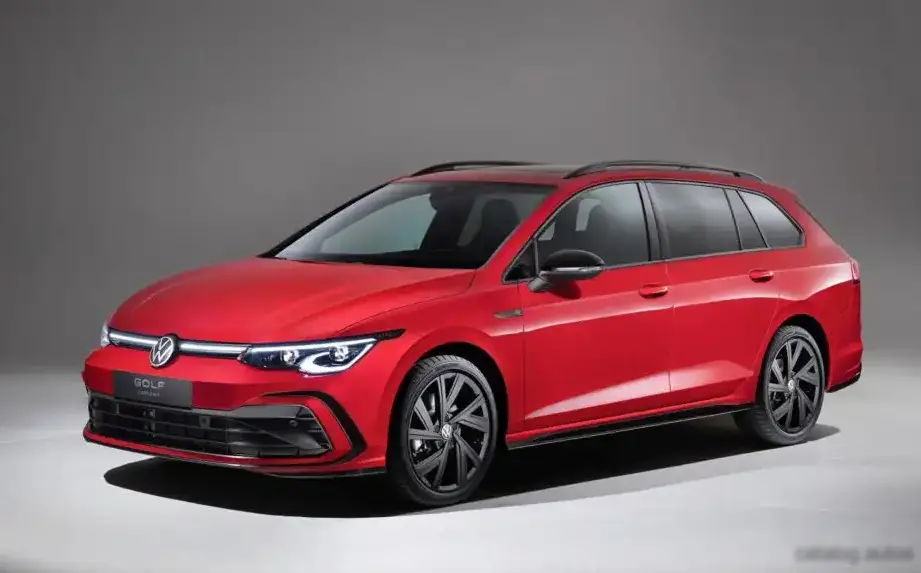
The Volkswagen Golf VIII Variant 1.5 eTSI, producing 150 horsepower, represents a significant iteration in the long-running Golf lineage. Introduced in 2020 and continuing through 2024 model years, this variant combines a gasoline engine with mild hybrid technology, packaged within the practical station wagon (estate) body style of the Golf VIII. It’s positioned as a mid-range offering, balancing fuel efficiency with respectable performance, and aimed at buyers seeking a versatile family vehicle. The Golf VIII generation, built on the MQB Evo platform, brought substantial technological advancements to the Golf, and the 1.5 eTSI variant exemplifies this with its integrated 48-volt mild hybrid system and dual-clutch gearbox (DSG).
Technical Specifications
| Brand | Volkswagen |
| Model | Golf |
| Generation | Golf VIII Variant |
| Type (Engine) | 1.5 eTSI (150 Hp) Mild Hybrid DSG |
| Start of production | 2020 |
| End of production | 2024 |
| Powertrain Architecture | MHEV (Mild Hybrid Electric Vehicle) |
| Body type | Station wagon (estate) |
| Seats | 5 |
| Doors | 5 |
| Fuel consumption at Low speed (WLTP) | 7.5 l/100 km (31.4 US mpg) |
| Fuel consumption at Medium speed (WLTP) | 5.4 l/100 km (43.6 US mpg) |
| Fuel consumption at high speed (WLTP) | 4.9 l/100 km (48 US mpg) |
| Fuel consumption at very high speed (WLTP) | 5.9 l/100 km (39.9 US mpg) |
| Combined fuel consumption (WLTP) | 5.7 l/100 km (41.3 US mpg) |
| CO2 emissions (WLTP) | 129 g/km |
| Fuel consumption (economy) – urban (NEDC) | 6 l/100 km (39.2 US mpg) |
| Fuel consumption (economy) – extra urban (NEDC) | 4.1 l/100 km (57.4 US mpg) |
| Fuel consumption (economy) – combined (NEDC) | 4.8 l/100 km (49 US mpg) |
| CO2 emissions (NEDC) | 110 g/km |
| Fuel Type | Petrol (Gasoline) |
| Acceleration 0 – 100 km/h | 8.7 sec |
| Acceleration 0 – 62 mph | 8.7 sec |
| Acceleration 0 – 60 mph | 8.3 sec |
| Maximum speed | 224 km/h (139.19 mph) |
| Emission standard | Euro 6d-ISC-FCM |
| Weight-to-power ratio | 9 kg/Hp |
| Weight-to-torque ratio | 5.4 kg/Nm |
| Power | 150 Hp @ 5000 rpm |
| Torque | 250 Nm @ 1500-3500 rpm (184.39 lb.-ft.) |
| Engine layout | Front, Transverse |
| Engine Model/Code | DFYA |
| Engine displacement | 1498 cm3 (91.41 cu. in.) |
| Number of cylinders | 4 |
| Engine configuration | Inline |
| Cylinder Bore | 74.5 mm (2.93 in.) |
| Piston Stroke | 85.9 mm (3.38 in.) |
| Compression ratio | 10.5:1 |
| Number of valves per cylinder | 4 |
| Fuel injection system | Direct injection |
| Engine aspiration | Turbocharger, Intercooler |
| Valvetrain | DOHC |
| Engine oil capacity | 4.3 l (4.54 US qt | 3.78 UK qt) |
| Coolant | 8 l (8.45 US qt | 7.04 UK qt) |
| Kerb Weight | 1350 kg (2976.24 lbs.) |
| Max. weight | 1970 kg (4343.11 lbs.) |
| Max load | 620 kg (1366.87 lbs.) |
| Trunk (boot) space – minimum | 611 l (21.58 cu. ft.) |
| Trunk (boot) space – maximum | 1642 l (57.99 cu. ft.) |
| Fuel tank capacity | 50 l (13.21 US gal | 11 UK gal) |
| Max. roof load | 75 kg (165.35 lbs.) |
| Permitted trailer load with brakes (8%) | 1700 kg (3747.86 lbs.) |
| Permitted trailer load with brakes (12%) | 1500 kg (3306.93 lbs.) |
| Permitted trailer load without brakes | 710 kg (1565.28 lbs.) |
| Permitted towbar download | 80 kg (176.37 lbs.) |
| Length | 4633 mm (182.4 in.) |
| Width | 1789 mm (70.43 in.) |
| Width including mirrors | 2073 mm (81.61 in.) |
| Height | 1498 mm (58.98 in.) |
| Wheelbase | 2669 mm (105.08 in.) |
| Front track | 1533-1549 mm (60.35 – 60.98 in.) |
| Rear (Back) track | 1503-1519 mm (59.17 – 59.8 in.) |
| Minimum turning circle | 11.1 m (36.42 ft.) |
| Drivetrain Architecture | ICE drives front wheels |
| Drive wheel | Front wheel drive |
| Number of gears and type of gearbox | 7 gears, automatic transmission DSG |
| Front suspension | Independent type McPherson |
| Rear suspension | Independent multi-link suspension |
| Front brakes | Ventilated discs |
| Rear brakes | Disc |
| Assisting systems | ABS (Anti-lock braking system) |
| Steering type | Steering rack and pinion |
| Power steering | Electric Steering |
| Tires size | 205/55 R 16 |
| Wheel rims size | 7 J x 16 |
Powertrain & Engine Architecture
At the heart of the Golf VIII Variant 1.5 eTSI lies the DFYA engine, a 1.5-liter turbocharged inline-four cylinder gasoline engine. This engine utilizes direct fuel injection and a Miller cycle combustion process to enhance efficiency. The turbocharger, coupled with an intercooler, provides a boost in power and torque. The “eTSI” designation indicates the inclusion of a 48-volt mild hybrid system. This system comprises a belt starter generator (BSG) and a small 48-volt lithium-ion battery. The BSG allows for extended engine-off coasting, regenerative braking to recapture energy, and provides a power boost during acceleration. The engine produces 150 horsepower at 5000 rpm and 250 Nm (184 lb-ft) of torque between 1500 and 3500 rpm. Power is delivered to the front wheels via a seven-speed dual-clutch transmission (DSG). The DSG provides quick and smooth gear changes, contributing to both performance and fuel economy.
Driving Characteristics
The 1.5 eTSI with the DSG transmission offers a balanced driving experience. Acceleration from 0 to 60 mph takes approximately 8.3 seconds, and the car reaches a top speed of 139.19 mph. The mild hybrid system is largely transparent to the driver, providing subtle assistance during acceleration and enabling a smoother stop-start experience. Compared to the more powerful Golf variants, such as those with the 2.0-liter TSI engine, the 1.5 eTSI feels less urgent in its acceleration. However, the readily available torque from the turbocharger ensures adequate performance for everyday driving situations. The DSG transmission is well-tuned, offering responsive shifts in both automatic and manual modes. The gear ratios are optimized for fuel efficiency, but also provide sufficient power for overtaking maneuvers.
Equipment & Trim Levels
The Golf VIII Variant 1.5 eTSI typically came equipped with a generous amount of standard features. These included automatic climate control, a touchscreen infotainment system with Apple CarPlay and Android Auto compatibility, LED headlights, and a suite of driver-assistance systems such as lane-keeping assist and automatic emergency braking. Interior upholstery was typically cloth, with options for leather available as upgrades. Trim levels varied by market, but generally offered progressively more features such as larger infotainment screens, upgraded sound systems, and additional comfort features like heated seats. Optional extras included a panoramic sunroof, adaptive cruise control, and a premium sound system.
Chassis & Braking
The Golf VIII Variant features an independent suspension setup, with a McPherson strut front suspension and a multi-link rear suspension. This configuration provides a comfortable ride and good handling characteristics. The chassis is relatively lightweight, contributing to the car’s agility. The braking system consists of ventilated discs at the front and solid discs at the rear. Anti-lock braking system (ABS) is standard, along with electronic stability control (ESC). The steering is electrically assisted, providing a precise and responsive feel.
Market Reception & Comparison
The Golf VIII Variant 1.5 eTSI was generally well-received by automotive critics. It was praised for its fuel efficiency, comfortable ride, and well-equipped interior. The mild hybrid system was seen as a positive step towards reducing emissions. Compared to other Golf variants, the 1.5 eTSI offered a compelling balance between price, performance, and fuel economy. The 2.0-liter TSI models offered more power, but at a higher cost and with slightly lower fuel economy. The diesel variants (like the 2.0 TDI) provided excellent fuel economy but were subject to stricter emissions regulations in some markets.
Legacy
The DFYA engine and the 7-speed DSG transmission have proven to be relatively reliable powertrains. While some early Golf VIII models experienced software glitches, these were largely addressed through software updates. The 1.5 eTSI variant remains a popular choice in the used car market, offering a practical and efficient option for buyers seeking a versatile family vehicle. Its mild hybrid technology provides a glimpse into the future of automotive powertrains, and its balanced driving characteristics make it a pleasant car to drive.