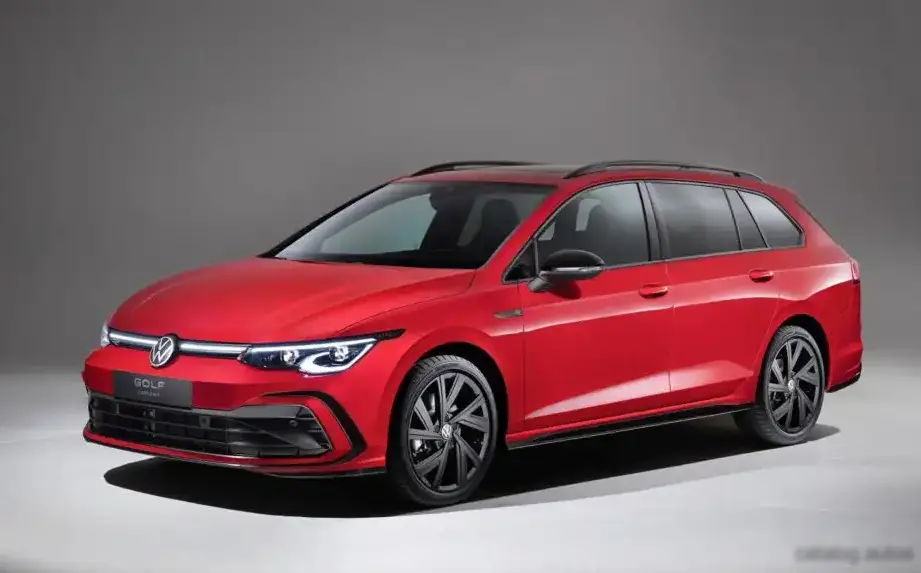
The Volkswagen Golf VIII Variant 1.5 TSI (150 hp) is a front-wheel-drive, five-door station wagon that was produced from 2020 to 2024. Positioned as a mid-range offering within the eighth-generation Golf Variant lineup, it aimed to balance fuel efficiency with respectable performance for family and practical-minded buyers. This variant builds upon the foundation of the Golf VIII platform (MQB evo) and represents Volkswagen’s continued commitment to offering a versatile and technologically advanced compact estate car in the European market, with limited availability in other regions. It slots between the lower-powered 1.0 TSI models and the more performance-oriented GTI and R variants.
Technical Specifications
| Brand | Volkswagen |
| Model | Golf |
| Generation | Golf VIII Variant |
| Type (Engine) | 1.5 TSI (150 Hp) |
| Start of production | 2020 |
| End of production | 2024 |
| Powertrain Architecture | Internal Combustion engine |
| Body type | Station wagon (estate) |
| Seats | 5 |
| Doors | 5 |
| Fuel consumption at Low speed (WLTP) | 7.8 l/100 km (30.2 US mpg, 36.2 UK mpg, 12.8 km/l) |
| Fuel consumption at Medium speed (WLTP) | 5.7 l/100 km (41.3 US mpg, 49.6 UK mpg, 17.5 km/l) |
| Fuel consumption at high speed (WLTP) | 4.9 l/100 km (48 US mpg, 57.6 UK mpg, 20.4 km/l) |
| Fuel consumption at very high speed (WLTP) | 5.6 l/100 km (42 US mpg, 50.4 UK mpg, 17.9 km/l) |
| Combined fuel consumption (WLTP) | 5.7 l/100 km (41.3 US mpg, 49.6 UK mpg, 17.5 km/l) |
| CO2 emissions (WLTP) | 129 g/km |
| Fuel consumption (economy) – urban (NEDC) | 6.5 l/100 km (36.2 US mpg, 43.5 UK mpg, 15.4 km/l) |
| Fuel consumption (economy) – extra urban (NEDC) | 4.4 l/100 km (53.5 US mpg, 64.2 UK mpg, 22.7 km/l) |
| Fuel consumption (economy) – combined (NEDC) | 5.2 l/100 km (45.2 US mpg, 54.3 UK mpg, 19.2 km/l) |
| CO2 emissions (NEDC) | 118 g/km |
| Fuel Type | Petrol (Gasoline) |
| Acceleration 0 – 100 km/h | 8.7 sec |
| Acceleration 0 – 62 mph | 8.7 sec |
| Acceleration 0 – 60 mph | 8.3 sec |
| Maximum speed | 224 km/h (139.19 mph) |
| Emission standard | Euro 6d-ISC-FCM |
| Weight-to-power ratio | 8.8 kg/Hp, 113.9 Hp/tonne |
| Weight-to-torque ratio | 5.3 kg/Nm, 189.8 Nm/tonne |
| Power | 150 Hp @ 5000 rpm |
| Power per litre | 100.1 Hp/l |
| Torque | 250 Nm @ 1500-3500 rpm (184.39 lb.-ft. @ 1500-3500 rpm) |
| Engine layout | Front, Transverse |
| Engine Model/Code | DPCA |
| Engine displacement | 1498 cm3 (91.41 cu. in.) |
| Number of cylinders | 4 |
| Engine configuration | Inline |
| Cylinder Bore | 74.5 mm (2.93 in.) |
| Piston Stroke | 85.9 mm (3.38 in.) |
| Compression ratio | 10.5:1 |
| Number of valves per cylinder | 4 |
| Fuel injection system | Direct injection |
| Engine aspiration | Turbocharger, Intercooler |
| Valvetrain | DOHC |
| Engine oil capacity | 4.3 l (4.54 US qt | 3.78 UK qt) |
| Coolant | 10 l (10.57 US qt | 8.8 UK qt) |
| Kerb Weight | 1317 kg (2903.49 lbs.) |
| Max. weight | 1930 kg (4254.92 lbs.) |
| Max load | 613 kg (1351.43 lbs.) |
| Trunk (boot) space – minimum | 611 l (21.58 cu. ft.) |
| Trunk (boot) space – maximum | 1642 l (57.99 cu. ft.) |
| Fuel tank capacity | 50 l (13.21 US gal | 11 UK gal) |
| Max. roof load | 75 kg (165.35 lbs.) |
| Permitted trailer load with brakes (8%) | 1700 kg (3747.86 lbs.) |
| Permitted trailer load with brakes (12%) | 1500 kg (3306.93 lbs.) |
| Permitted trailer load without brakes | 690 kg (1521.19 lbs.) |
| Permitted towbar download | 80 kg (176.37 lbs.) |
| Length | 4633 mm (182.4 in.) |
| Width | 1789 mm (70.43 in.) |
| Width including mirrors | 2073 mm (81.61 in.) |
| Height | 1498 mm (58.98 in.) |
| Wheelbase | 2669 mm (105.08 in.) |
| Front track | 1533-1549 mm (60.35 – 60.98 in.) |
| Rear (Back) track | 1503-1519 mm (59.17 – 59.8 in.) |
| Minimum turning circle (turning diameter) | 11.1 m (36.42 ft.) |
| Drivetrain Architecture | The Internal combustion engine (ICE) drives the front wheels of the vehicle. |
| Drive wheel | Front wheel drive |
| Number of gears and type of gearbox | 6 gears, manual transmission |
| Front suspension | Independent type McPherson |
| Rear suspension | Independent multi-link suspension |
| Front brakes | Ventilated discs |
| Rear brakes | Disc |
| Assisting systems | ABS (Anti-lock braking system) |
| Steering type | Steering rack and pinion |
| Power steering | Electric Steering |
| Tires size | 205/55 R 16 |
| Wheel rims size | 7 J x 16 |
INTRODUCTION
The Volkswagen Golf VIII Variant 1.5 TSI (150 hp) represents a key iteration of the eighth-generation Golf estate. Introduced in 2020, it aimed to provide a practical and efficient option for buyers seeking a versatile family vehicle. The “Variant” designation signifies the station wagon body style, offering increased cargo capacity compared to the standard hatchback. This model utilizes Volkswagen’s modular transverse matrix (MQB evo) platform, which underpins a wide range of vehicles across the Volkswagen Group. The 1.5 TSI engine, part of Volkswagen’s EA211 family, was a central component of the Golf VIII range, offering a balance between performance and fuel economy.
Powertrain & Engine Architecture
At the heart of the Golf VIII Variant 1.5 TSI lies the DPCA engine code, a 1.5-liter turbocharged four-cylinder gasoline engine. This engine features direct fuel injection and a Miller cycle combustion process, contributing to improved thermal efficiency. The engine produces 150 horsepower at 5000 rpm and 250 Nm (184 lb-ft) of torque between 1500 and 3500 rpm. The turbocharger, coupled with an intercooler, provides a responsive power delivery. The engine is paired with a six-speed manual transmission, delivering power to the front wheels. The EA211 engine family is known for its compact design and relatively lightweight construction. The 1.5 TSI also incorporates a particulate filter to reduce emissions, meeting stringent Euro 6d-ISC-FCM standards.
Driving Characteristics
The 1.5 TSI engine in the Golf VIII Variant provides adequate performance for everyday driving. Acceleration from 0 to 100 km/h (0-62 mph) takes approximately 8.7 seconds. While not a particularly sporty configuration, the engine delivers a usable amount of power for overtaking and highway cruising. The six-speed manual transmission offers precise shifts and allows drivers to maintain optimal engine speed. Compared to the more powerful GTI models, the 1.5 TSI prioritizes fuel efficiency over outright performance. The gear ratios are tuned for a balance between acceleration and fuel economy, with a relatively long sixth gear for comfortable highway driving. The suspension setup provides a comfortable ride, although it may not be as engaging as the sportier suspension options available on other Golf variants.
Equipment & Trim Levels
The Golf VIII Variant 1.5 TSI typically came equipped with a respectable level of standard features. These included air conditioning, a touchscreen infotainment system with Apple CarPlay and Android Auto compatibility, LED headlights, and a suite of safety features such as automatic emergency braking and lane departure warning. Interior upholstery was typically cloth, with optional upgrades to leather available. Higher trim levels offered additional features such as a digital instrument cluster, adaptive cruise control, and a panoramic sunroof. Optional extras included a premium sound system, heated seats, and parking assist.
Chassis & Braking
The Golf VIII Variant utilizes an independent McPherson strut suspension at the front and a multi-link suspension at the rear, providing a comfortable and controlled ride. The chassis is designed to minimize weight and maximize rigidity. Braking duties are handled by ventilated discs at the front and solid discs at the rear, equipped with ABS (Anti-lock Braking System). The steering system is an electric power steering system, providing precise and responsive steering feel. The suspension tuning is geared towards comfort and practicality, rather than outright sportiness.
Market Reception & Comparison
The Golf VIII Variant 1.5 TSI was generally well-received by automotive critics. It was praised for its fuel efficiency, comfortable ride, and spacious interior. However, some critics noted that the 1.5 TSI engine could feel slightly underpowered when fully loaded or driving uphill. Compared to the 1.6 TDI diesel variant, the 1.5 TSI offered a more refined driving experience but slightly lower fuel economy. Against the more powerful GTI models, the 1.5 TSI provided a more affordable and practical option, albeit with less performance. The combined fuel consumption of 5.7 l/100 km (41.3 US mpg) was considered competitive within its class.
Legacy
The 1.5 TSI engine has proven to be a reliable and durable powertrain. While some early models experienced minor issues with the particulate filter, these were largely addressed through software updates. The Golf VIII Variant 1.5 TSI remains a popular choice in the used car market, offering a good balance of practicality, fuel efficiency, and reliability. Its continued demand reflects the enduring appeal of the Golf nameplate and the versatility of the station wagon body style. The engine’s relatively simple design and readily available parts contribute to its long-term maintainability.