
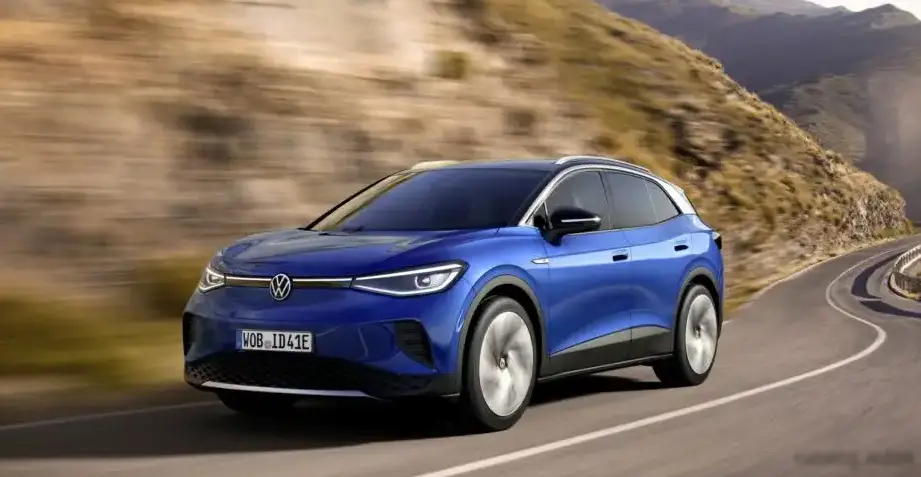
The Volkswagen ID.4 82 kWh, producing 204 horsepower, represents Volkswagen’s initial foray into a dedicated all-electric SUV for the global market, launching in 2020. Built upon the modular electric drive matrix (MEB) platform, the ID.4 aimed to deliver a practical and accessible electric vehicle experience. This particular variant, equipped with the larger 82 kWh battery pack, was positioned as a mid-range offering within the ID.4 lineup, balancing range with a more attainable price point compared to higher-specification models. It was primarily targeted towards families and individuals seeking a zero-emission vehicle for daily commuting and longer journeys.
Technical Specifications
| Brand | Volkswagen |
| Model | ID.4 |
| Generation | ID.4 |
| Type (Engine) | 82 kWh (204 Hp) |
| Start of production | 2020 |
| Powertrain Architecture | BEV (Electric Vehicle) |
| Body type | SUV |
| Seats | 5 |
| Doors | 5 |
| Fuel Type | Electricity |
| Acceleration 0 – 100 km/h | 8.5 sec |
| Acceleration 0 – 62 mph | 8.5 sec |
| Acceleration 0 – 60 mph | 8.1 sec |
| Maximum speed | 160 km/h (99.42 mph) |
| Weight-to-power ratio | 10 kg/Hp, 99.6 Hp/tonne |
| Weight-to-torque ratio | 6.6 kg/Nm, 151.3 Nm/tonne |
| Gross battery capacity | 82 kWh |
| Net (usable) battery capacity | 77 kWh |
| Battery technology | Lithium-ion (Li-Ion) |
| Battery weight | 493 kg (1086.88 lbs) |
| Battery location | Below the floor |
| All-electric range (WLTP) | 522 km (324.36 mi) |
| All-electric range | 520 km (323.11 mi) |
| Average Energy consumption (WLTP) | 17.2 kWh/100 km (27.68 kWh/100 mi, 122 MPGe, 5.8 km/kWh, 3.6 mi/kWh) |
| Average Energy consumption | 16.2 kWh/100 km (26.07 kWh/100 mi, 129 MPGe, 6.2 km/kWh, 3.8 mi/kWh) |
| Electric motor power | 204 Hp |
| Electric motor Torque | 310 Nm (228.64 lb.-ft.) |
| Electric motor model/code | EBJA |
| Maximum revolutions of the electric motor | 16000 rpm |
| Electric motor location | Rear axle, Transverse |
| Electric motor type | Synchronous |
| System power | 204 Hp |
| System torque | 310 Nm (228.64 lb.-ft.) |
| Kerb Weight | 2049 kg (4517.27 lbs) |
| Max. weight | 2660 kg (5864.3 lbs) |
| Max load | 611 kg (1347.02 lbs) |
| Trunk (boot) space – minimum | 543 l (19.18 cu. ft.) |
| Trunk (boot) space – maximum | 1575 l (55.62 cu. ft.) |
| Max. roof load | 75 kg (165.35 lbs) |
| Permitted trailer load with brakes (8%) | 1200 kg (2645.55 lbs) |
| Permitted trailer load with brakes (12%) | 1000 kg (2204.62 lbs) |
| Permitted trailer load without brakes | 750 kg (1653.47 lbs) |
| Permitted towbar download | 75 kg (165.35 lbs) |
| Length | 4584 mm (180.47 in) |
| Width | 1852 mm (72.91 in) |
| Height | 1631 mm (64.21 in) |
| Wheelbase | 2771 mm (109.09 in) |
| Front track | 1587-1597 mm (62.48 – 62.87 in) |
| Rear (Back) track | 1567-1577 mm (61.69 – 62.09 in) |
| Drag coefficient (Cd) | 0.28 |
| Minimum turning circle (turning diameter) | 10.2 m (33.46 ft) |
| Approach angle | 17.5° |
| Departure angle | 21.2° |
| Ramp-over (brakeover) angle | 17.1° |
| Drivetrain Architecture | One electric motor drives the rear wheels |
| Drive wheel | Rear wheel drive |
| Number of gears and type of gearbox | 1 gears, automatic transmission |
| Front suspension | Independent type McPherson, Transverse stabilizer |
| Rear suspension | Independent multi-link suspension, Transverse stabilizer |
| Front brakes | Ventilated discs |
| Rear brakes | Drum |
| Assisting systems | ABS (Anti-lock braking system) |
| Steering type | Steering rack and pinion |
| Power steering | Electric Steering |
| Front wheel tires | 235/55 R19; 235/50 R20; 235/45 R21 |
| Rear wheel tires | 255/50 R19; 255/45 R20; 255/40 R21 |
| Front wheel rims | 8J x 19; 8J x 20; 8.5J x 21 |
| Rear wheel rims | 8J x 19; 9J x 20; 9J x 21 |
Powertrain & Engine Architecture
The ID.4 82 kWh utilizes a permanently magnetized synchronous motor located on the rear axle. This motor, designated EBJA, produces 204 horsepower and 310 Nm (228.64 lb-ft) of torque. The motor’s design prioritizes efficiency and smooth power delivery. Power is delivered through a single-speed automatic transmission, characteristic of most battery electric vehicles. The 82 kWh battery pack, composed of lithium-ion cells, is mounted low in the vehicle’s floor, contributing to a lower center of gravity and improved handling. The battery management system (BMS) is crucial for optimizing battery life, performance, and safety, monitoring cell voltages, temperatures, and overall health. The ID.4 supports DC fast charging, allowing for a significant range boost in a relatively short period.
Driving Characteristics
The ID.4 82 kWh offers a comfortable and refined driving experience. Acceleration from 0-60 mph takes approximately 8.1 seconds, which is adequate for everyday driving but doesn’t provide particularly sporty performance. The single-speed transmission provides seamless acceleration, and the instant torque characteristic of electric motors delivers brisk response in urban environments. The rear-wheel-drive configuration contributes to balanced handling, although it can exhibit some understeer when pushed hard. Regenerative braking is adjustable, allowing drivers to customize the level of deceleration when lifting off the throttle, enhancing efficiency and extending range. Compared to the higher-performance all-wheel-drive variants, the 82 kWh model prioritizes efficiency and range over outright speed.
Equipment & Trim Levels
The ID.4 82 kWh typically came standard with features such as a 10-inch touchscreen infotainment system, Apple CarPlay and Android Auto compatibility, LED headlights, and a suite of driver-assistance technologies including forward collision warning, automatic emergency braking, and lane-keeping assist. Interior upholstery was typically cloth, with options for leatherette or leather upgrades. Higher trim levels offered features like a panoramic sunroof, premium audio system, and adaptive cruise control. The ID.4’s interior design is minimalist and modern, emphasizing usability and a spacious feel.
Chassis & Braking
The ID.4 features an independent McPherson strut suspension at the front and an independent multi-link suspension at the rear, providing a comfortable ride and good handling characteristics. Stabilizer bars are included at both ends to reduce body roll. The braking system consists of ventilated discs at the front and drum brakes at the rear. While the drum brakes on the rear are a cost-saving measure, they provide adequate stopping power for the vehicle’s weight and performance. The ID.4 is equipped with an electric power steering system, offering precise and responsive steering feel.
Market Reception & Comparison
The ID.4 82 kWh was generally well-received by critics, praised for its spacious interior, comfortable ride, and competitive range. However, some reviewers noted the infotainment system could be occasionally laggy and the rear drum brakes were a compromise in a vehicle of this price point. Compared to other electric SUVs in its class, such as the Tesla Model Y and Hyundai Kona Electric, the ID.4 offered a compelling combination of value, practicality, and range. Its fuel economy, measured in MPGe, consistently ranked among the best in its segment. Reliability reports have been generally positive, with few major issues reported.
Legacy
The Volkswagen ID.4 82 kWh played a significant role in establishing Volkswagen as a major player in the electric vehicle market. The MEB platform proved to be a versatile and scalable foundation for a range of electric vehicles. The 82 kWh variant remains a popular choice in the used car market, offering a relatively affordable entry point into electric vehicle ownership. The powertrain has demonstrated good long-term reliability, and the availability of replacement parts and service support is readily available. As the electric vehicle market continues to evolve, the ID.4 82 kWh will be remembered as a pivotal model that helped accelerate the transition to sustainable transportation.
