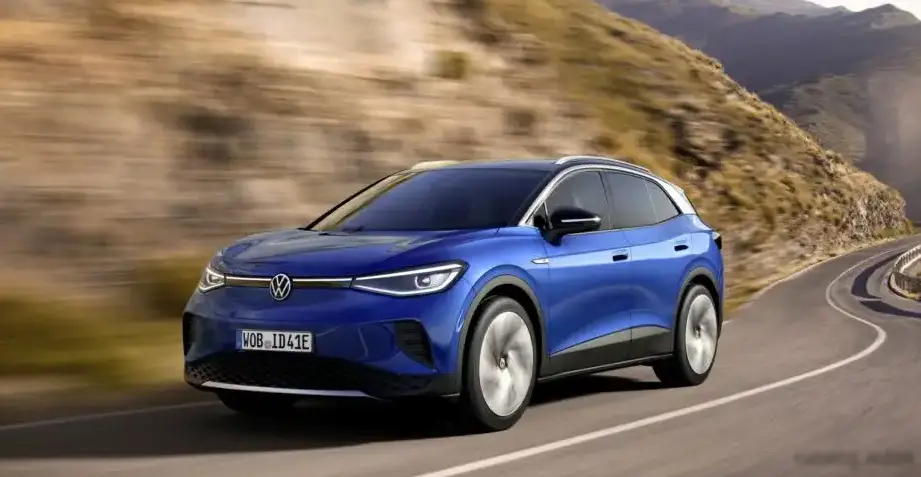
The Volkswagen ID.4 GTX 82 kWh (340 Hp) 4MOTION, launched in October 2023, represents the performance-oriented variant within the ID.4 family of all-electric SUVs. Positioned as a step up from the standard ID.4 models, the GTX trim adds dual-motor all-wheel drive and increased power output, targeting drivers seeking a more engaging driving experience without sacrificing the practicality and efficiency of an electric vehicle. It builds upon the foundation of the ID.4, which itself is based on the Volkswagen Group’s modular electric drive matrix (MEB) platform.
Technical Specifications
| Brand | Volkswagen |
| Model | ID.4 |
| Generation | ID.4 |
| Type (Engine) | GTX 82 kWh (340 Hp) 4MOTION |
| Start of production | October, 2023 |
| Powertrain Architecture | BEV (Electric Vehicle) |
| Body type | SUV |
| Seats | 5 |
| Doors | 5 |
| Fuel Type | Electricity |
| Acceleration 0 – 100 km/h | 5.4 sec |
| Acceleration 0 – 62 mph | 5.4 sec |
| Acceleration 0 – 60 mph | 5.1 sec |
| Maximum speed | 180 km/h (111.85 mph) |
| Weight-to-power ratio | 6.6 kg/Hp, 150.7 Hp/tonne |
| Gross battery capacity | 82 kWh |
| Net (usable) battery capacity | 77 kWh |
| Battery voltage | 354 V |
| Battery technology | Lithium-ion (Li-Ion) |
| Battery location | Below the floor |
| All-electric range (WLTP) | 515 km (320.01 mi) |
| Average Energy consumption (WLTP) | 17.1 kWh/100 km (27.52 kWh/100 mi) |
| MPGe | 122 |
| km/kWh | 5.8 |
| mi/kWh | 3.6 |
| Kerb Weight | 2256 kg (4973.63 lbs.) |
| Max. weight | 2770 kg (6106.8 lbs.) |
| Max load | 514 kg (1133.18 lbs.) |
| Trunk (boot) space – minimum | 543 l (19.18 cu. ft.) |
| Trunk (boot) space – maximum | 1575 l (55.62 cu. ft.) |
| Max. roof load | 75 kg (165.35 lbs.) |
| Permitted trailer load with brakes (8%) | 1400 kg (3086.47 lbs.) |
| Permitted trailer load with brakes (12%) | 1200 kg (2645.55 lbs.) |
| Permitted trailer load without brakes | 750 kg (1653.47 lbs.) |
| Permitted towbar download | 75 kg (165.35 lbs.) |
| Length | 4582 mm (180.39 in.) |
| Width | 1852 mm (72.91 in.) |
| Width including mirrors | 2108 mm (82.99 in.) |
| Height | 1632 mm (64.25 in.) |
| Wheelbase | 2769 mm (109.02 in.) |
| Front track | 1588-1598 mm (62.52 – 62.91 in.) |
| Rear (Back) track | 1564-1570 mm (61.57 – 61.81 in.) |
| Drag coefficient (Cd) | 0.29 |
| Minimum turning circle | 11.6 m (38.06 ft.) |
| Approach angle | 16.5° |
| Departure angle | 18.3° |
| Ramp-over angle | 13.8° |
| Drivetrain Architecture | One electric motor drives the front wheels, one electric motor drives the rear wheels. |
| Drive wheel | All wheel drive (4×4) |
| Number of gears | 1 |
| Type of gearbox | automatic transmission |
| Front suspension | Independent, type McPherson with coil spring and anti-roll bar |
| Rear suspension | Independent multi-link spring suspension with stabilizer |
| Front brakes | Ventilated discs |
| Rear brakes | Drum |
| Front tires | 235/50 R20 |
| Rear tires | 255/45 R20 |
| Front wheel rims | 8J x 20 |
| Rear wheel rims | 9J x 20 |
Powertrain & Engine Architecture
The ID.4 GTX utilizes a dual-motor, all-wheel-drive (4MOTION) powertrain. The front axle is driven by an asynchronous electric motor, while the rear axle employs a synchronous motor. This combination delivers a total system output of 340 horsepower. The 82 kWh (gross) / 77 kWh (net) lithium-ion battery pack is located under the vehicle floor, contributing to a low center of gravity and improved handling. The battery operates at 354 volts. The GTX does not utilize a traditional multi-speed transmission; instead, it features a single-speed gearbox for each axle, providing direct drive. The power electronics and thermal management systems are crucial components, ensuring efficient operation and longevity of the battery and motors. The GTX benefits from enhanced cooling systems compared to standard ID.4 models to manage the increased power output.
Driving Characteristics
The dual-motor setup of the ID.4 GTX provides significantly quicker acceleration than the single-motor variants. The 0-60 mph sprint is achieved in approximately 5.1 seconds, and 0-100 km/h in 5.4 seconds. The all-wheel-drive system offers improved traction and stability, particularly in adverse weather conditions. The GTX’s suspension is tuned for a slightly firmer ride compared to the standard ID.4, enhancing handling and responsiveness. While the single-speed gearbox provides instant torque, it lacks the gear changes found in traditional automatic transmissions, resulting in a different driving feel. The regenerative braking system allows for one-pedal driving in many situations, increasing efficiency and convenience.
Equipment & Trim Levels
The GTX trim level typically includes a comprehensive suite of standard features. These often include premium interior upholstery (often a combination of leatherette and cloth), sport seats, a larger touchscreen infotainment system, and advanced driver-assistance systems (ADAS) such as adaptive cruise control, lane keeping assist, and automatic emergency braking. Optional extras can include a panoramic sunroof, premium sound system, and head-up display. The GTX also features unique exterior styling elements, such as distinctive bumpers, badging, and alloy wheel designs, differentiating it from other ID.4 models.
Chassis & Braking
The ID.4 GTX utilizes an independent suspension system on both the front and rear axles. The front suspension employs a McPherson strut design with coil springs and an anti-roll bar, while the rear features a multi-link setup with a stabilizer bar. The braking system consists of ventilated discs on the front axle and drum brakes on the rear. ABS (Anti-lock Braking System) is standard. The GTX’s chassis is optimized for the increased power and torque, with revised suspension tuning and potentially stiffer springs and dampers. Steering is rack and pinion with electric power assistance.
Market Reception & Comparison
The ID.4 GTX has been generally well-received by automotive critics, praised for its performance, handling, and practicality. Compared to the standard ID.4, the GTX offers a more engaging driving experience and quicker acceleration. However, the increased power and performance come at the cost of slightly reduced range compared to some of the more efficiency-focused ID.4 variants. The GTX competes with other performance-oriented electric SUVs, such as the Tesla Model Y Performance and the Ford Mustang Mach-E GT. Its pricing typically positions it in the mid-to-upper range of the ID.4 lineup.
Legacy
As a relatively recent model, the long-term reliability of the ID.4 GTX is still being established. However, Volkswagen’s electric vehicle technology is maturing, and the MEB platform has proven to be generally robust. The GTX’s dual-motor powertrain and advanced battery technology represent a significant step forward in Volkswagen’s electrification strategy. In the used car market, the ID.4 GTX is expected to hold its value well due to its performance capabilities and desirable features. Its status as a performance variant within a popular electric SUV range should ensure continued demand in the years to come.