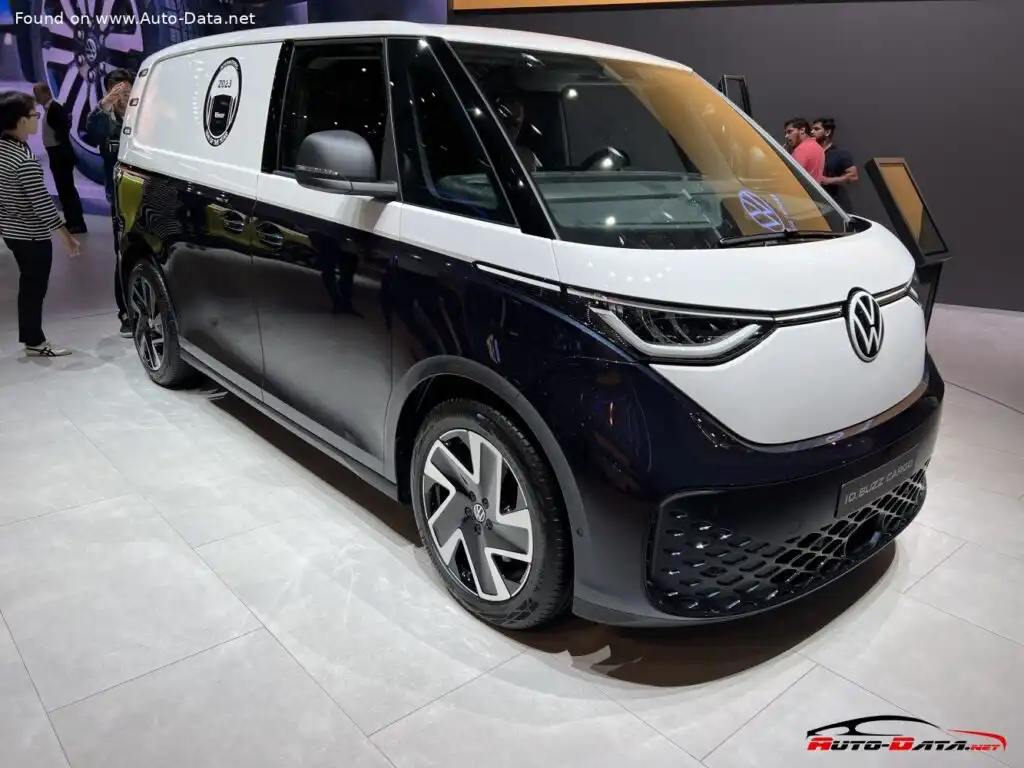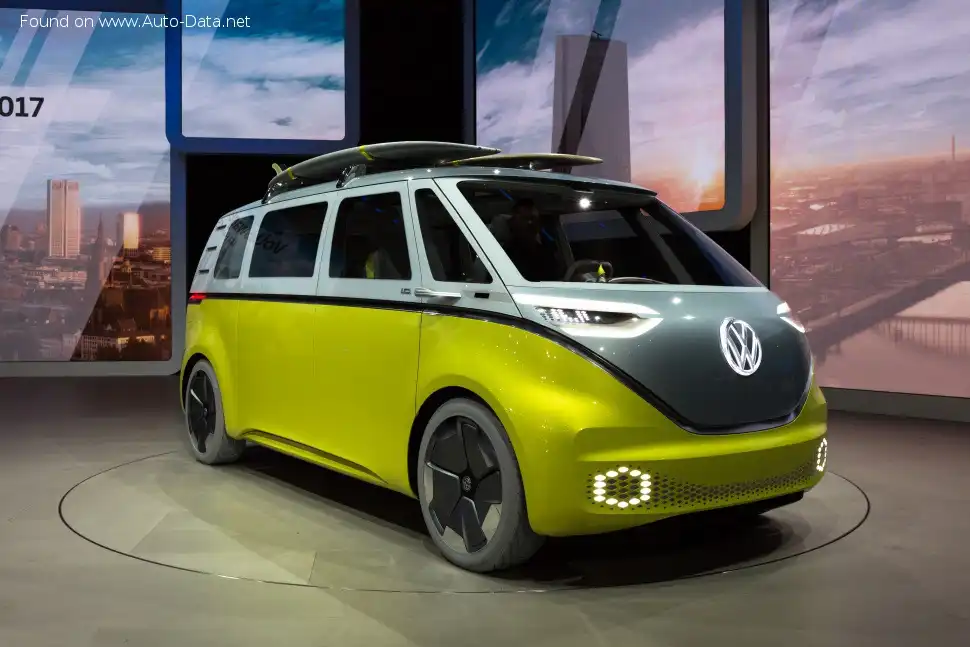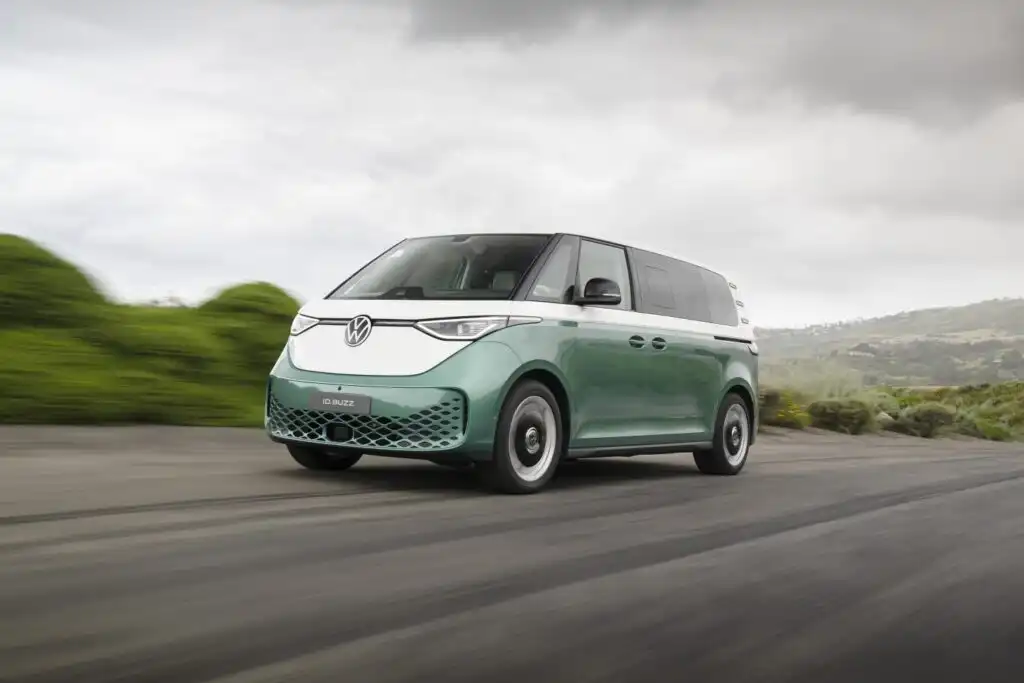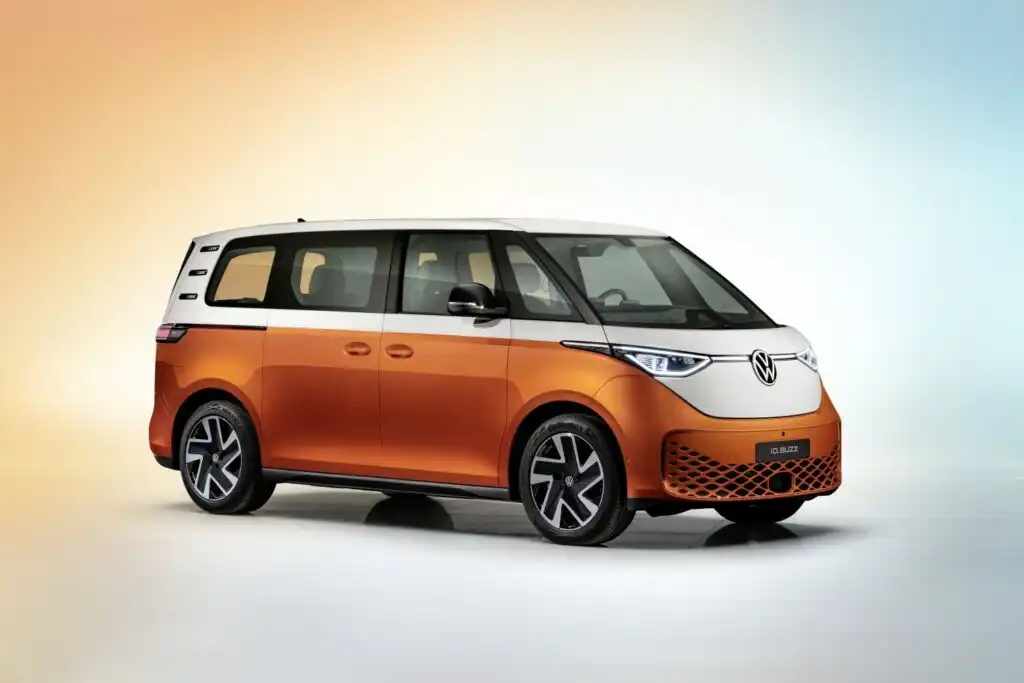
The Volkswagen ID. Buzz 59 kWh, producing 170 horsepower, represents the entry point into the ID. Buzz lineup, launched in September 2024. Positioned as a modern reimagining of the iconic Volkswagen Type 2 “Bus,” the ID. Buzz is a battery electric vehicle (BEV) designed to appeal to families and those seeking a spacious, versatile, and environmentally conscious MPV (Multi-Purpose Vehicle). This particular variant, with its 59 kWh battery pack, is primarily targeted at urban and suburban drivers with shorter daily commutes and access to charging infrastructure. It serves as a more accessible option compared to the longer-range, higher-output versions of the ID. Buzz.
Technical Specifications
| Brand | Volkswagen |
| Model | ID. Buzz |
| Generation | ID. Buzz |
| Type (Engine) | 59 kWh (170 Hp) |
| Start of production | September, 2024 |
| Powertrain Architecture | BEV (Electric Vehicle) |
| Body type | MPV |
| Seats | 5-6 |
| Doors | 5 |
| Fuel Type | Electricity |
| Acceleration 0 – 100 km/h | 10.7 sec |
| Acceleration 0 – 62 mph | 10.7 sec |
| Acceleration 0 – 60 mph | 10.2 sec |
| Maximum speed | 145 km/h (90.1 mph) |
| Weight-to-power ratio | 13.7 kg/Hp, 73.1 Hp/tonne |
| Weight-to-torque ratio | 7.5 kg/Nm, 133.3 Nm/tonne |
| Net (usable) battery capacity | 59 kWh |
| Battery technology | Lithium-ion (Li-Ion) |
| Battery location | Below the floor |
| All-electric range (WLTP) | 306-331 km (190.14 – 205.67 mi) |
| Average Energy consumption (WLTP) | 20.3-21.9 kWh/100 km (32.67 – 35.24 kWh/100 mi) |
| MPGe | 103 – 96 |
| km/kWh | 4.9 – 4.6 |
| mi/kWh | 3.1 – 2.8 |
| Electric motor power | 170 Hp |
| Electric motor Torque | 310 Nm (228.64 lb.-ft.) |
| Electric motor location | Rear axle, Transverse |
| Electric motor type | Synchronous |
| System power | 170 Hp |
| System torque | 310 Nm (228.64 lb.-ft.) |
| Kerb Weight | 2325 kg (5125.75 lbs.) |
| Max. weight | 3000 kg (6613.87 lbs.) |
| Max load | 675 kg (1488.12 lbs.) |
| Trunk (boot) space – minimum | 1121 l (39.59 cu. ft.) |
| Trunk (boot) space – maximum | 2205 l (77.87 cu. ft.) |
| Permitted trailer load with brakes (12%) | 1000 kg (2204.62 lbs.) |
| Permitted trailer load without brakes | 750 kg (1653.47 lbs.) |
| Permitted towbar download | 75 kg (165.35 lbs.) |
| Length | 4712 mm (185.51 in.) |
| Width | 1985 mm (78.15 in.) |
| Width including mirrors | 2212 mm (87.09 in.) |
| Height | 1927 mm (75.87 in.) |
| Wheelbase | 2989 mm (117.68 in.) |
| Front track | 1673-1683 mm (65.87 – 66.26 in.) |
| Rear (Back) track | 1666-1670 mm (65.59 – 65.75 in.) |
| Front overhang | 819 mm (32.24 in.) |
| Rear overhang | 904 mm (35.59 in.) |
| Ride height (ground clearance) | 158 mm (6.22 in.) |
| Minimum turning circle (turning diameter) | 11.1 m (36.42 ft.) |
| Drivetrain Architecture | One electric motor drives the rear wheels. |
| Drive wheel | Rear wheel drive |
| Number of gears and type of gearbox | 1 gears, automatic transmission |
| Front suspension | Independent, type McPherson with coil spring and anti-roll bar |
| Rear suspension | Independent multi-link spring suspension with stabilizer |
| Front brakes | Ventilated discs |
| Rear brakes | Drum |
| Assisting systems | ABS (Anti-lock braking system) |
| Steering type | Steering rack and pinion |
| Power steering | Electric Steering |
| Front wheel tires | 235/60 R18 |
| Rear wheel tires | 255/55 R18 |
| Front wheel rims | 8J x 18 |
| Rear wheel rims | 8.5J x 18 |
Powertrain & Engine Architecture
The ID. Buzz 59 kWh utilizes a single rear-mounted synchronous electric motor, delivering 170 horsepower and 310 Nm (228.64 lb.-ft.) of torque. The motor is powered by a 59 kWh lithium-ion battery pack located under the vehicle floor, contributing to a low center of gravity and improved handling. Unlike traditional internal combustion engines, this powertrain requires no multi-gear transmission; a single-speed automatic transmission efficiently delivers power to the rear wheels. The battery management system is crucial for optimizing battery life, performance, and safety, monitoring cell voltages, temperatures, and overall health. Regenerative braking is integrated into the system, capturing kinetic energy during deceleration and converting it back into electricity to recharge the battery, enhancing efficiency.
Driving Characteristics
The ID. Buzz 59 kWh offers a smooth and quiet driving experience, characteristic of electric vehicles. Acceleration is adequate for everyday driving, achieving 0-60 mph in approximately 10.2 seconds. While not as brisk as the higher-powered variants, the 170 hp motor provides sufficient torque for confident merging and overtaking. The single-speed transmission ensures seamless acceleration without noticeable gear changes. The rear-wheel-drive configuration contributes to a balanced feel, although it may require some adjustment for drivers accustomed to front-wheel-drive vehicles, particularly in slippery conditions. The relatively lower power output and battery capacity make this variant more suited for urban and suburban environments, where range anxiety is less of a concern.
Equipment & Trim Levels
The base ID. Buzz 59 kWh typically comes standard with features such as a digital instrument cluster, a central touchscreen infotainment system with Apple CarPlay and Android Auto compatibility, automatic climate control, and a suite of driver-assistance systems including forward collision warning, automatic emergency braking, and lane-keeping assist. Interior upholstery is generally cloth, with options for upgraded materials. Available optional extras include a panoramic sunroof, premium audio system, and adaptive cruise control. Trim levels may vary by market, but generally offer increasing levels of luxury and technology.
Chassis & Braking
The ID. Buzz features an independent suspension system, with McPherson struts at the front and a multi-link setup at the rear, providing a comfortable ride quality. Stabilizer bars are included to minimize body roll during cornering. The braking system consists of ventilated discs at the front and drum brakes at the rear, a cost-saving measure for the entry-level variant. ABS (Anti-lock Braking System) is standard, enhancing braking performance and stability. The electric steering system provides precise and responsive steering feel.
Market Reception & Comparison
The ID. Buzz 59 kWh has been generally well-received by critics, praised for its retro-inspired design, spacious interior, and smooth electric powertrain. However, some reviewers have noted the relatively limited range compared to other EVs and the slower acceleration compared to higher-powered versions. Compared to the ID. Buzz with the larger 77 kWh battery pack, the 59 kWh variant offers a lower purchase price but sacrifices range. Against competitors like the Mercedes-Benz EQB or Tesla Model Y, the ID. Buzz distinguishes itself with its unique styling and focus on practicality and passenger space.
Legacy
As a relatively new model, the long-term reliability of the ID. Buzz 59 kWh is still being established. However, Volkswagen has a strong reputation for building durable vehicles, and the electric powertrain is expected to require less maintenance than a traditional internal combustion engine. The ID. Buzz represents a significant step forward in Volkswagen’s electrification strategy, and the 59 kWh variant provides a more accessible entry point for consumers interested in embracing electric mobility. Its success will likely depend on continued improvements in battery technology and charging infrastructure.